Study strategy8-minute readFor AIMS candidates in the final month
AIMS exam tips for the final month: the trial exam, the computer set-up and a section-by-section taper
AIMS exam tips for the last four weeks: two full 150-item mocks, the trial exam, your computer and ID, and a taper that protects every compulsory section.
If you are four weeks from your sitting, these AIMS exam tips are about one change of mindset. Up to now you were learning the seven sections. From here you are rehearsing a three-hour, 150-item paper that you will take at home, on camera, with no scheduled break.
This post gives you a week-by-week plan for the last month: what to do, what to leave alone, and what to have ready on the day. It assumes you are an Option 2 applicant who has already passed Stage 1 and is eligible to sit, which is the route that leads to this paper. If you are unsure, read who actually sits the AIMS Professional Examination first.
What are AIMS exam tips for the final month really for?
The final month is for converting knowledge into performance under the real conditions. The paper is 150 single-response multiple-choice questions in three hours, held online with remote proctoring, and it is set at the level of a Medical Laboratory Scientist with at least two years of postgraduate experience (AIMS Professional Examination Pack v8.2). You are unlikely to learn much new in four weeks. You can, however, get much better at sitting it.
Three jobs fill the month. First, sit two full 150-item mocks so that the length stops being a surprise. Second, read each score report by section, because AIMS requires at least 50% in each of Anatomical Pathology, Chemical Pathology, Haematology, Medical Microbiology and Transfusion Science, plus 50% in either Molecular Pathology or Immunopathology, and 75 correct overall. Third, fix the logistics: computer, room, ID and the trial exam.
The full pass condition is explained in the AIMS passing score post. Here we use them only to decide where your last hours go.
What should you do four weeks before the exam?
Four weeks out, sit your first full mock under honest conditions and use it to find your weakest compulsory section. Do it in one sitting, three hours, at the same time of day as your real sitting, with no notes, no phone and no pauses. The TerumoEdge Full Mock has 150 items across all seven disciplines, shuffled together, and gives a per-discipline score report on raw marks. It does not reproduce AIMS's scaled score, so read it as a diagnostic, not a prediction.
After the mock, sort the sections by distance from their floor, not by how you feel about them. The floors in questions are 7 of 14 in Anatomical Pathology, 15 of 30 in Chemical Pathology, 15 of 30 in Haematology, 13 of 26 in Medical Microbiology and 10 of 20 in Transfusion Science. Whichever section sits closest to its floor gets the repair block in week three.
Spend the rest of week four on the two largest sections, because they hold 60 of the 150 items. Do short timed sets, then read every explanation, including those for items you got right.
What should week three look like?
Week three is the repair week: spend most of your hours on the one or two compulsory sections that sit closest to their floors. A repair block is narrow and mechanical. Pick the topic families where your mock misses clustered, do a timed set of 20 to 30 items on each, then reread the explanations and redo only the items you missed two days later.
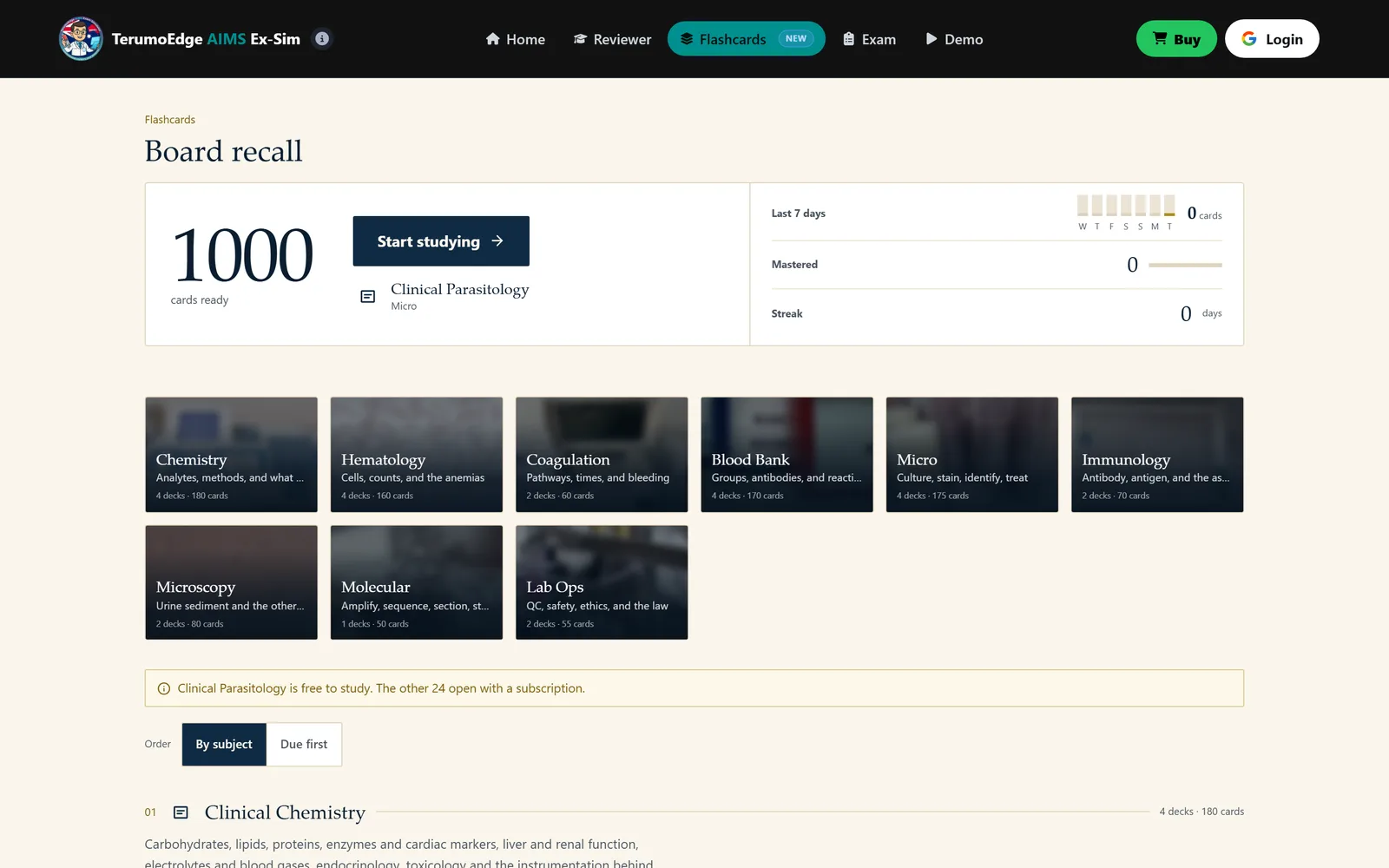
Keep the other sections alive with short daily recall. Flashcards suit this because ten minutes fits any gap in a shift. Our flashcards cover 1,000 recall cards in 25 decks, organised by laboratory subject rather than by the seven AIMS sections, so use them for recall, not as a map of the paper.
If Molecular Pathology is one of your worries, check yourself early against the topics the AIMS study guide lists: PCR, Sanger sequencing, NGS, Bcr-Abl, BRAF V600E, JAK2 V617F, and HGVS and ISCN nomenclature. Check yourself against them early. Transfusion Science also lists quality assurance in the blood bank, and the pack's recommended reading names the ANZSBT Guidelines. Both come from the June 2025 pack (AIMS Professional Examination Pack v8.1).
What happens in week two, and when is the trial exam?
The AIMS pack describes a practice test followed by a trial exam within the two weeks before the official exam, so week two is when you run them. Those rules come from the June 2025 pack, which says the exam uses the WebLock secured browser on the same computer you will use on the day. Check the current pack for any change before you plan around it.
Treat the trial exam as a technical and personal rehearsal. Use the computer you will sit on, in the room you will sit in, at the hour you will sit. Confirm that your webcam works and that your mobile phone is set up for supervision, since AIMS describes live supervision by webcam and mobile phone (the March 2026 exam pack). Have your passport or driver's licence within reach for the proctor.
Do your second full mock in the same week, ideally a few days away from the trial exam so that one does not drain the other. The mock trains your pace. The trial exam trains your set-up. Our online exam rules post turns each rule into a habit you can rehearse.
What should you do in exam week?
In exam week, stop adding topics and spend your effort on recall, rest and the room. The knowledge you hold on Monday is almost the knowledge you will have on Saturday, and new material mostly raises anxiety. Reread your own error log, redo old misses, and skim the explanations for items that tripped you up before.
Prepare the physical set-up two days ahead, not the night before. Clear the desk of books, notes and headphones, because the pack states none are allowed. A calculator will not be required, so remove it as well and practise without one. Check that the computer is charged and plugged in, that updates are finished, and that nothing else will launch on its own.
Plan around the no-break rule. The pack says there are no bathroom or rest breaks unless approved, so decide what you will eat and drink beforehand and use the bathroom just before you start. Answers can be reviewed before submission, which gives you a safety net at the end, so leave a few minutes for it.
What about the day itself?
On the day, your only job is to execute a plan you have already rehearsed. Start the check-in early, because identity and environment checks take time and you want your first minutes to be calm. Show your passport or driver's licence to the proctor when asked.
Pace at about 72 seconds per item, which is 180 minutes divided by 150, and glance at the clock at fixed checkpoints instead of continuously. Our time management post lays out the checkpoints. When an item stalls you, flag it and move on, since you can come back before submitting.
If you believe a question contains an error, the pack asks you to report it within five business days. Make a note of the question's position and what seemed wrong, and report it after the sitting. Then step away from the screen. Results can take up to ten weeks, and the paper itself is never released, so there is nothing to gain from replaying it.
A week-by-week summary
The table below condenses the month. Use it as a checklist and adjust the order to your shifts. If you work rotating duty, the companion post on reviewing for the AIMS exam while working shows how to fit the same blocks around a roster.
| Week | Do | Don't |
|---|---|---|
| Four weeks out | Sit a first full 150-item mock in one three-hour block; rank sections by distance from their floors | Judge yourself on one section's feel; start a new textbook |
| Three weeks out | Run repair blocks on the weakest compulsory sections; daily short recall | Neglect the sections you already pass comfortably |
| Two weeks out | Complete the practice test and trial exam; sit a second full mock; confirm ID, webcam and phone set-up | Change computers or rooms after the trial exam |
| Exam week | Review your error log; prepare the room two days ahead; sleep on schedule | Start new topics; sit another full mock in the last two days |
| Exam day | Check in early; pace by checkpoints; flag and return | Replay hard items afterwards |
Frequently asked questions
When is the AIMS trial exam?
According to the June 2025 exam pack, a practice test comes first, then a trial exam within the two weeks before the official exam. The trial runs on the same computer you will use on the day, with the WebLock secured browser. Confirm the exact arrangements in the current pack and with AIMS, because procedures can change between versions.
Should I study the night before the AIMS exam?
Light recall is fine, but a new topic is not. Review your error log, skim a few flashcards and then stop. The paper is three hours with no scheduled breaks, so a rested head matters more than one extra topic. Prepare your desk, ID and computer earlier in the week so the evening is free.
Can I fix a weak section in one month?
You can improve a weak section in a month, but we cannot promise how much. A focused repair block, timed sets, and rereading explanations usually help more than hours of passive reading. Because each compulsory section has its own 50% floor, repairing the section nearest its floor is the most useful use of limited time.
Do I need a calculator for the AIMS exam?
No. The June 2025 pack states that a calculator will not be required, and it also says that books, notes and headphones are not allowed. Practise without a calculator during your mocks so that nothing about the day feels unfamiliar.
How many full mocks should I sit in the last month?
We suggest two: one at four weeks out to find the weakest section, and one in week two for pace and stamina. AIMS does not specify a number. Beyond two, full mocks can drain energy that targeted repair would use better, especially if you are working shifts.
Sources
- AIMS Professional Examination Pack, Medical Laboratory Scientist ANZSCO 234611, PEP v8.2 (03/2026) — Australian Institute of Medical and Clinical Scientists
- AIMS Professional Examination Pack, PEP v8.1 (06/2025) — Australian Institute of Medical and Clinical Scientists
- Professional Examinations for Migration — Australian Institute of Medical and Clinical Scientists
From the publisher
Sit it here first.
TerumoEdge AIMS Ex-Sim is a simulator for the AIMS Professional Examination: a full-screen, timed exam room, a 150-item Full Mock across all seven disciplines, and a written explanation for every item.
- 5,981 items across the seven AIMS disciplines
- 39 fixed sets in each discipline, 273 in all, plus random draws
- A 150-item, three-hour Full Mock with a per-discipline score report
- An English explanation with references for every item, not a bare answer key
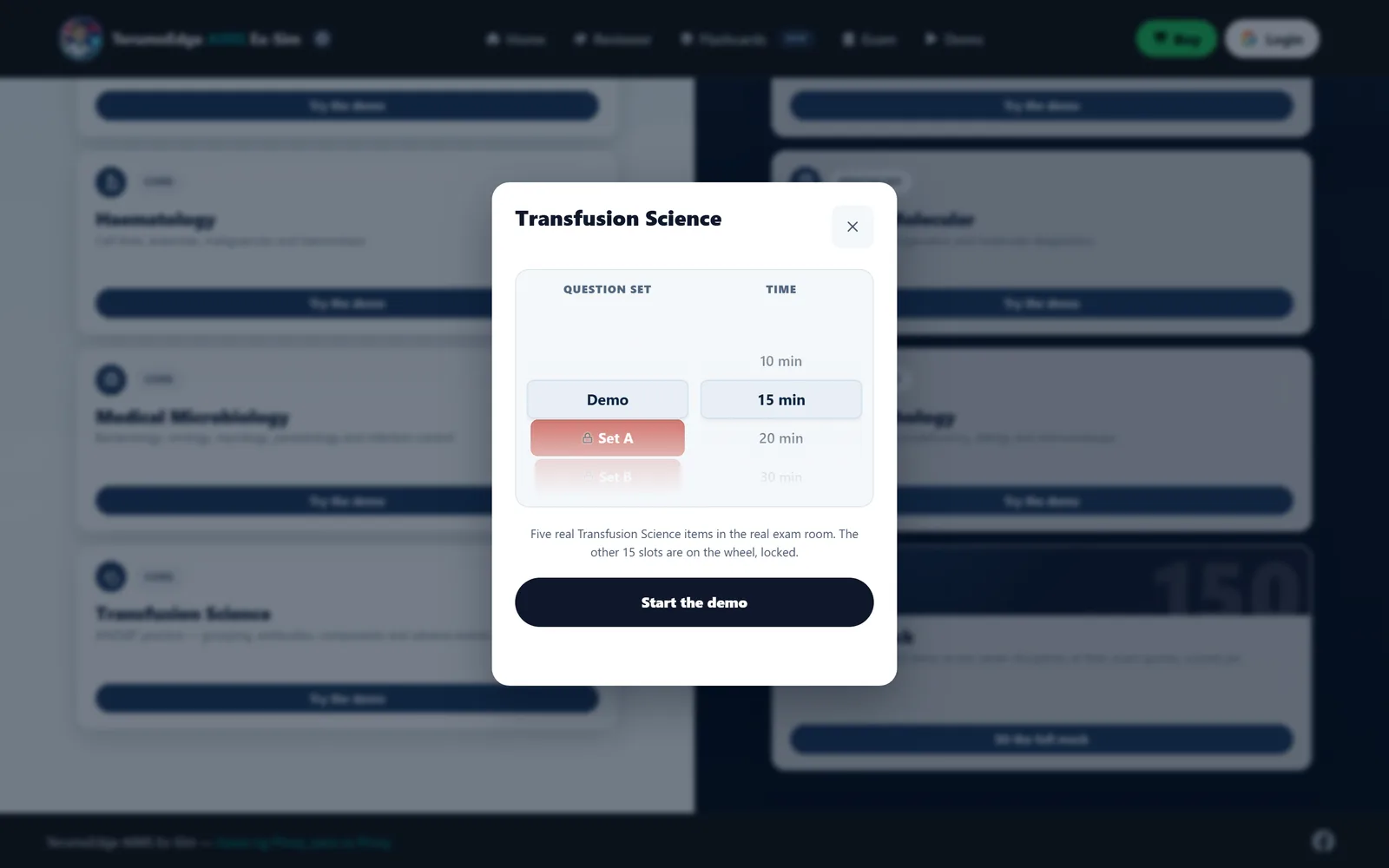
Try the free AIMS simulator demo Five real items in each of the seven disciplines. No account needed.
About this article
Written by the TerumoEdge AIMS editorial team, who build the TerumoEdge AIMS Ex-Sim. Exam facts are checked against the AIMS Professional Examination Pack and the AIMS Guidelines for Skills and Qualifications Assessment, and every article lists its sources. How we write and check our articles.
First published .