
Your situation7-minute readFor working medtechs reviewing on shifts
How to review for the AIMS exam while working lab shifts: a schedule that survives night duty
How to review for the AIMS exam while working: short blocks on rotating shifts, bench work as practice, phone recall, full mocks on days off and leave planning.
If you are doing shift work in a laboratory and trying to review for the AIMS exam while working, you already know the problem. Your hours change from week to week, your sleep is not on a clock, and a long day at the bench leaves little for a textbook.
This post offers a way to review that survives rotating shifts. It rests on one fact: Option 2 needs at least two years of postgraduate experience in a medical pathology laboratory (AIMS Guidelines, GAPSQ v18.2), so you are not alone. Nearly everyone who sits the Professional Examination has been working. If you are still in Stage 1, our post on building your Stage 1 file covers the paperwork.
Is it realistic to review for the AIMS exam while working?
It is realistic, because the exam is set at the level of an MLS with at least two years of experience, and you are already working at that level. AIMS describes the paper as 150 single-response questions in three hours, set for professionals with at least two years of postgraduate experience (AIMS Professional Examination Pack v8.2). Your bench years are an asset.
We cannot offer pass statistics for working candidates, because AIMS publishes none and we will not invent any. What we can say is that your limit is time and energy, and both can be planned.
Start by counting your real hours. Take a normal month and mark the days you have off, the shifts you work and the commute. Then count the pockets: the hour before a shift, the quiet gaps at the bench, the ten minutes on a bus. Most people find fewer long blocks than they hoped and more short ones than they noticed.
Write the number down. A modest, repeatable five to eight hours a week beats a heroic plan that fails by the second week. Be honest about your sleep too, since tired review is slow review.
What does a week of review look like on rotating shifts?
Build each week from two kinds of time: short weekday blocks of 20 to 40 minutes and one or two longer blocks on days off. The shape of the week changes with your shift, but the ingredients stay the same. The table gives a sample for a day-shift week and a night-shift week.
| Day | Day-shift version | Night-shift version |
|---|---|---|
| Weekday 1 | 30 min timed set (one discipline) before work | 30 min recall after waking, before the shift |
| Weekday 2 | 10 min flashcards at lunch; 30 min explanation review at night | 20 min set at the start of the break; 10 min flashcards on the way home |
| Weekday 3 | 40 min weak-section repair after dinner | Rest or light recall only; protect sleep after the last night |
| Weekday 4 | 30 min mixed timed set | 30 min mixed set on the first day back on days |
| Day off 1 | 90 min section block; error log update | 90 min section block after a full sleep |
| Day off 2 | Full 150-item mock (three hours), then 45 min review | Full mock only once you are rested; otherwise a 50-item set |
Move things around freely. A night worker coming off a run of shifts should not sit a full mock the next morning. The point is the pattern: short, frequent, protected sleep, one long block.
Use our study plan for the section split. Hours should follow the section weights, with a floor of time for every compulsory section.
How do you turn bench work into review?
Treat the bench as a source of practice, because many AIMS topics appear in your daily work. The aim is to attach a small question to a task you are already doing, so the review costs no extra time.
A quality control round is the clearest case. When you check a run, name the Westgard rule that a result would break and say what you would do next. A blood grouping can become a short drill: what would a discrepancy between forward and reverse typing suggest, and what is the next step? A blood film is a prompt to describe the morphology in words before you read the report.
Keep the habit honest. Never use patient information outside your laboratory, and do not take notes that identify patients. Write only the concept on a card or in your phone.
Notice, too, what your own bench does not cover. If your laboratory has no molecular or blood bank work, the study guide topics there, such as PCR, Sanger sequencing and NGS, or quality assurance in the blood bank, need deliberate study (AIMS Professional Examination Pack v8.1). That is worth checking early, whichever country you trained in.
How do phone and flashcards fit a shift?
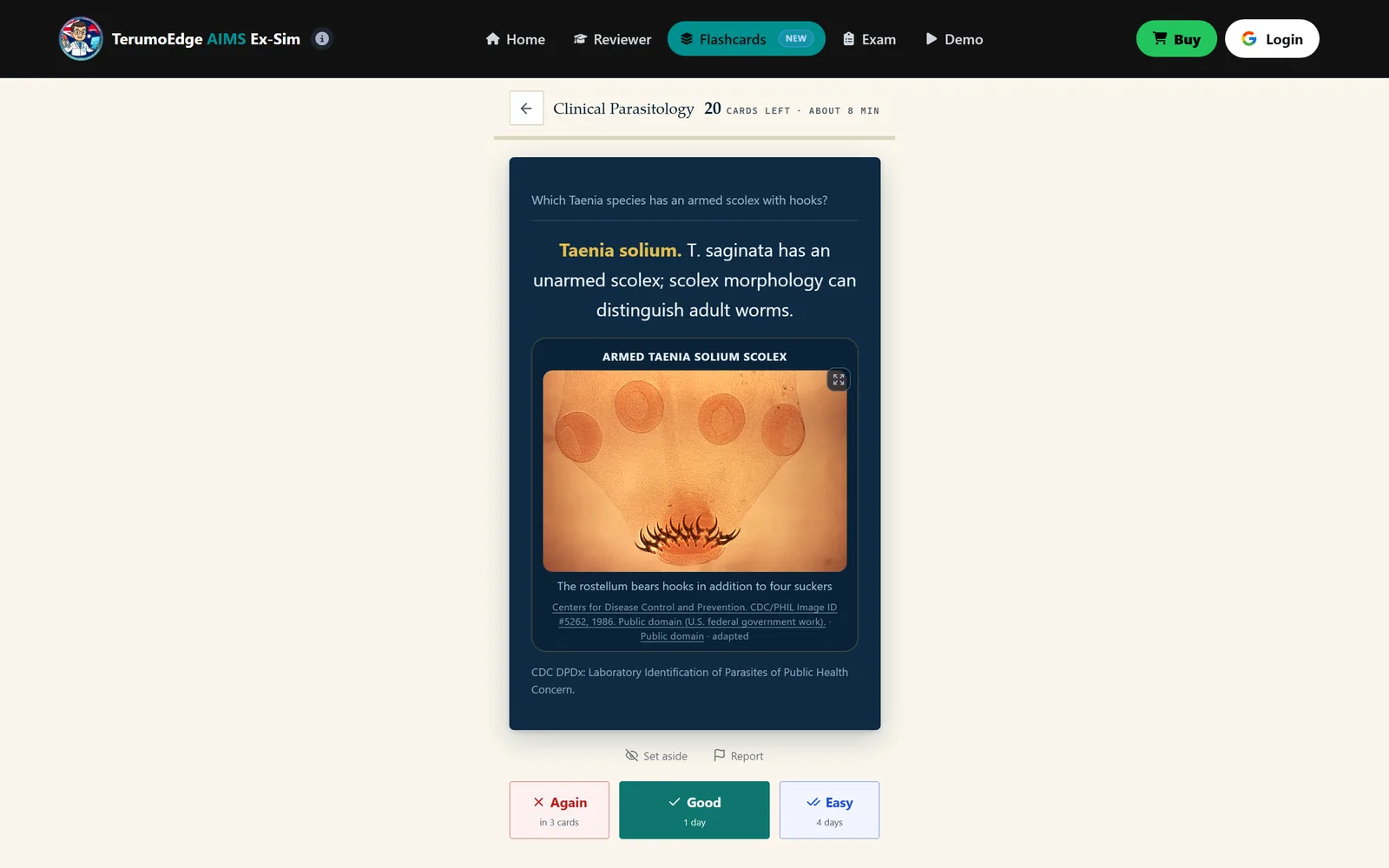
Phone sessions fit the gaps that a textbook cannot use. Ten minutes of recall in a queue, on a break or on the way home adds up across a week. Our flashcards give 1,000 recall cards in 25 decks, organised by laboratory subject rather than by the seven AIMS sections, so they are a shared laboratory-science resource and not a copy of the AIMS study guide.
Match the tool to the energy you have. When you are fresh, do timed questions, because they demand effort. When you are tired, do recall of facts you have already met, because you can do that with little energy. Avoid learning a hard new mechanism at the end of a night shift.
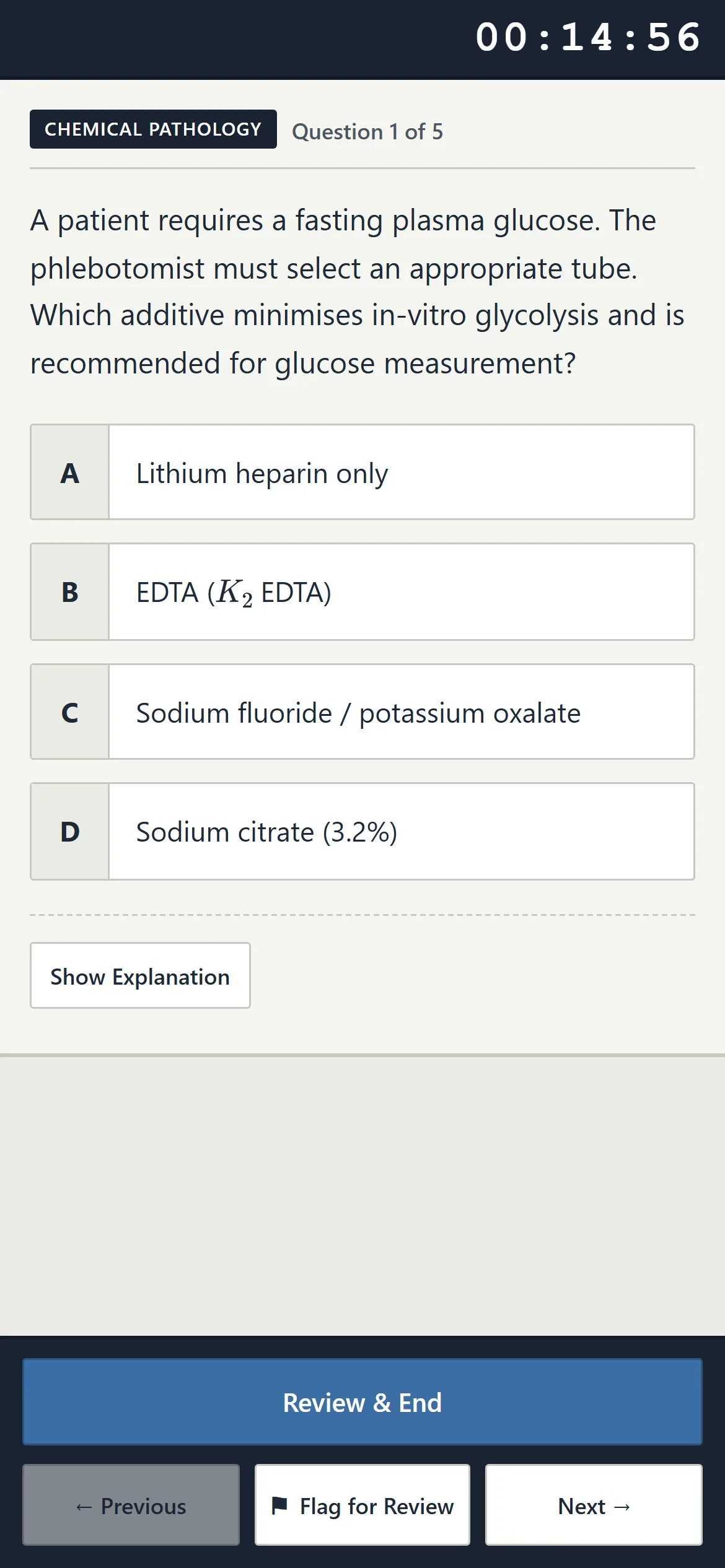
The exam room also works at phone width, which helps with short sets. A full-length paper is different. The real sitting runs in a secured browser on a computer, as the June 2025 pack describes, so rehearse full mocks on the computer you will use.
Finally, keep the phone from becoming a distraction. Put the study apps on the home screen and move the rest away during a block.
When do full mocks happen, and what about leave?
Schedule full mocks on days off, because a 150-item paper needs a clear three hours with no interruptions. The exam has no breaks unless approved, so your mock should not either. Sit it when you are rested, not after a run of nights, and at the hour of your real sitting where you can.
Aim for the first full mock about four weeks before your sitting and a second in the two weeks before it. See the final-month plan for how those fit together.
Plan leave around two events. The June 2025 pack describes a practice test and then a trial exam within the two weeks before the official exam, so look at your roster for that window. Then protect the sitting itself. A night shift the evening before is a poor plan, so ask your manager early about changing a roster or taking leave. We cannot say how much leave is wise, since it depends on your laboratory and your workload.
Check the closing dates too: applications close on 1 December for March and 10 July for September (AIMS Professional Examination Pack v8.2).
Self review or a review center when you work?
Either can fit a working schedule, but they trade structure for flexibility. A review course offers a timetable and a cohort, which helps if you drift without deadlines. Self review lets you fit study around a changing roster. We make the simulator that publishes this blog, so weigh this accordingly. The point that matters most is the same for both: you need timed, full-length practice against the section floors.
If you work rotating shifts, a fixed class schedule can clash with your roster, and a self-paced plan may fit better. If you have a stable day schedule and need accountability, structure may help more. Our comparison in review center or self review sets out the trade-offs.
Whichever you choose, watch for material sold as "actual AIMS questions". AIMS says completed examinations are not released under any circumstances and that further sample questions will not be provided beyond the 25 in the pack. Such claims cannot be true of released exam content.
Frequently asked questions
Can I pass the AIMS exam while working full time?
Many candidates review while working, since Option 2 requires two years of laboratory experience. We have no statistics on how working candidates fare, because AIMS publishes none. What you can control is a repeatable schedule, regular timed practice and protected sleep.
How many hours a week should I review?
AIMS does not set a number, and the right figure depends on your starting point. A modest, repeatable amount is better than an ambitious one you abandon. Count your real free hours first, then choose a weekly total you can keep for the whole review.
Should I take leave before the exam?
Plan around two events: the trial exam, which the June 2025 pack places within the two weeks before the sitting, and the sitting itself. Avoid a night shift the evening before. How much leave you take is your decision and depends on your employer, so ask early.
Can I study with flashcards on a night shift?
Yes, for recall of material you have already learned. They suit low-energy moments better than new, difficult material. Keep sessions short, and do timed questions when you are fresh.
Sources
- Guidelines for Skills and Qualifications Assessment, MLS ANZSCO 234611 and MLT ANZSCO 311213, GAPSQ v18.2 (06/2024) — Australian Institute of Medical and Clinical Scientists
- AIMS Professional Examination Pack, Medical Laboratory Scientist ANZSCO 234611, PEP v8.2 (03/2026) — Australian Institute of Medical and Clinical Scientists
- AIMS Professional Examination Pack, PEP v8.1 (06/2025) — Australian Institute of Medical and Clinical Scientists
- Skills Assessment for Overseas Qualified Professionals — Australian Institute of Medical and Clinical Scientists
From the publisher
Sit it here first.
TerumoEdge AIMS Ex-Sim is a simulator for the AIMS Professional Examination: a full-screen, timed exam room, a 150-item Full Mock across all seven disciplines, and a written explanation for every item.
- 5,981 items across the seven AIMS disciplines
- 39 fixed sets in each discipline, 273 in all, plus random draws
- A 150-item, three-hour Full Mock with a per-discipline score report
- An English explanation with references for every item, not a bare answer key
Try the free AIMS simulator demo Five real items in each of the seven disciplines. No account needed.
About this article
Written by the TerumoEdge AIMS editorial team, who build the TerumoEdge AIMS Ex-Sim. Exam facts are checked against the AIMS Professional Examination Pack and the AIMS Guidelines for Skills and Qualifications Assessment, and every article lists its sources. How we write and check our articles.
First published .