The AIMS explained6-minute readFor AIMS exam candidates
The AIMS passing score: 75 of 150, the section minimums, the 500 cut score, and what your result tells you
The AIMS passing score explained: 75 of 150 correct, 50% in each compulsory section, the 0 to 1000 scale with a cut score of 500, and when results arrive.
The AIMS passing score is not one number. It is a short rule with three parts, and candidates who read only "75 of 150" can fail while scoring well above it. This post states the rule exactly as the Australian Institute of Medical and Clinical Scientists (AIMS) publishes it, works out what each section floor means in questions, and walks through four made-up candidates so you can see which part of the rule decides each outcome.
We also cover the 0 to 1000 scaled score, how long results take, and what you will and will not see afterwards. If you are unsure of the paper itself, start with the AIMS exam format.
What is the AIMS passing score rule in one sentence?
To pass, you must answer at least 75 of the 150 questions correctly, score at least 50% in each of the five asterisked disciplines, and score 50% in either Molecular Pathology or Immunopathology. The exam pack says the asterisked disciplines "MUST be passed" and that "to pass the examination overall 75 questions MUST be answered correctly" (S1).
The five compulsory disciplines are Anatomical Pathology, Chemical Pathology, Haematology, Medical Microbiology and Transfusion Science. All three conditions apply together. A strong total does not excuse a failed compulsory discipline, and cleared floors do not excuse a total of 74.
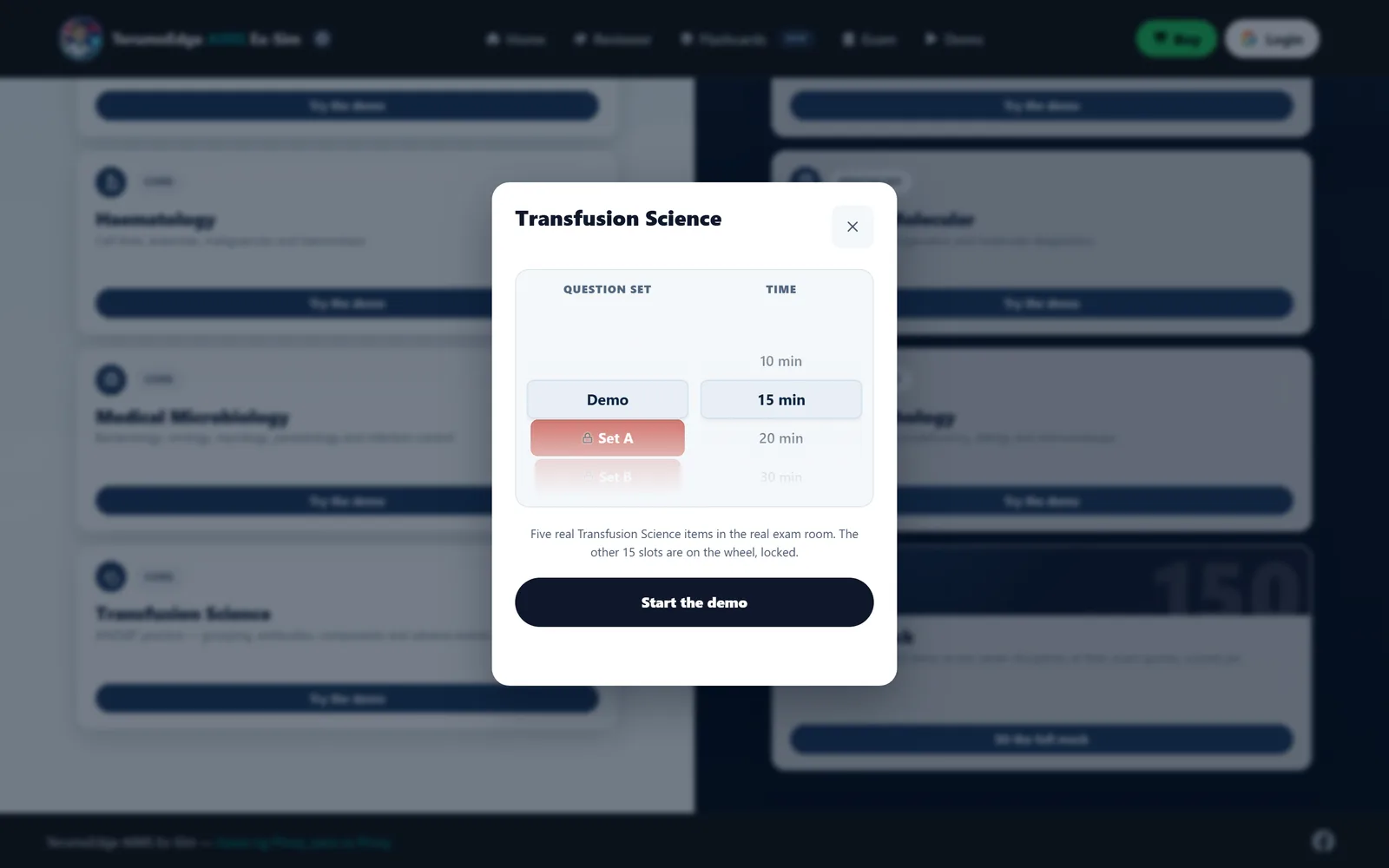
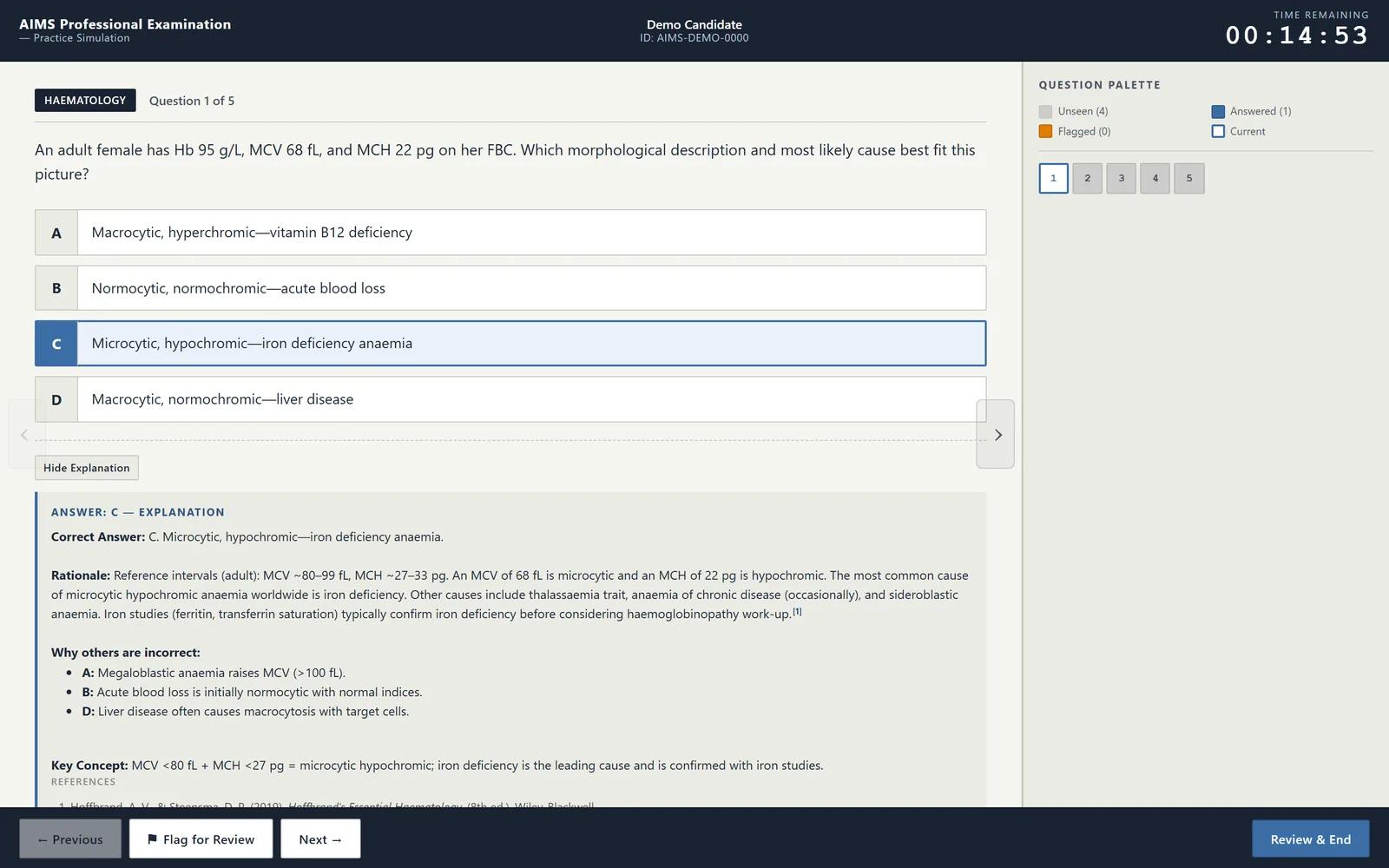
This is why practice that reports only one percentage can mislead you. A tool that tells you "you scored 62%" has not told you whether Transfusion Science sat at 45%. Our free demo lets you try each of the seven disciplines on its own, with five items per discipline, so you can see how a section-level score feels before you commit to a study plan.
Read it as a checklist rather than a score. Seven boxes can be ticked or crossed: five compulsory sections, the Molecular-or-Immunopathology pair, and the overall mark. Nothing in the sources lets one box compensate for another.
What are the section minimums in questions?
At 50%, the floors are 7 correct in Anatomical Pathology, 15 in Chemical Pathology, 15 in Haematology, 13 in Medical Microbiology and 10 in Transfusion Science. We worked these out from AIMS's section sizes of 14, 30, 30, 26 and 20 items (S1).
| Section | Items | Correct needed for 50% | Status |
|---|---|---|---|
| Anatomical Pathology | 14 | 7 | Compulsory |
| Chemical Pathology | 30 | 15 | Compulsory |
| Haematology | 30 | 15 | Compulsory |
| Medical Microbiology | 26 | 13 | Compulsory |
| Transfusion Science | 20 | 10 | Compulsory |
| Molecular Pathology | 16 | 8 | One of these two |
| Immunopathology | 14 | 7 | One of these two |
Those numbers are our arithmetic, not an AIMS table, so check them against the sizes in the current pack. The smallest compulsory section leaves the least room: in Anatomical Pathology, eight wrong answers out of 14 fail the discipline whatever else happens.
How does the Molecular-or-Immunopathology rule work?
You need 50% in at least one of the two: 8 of 16 in Molecular Pathology or 7 of 14 in Immunopathology (S1). Clearing both is fine, and clearing neither fails the paper.
It is an either-or pair rather than a free skip. Both sections still count toward the overall 75 correct, so leaving one unstudied costs you up to 14 or 16 questions of the total. Banking on the other section to carry you is a gamble about two small sections, not a plan.
Because the Molecular Pathology section was called Genomic Pathology in older documents, make sure any practice material you use scores the same two sections AIMS names now. We explain the change in the format post, and our Molecular Pathology review covers the study-guide topics.
How do the rules decide different candidates? A hypothetical table
The four candidates below are invented to show how the rule behaves. They are not real results and not typical ones.
| Hypothetical candidate | Overall | The part that decides it | Outcome under the rule (S1) |
|---|---|---|---|
| A: 92 correct, every compulsory floor cleared, Molecular 10 of 16 | 92 of 150 | Nothing fails | Pass |
| B: 110 correct, Haematology 14 of 30 | 110 of 150 | Haematology is under 50% | Fail, Haematology a failed compulsory discipline |
| C: every floor cleared, total 74 | 74 of 150 | Overall mark below 75 | Fail |
| D: 100 correct, Molecular 7 of 16 and Immunopathology 6 of 14 | 100 of 150 | Both under 50% | Fail |
Candidate B is the one that surprises people. A total of 110 is far above 75, yet one question short of the Haematology floor ends the attempt. Candidate C shows the opposite: cleared floors sum to at least 67, so a total of 74 is possible while every discipline is satisfied, and the overall mark still binds. Our retaker strategy post uses this logic to read a fail letter.
What are the 0 to 1000 scale and the 500 cut score?
AIMS reports a Rasch-based scaled score from 0 to 1000, with the pass, or cut score, set at 500 (S1). The Rasch model adjusts raw performance for question difficulty, which is why a scaled score is not the same thing as a percentage.
AIMS does not publish a conversion between raw marks and the 500 cut score in the sources we use, so we do not offer one. Do not translate "I got 80 correct" into a scaled number, and be wary of anyone who does.
What you can rely on is the raw rule above: 75 of 150, plus the section floors. Practice tools report raw marks and percentages. That includes our own Full Mock, which applies the section minimums to raw marks but cannot produce an AIMS scaled score. Use a mock to find weak sections and to build stamina, not to predict a scaled result.
What does your result tell you, and when does it arrive?
Results take up to ten weeks (S2). AIMS reports the outcome as Pass or Fail, along with any failed compulsory disciplines (S1). So a failing letter tells you which compulsory sections cost you, but not your answers.
"Completed examinations are not released under any circumstances" (S1), which means you cannot review your paper afterwards. If you believe a question contained an error, the exam pack asks you to report it within five business days (S2).
AIMS publishes no pass rates, and we found no examinee counts from AIMS, so we quote none. Any percentage you see in a forum or an advertisement is not from AIMS. For the same reason, we do not estimate how hard the paper is.
One more line from the guidelines: applicants who do not qualify for, or fail, the exam "may be assessed as suitable for" Medical Laboratory Technician ANZSCO 311213 (S3). The wording is "may", and it is AIMS's decision.
Frequently asked questions
What is the AIMS passing score?
You need 75 of 150 questions correct, at least 50% in each of Anatomical Pathology, Chemical Pathology, Haematology, Medical Microbiology and Transfusion Science, and 50% in Molecular Pathology or Immunopathology (S1). AIMS reports a scaled score from 0 to 1000 with the cut score set at 500.
What is the AIMS pass rate?
AIMS does not publish a pass rate, and we found no examinee numbers from AIMS in the sources we checked. We therefore quote none and do not estimate one. Treat any figure you see online as unsourced, however confident it sounds.
How long do AIMS results take?
Results take up to ten weeks after the exam (S2). The result is reported as Pass or Fail, with any failed compulsory disciplines listed (S1). The ten-week figure is a maximum, so plan around the upper end if you have deadlines.
Can I see my exam paper afterwards?
No. The exam pack states that completed examinations are not released under any circumstances (S1). You can report a suspected question error within five business days (S2), but you cannot request your paper or a list of the questions you missed.
Sources
- Medical Laboratory Scientist Professional Examination Pack v8.2 (03/2026) — Australian Institute of Medical and Clinical Scientists
- Medical Laboratory Scientist Professional Examination Pack v8.1 (06/2025) — Australian Institute of Medical and Clinical Scientists
- Guidelines for Skills and Qualifications Assessment, MLS and MLT, v18.2 (06/2024) — Australian Institute of Medical and Clinical Scientists
From the publisher
Sit it here first.
TerumoEdge AIMS Ex-Sim is a simulator for the AIMS Professional Examination: a full-screen, timed exam room, a 150-item Full Mock across all seven disciplines, and a written explanation for every item.
- 5,981 items across the seven AIMS disciplines
- 39 fixed sets in each discipline, 273 in all, plus random draws
- A 150-item, three-hour Full Mock with a per-discipline score report
- An English explanation with references for every item, not a bare answer key
Try the free AIMS simulator demo Five real items in each of the seven disciplines. No account needed.
About this article
Written by the TerumoEdge AIMS editorial team, who build the TerumoEdge AIMS Ex-Sim. Exam facts are checked against the AIMS Professional Examination Pack and the AIMS Guidelines for Skills and Qualifications Assessment, and every article lists its sources. How we write and check our articles.
First published .