
Study strategy7-minute readFor AIMS candidates nervous about a proctored sitting at home
AIMS exam anxiety: how to stay steady through three hours on camera at home
AIMS exam anxiety is common in a home sitting: live webcam, no breaks, no paper review. Here is a rehearsal ladder, a reset routine and a plan for the wait.
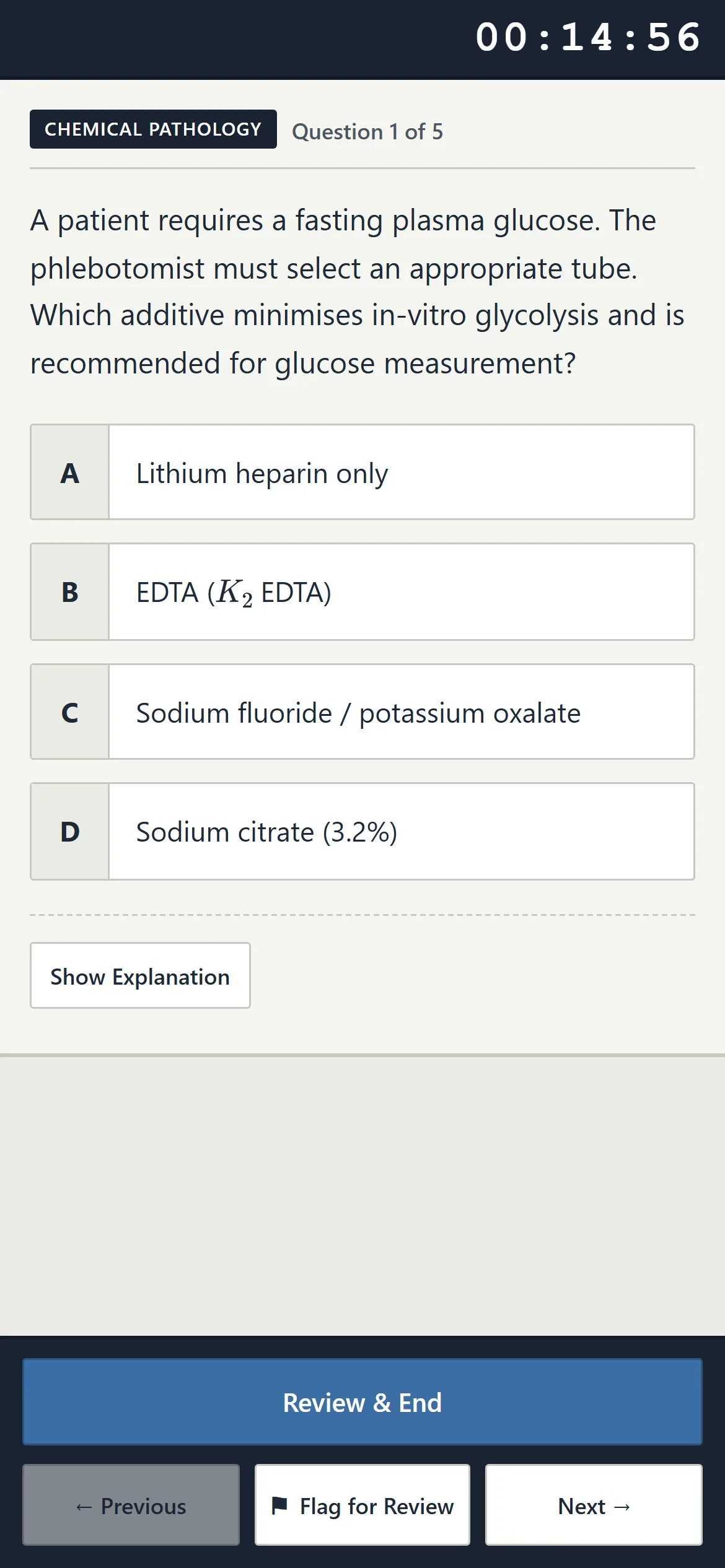
AIMS exam anxiety has a particular shape. You will sit 150 questions in three hours, at home, while a proctor watches through your webcam and your mobile phone. Nobody can see you try again. That combination makes ordinary exam nerves feel larger, and it is worth saying so plainly.
This post is for Filipino medical technologists who are Option 2 applicants and will sit the Professional Examination remotely. It does not promise that nerves will vanish. It shows how to make the sitting familiar, how to control the room, what to do when one item stalls you, and how to get through the wait for results.
Why does AIMS exam anxiety feel bigger in a home-proctored sitting?
A home sitting feels bigger because several pressures arrive together and you cannot step away from any of them. The AIMS pack describes an exam run twice a year with online remote proctoring and live supervision by webcam and mobile phone (AIMS Professional Examination Pack v8.2). The June 2025 pack adds that there are no bathroom or rest breaks unless approved, and that books, notes and headphones are not allowed (AIMS Professional Examination Pack v8.1).
Then add what comes after. AIMS states that completed examinations are not released under any circumstances, so you will never see which items you missed. Results may take up to ten weeks. A paper with seven sections, each with its own pass floor, can make any single bad item feel like a disaster.
Naming these pressures helps because each one has a counter. Familiarity answers the camera. Preparation answers the no-break rule. A plan for the wait answers the silence. The rest of this post takes them in turn.
How do you make the exam familiar? The rehearsal ladder
Climb a ladder of rehearsals, so that by the time you sit the real paper, you have already done every part of it at least once. Anxiety feeds on the unknown. A step-by-step ladder replaces the unknown with a list of things you have survived.
| Step | What you simulate | The sign you are ready |
|---|---|---|
| 1 | A 20-item timed set in one discipline, at your desk | You finish with time left and read the explanations calmly |
| 2 | A 50-item mixed set, no pausing the clock | You can keep a steady pace without checking the timer every minute |
| 3 | The same set with phone away, headphones off and notes removed | Missing your usual comforts no longer distracts you |
| 4 | A full 150-item paper in one three-hour block, with no break | You finish, and your last 30 items are as careful as your first 30 |
| 5 | The AIMS practice test and trial exam on the real computer | The set-up works and you know every check-in screen |
Our simulator's Full Mock has 150 items across all seven disciplines in three hours, and it is a sensible way to reach step four. It reports raw marks, not AIMS's scaled score. The June 2025 pack says the practice test and trial exam fall within the two weeks before the official sitting, so step five sits late in your plan. See the final-month plan for how to fit it in.
How do you control the room on the day?
Control everything you can before the clock starts, so that one live variable is the paper. Choose the room and the desk now, and use them for every rehearsal from step three onwards. Practise with the camera angle and lighting you will use. Keep the desk clear, since the pack says books, notes and headphones are not allowed.
Plan your body as well as your equipment. The no-break rule means you decide in advance what you will eat, how much you will drink and when you will use the bathroom. Have your passport or driver's licence ready for the proctor, because fumbling for ID at the start is an avoidable stress.
Tell the people you live with when you will be on camera and for how long. A short note on the door and a quiet house reduce the chance of an interruption you cannot control. Switch off anything that might ping, and keep the mobile phone positioned for supervision as the instructions require.
Do all of this at least two days early. On the day itself, you want to be checking in, not troubleshooting.
What can you do when one item stalls you? A 30-second reset
Use a short fixed routine, because deciding what to do while panicking costs time you do not have. The routine should take about 30 seconds and have three physical steps. Nothing about it needs to be clever.
First, take one slow breath out, longer than the breath in, and drop your shoulders. Second, read the stem again from the first word, covering the options with your hand or by attention. Third, decide: answer with your best option, or flag the item and move on. The pack states that answers can be reviewed before submission, so flagging costs you nothing except the decision to come back.
Pacing helps the reset. At 72 seconds per item, which is 180 minutes divided by 150, an item that has taken three minutes is no longer a fair trade. Our time management post covers checkpoints.
Practise the reset in your mocks, not for the first time on the day. Mark the moments when you used it. If you used it ten times and still finished, that record becomes evidence that you can handle a hard item.
How do you get through the wait for results?
Plan the wait before you sit, because the ten-week estimate is an upper bound and you will not control it. The June 2025 pack says results can take up to ten weeks. AIMS reports a Pass or Fail, plus any failed compulsory disciplines, so there is no item-level feedback to analyse while you wait.
Replaying the paper in your head is the most common trap. You cannot verify any of it, and the paper is not released. When you notice yourself reconstructing questions, name it and move on to something concrete.
Give the weeks structure. Return to your normal sleep and shift pattern. Do something physical most days. Catch up with people you neglected during review. If you want to keep your knowledge warm, do short recall sessions rather than new study, unless you already know you will need to retake. In that case, our post on what to do after a result that falls short starts from the letter.
Do not read forum guesses about how the exam "went" for others. AIMS publishes no pass rates, so any figure you see online has no official source.
When does anxiety need more than tips?
Anxiety needs more than tips when it disrupts your sleep, appetite, work or relationships, or when you feel unable to prepare at all. Practical routines help ordinary exam nerves. They are not a treatment for an anxiety problem, and we are not clinicians.
If your worry is constant, your sleep is badly affected, you have panic symptoms, or you feel hopeless, please speak to a doctor or a qualified mental health professional. Many people find it helps to talk to someone before the exam, not only after it. If you are in crisis or fear for your safety, contact your local emergency services or a crisis line in your area straight away.
General habits can also support you: regular sleep, daylight and movement, steady meals, and limiting caffeine near bedtime. Tell a friend or family member what you are going through, since isolation tends to magnify exam fear.
Seeking support is compatible with careful preparation. If you are unsure whether adjustments are possible for the sitting, ask AIMS directly.
Frequently asked questions
How do I stop blanking on a hard item?
Use a fixed 30-second reset: one slow breath out, reread the stem from the first word, then answer or flag. Flagging is allowed because answers can be reviewed before submission, according to the June 2025 pack. Practise the routine in timed mocks so it is automatic when you need it.
Is it normal to feel unprepared before the trial exam?
Yes, it is common, and the feeling is not a reliable measure of readiness. The trial exam is a rehearsal of the process, held within the two weeks before the official sitting. Judge readiness by your mock results by section, not by how confident you feel that day.
How do I cope with waiting for results?
Expect up to ten weeks, as the pack states, and plan the weeks. Keep your usual sleep and routines, do something physical, and avoid replaying questions, because the paper is never released. Keep any study light and low-pressure until you know the outcome.
Does the proctor watch me the whole time?
The pack describes live supervision by webcam and mobile phone. It does not describe how closely any proctor watches, so we make no claim. Practise with your camera and phone positioned as instructed so that being observed feels ordinary by exam day.
Sources
- AIMS Professional Examination Pack, Medical Laboratory Scientist ANZSCO 234611, PEP v8.2 (03/2026) — Australian Institute of Medical and Clinical Scientists
- AIMS Professional Examination Pack, PEP v8.1 (06/2025) — Australian Institute of Medical and Clinical Scientists
- Professional Examinations for Migration — Australian Institute of Medical and Clinical Scientists
From the publisher
Sit it here first.
TerumoEdge AIMS Ex-Sim is a simulator for the AIMS Professional Examination: a full-screen, timed exam room, a 150-item Full Mock across all seven disciplines, and a written explanation for every item.
- 5,981 items across the seven AIMS disciplines
- 39 fixed sets in each discipline, 273 in all, plus random draws
- A 150-item, three-hour Full Mock with a per-discipline score report
- An English explanation with references for every item, not a bare answer key
Try the free AIMS simulator demo Five real items in each of the seven disciplines. No account needed.
About this article
Written by the TerumoEdge AIMS editorial team, who build the TerumoEdge AIMS Ex-Sim. Exam facts are checked against the AIMS Professional Examination Pack and the AIMS Guidelines for Skills and Qualifications Assessment, and every article lists its sources. How we write and check our articles.
First published .