
Study strategy7-minute readFor AIMS candidates who run out of time
AIMS exam time management: pacing 150 items in three hours with no breaks
AIMS exam time management for 150 items in three hours: the 72 seconds per item arithmetic, checkpoints, flag and return, and how to train your pace.
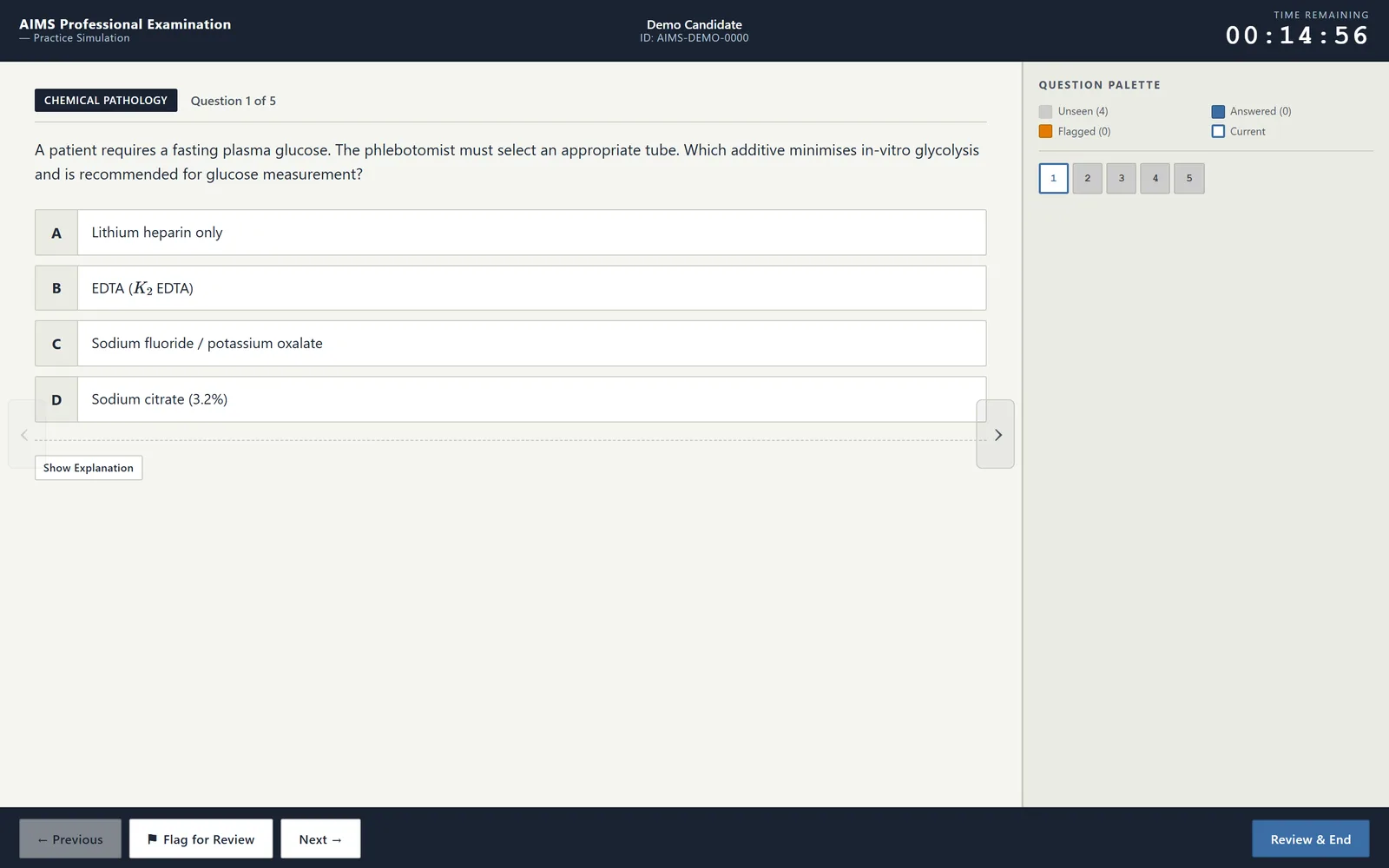
AIMS exam time management starts with one piece of arithmetic. The Professional Examination is 150 single-response multiple-choice items in three hours, which is 180 minutes divided by 150, or 72 seconds per item. That is the average, and there is nothing spare in it. The pack describes no breaks unless approved, so the whole paper runs as one block.
Most candidates who run short do not read slowly. They get stuck on a handful of items and pay for it later. This post sets out the pace, the checkpoints, what to do with a long item, how to flag and return, and how to train it. Only Option 2 applicants sit this paper; see who sits the AIMS Professional Examination.
How does AIMS exam time management work out to 72 seconds per item?
The pace is 72 seconds per item on average, or about 66 seconds if you reserve 15 minutes for a review pass. The AIMS Professional Examination Pack describes a paper of 150 single-response questions to be completed in three hours (AIMS exam pack v8.2).
The sums are short. 180 minutes is 10,800 seconds, and 10,800 divided by 150 is 72. Reserve 15 minutes and you have 165 minutes, or 9,900 seconds, for the first pass: 9,900 divided by 150 is 66.
Use 66 seconds as the working pace and 72 as the hard ceiling. A short item will take 30 seconds and a long case will take two minutes, so the average hides a lot of variation. What matters is that you know where you should be at each point, which the next section covers.
Which checkpoints should you use through the three hours?
Check your position every 25 items, using the table below. A checkpoint turns a vague worry about time into a number you can act on. At 36 minutes, you should have answered 30 items; if you have answered only 24, you are behind by six items, about seven minutes, and you can catch up by speeding up slightly over the next block.
| Checkpoint | Items answered | Latest elapsed time at 72 s | Target with a 15-minute buffer (66 s) |
|---|---|---|---|
| Start of the paper | 0 | 0:00 | 0:00 |
| Early check | 30 | 0:36 | 0:33 |
| One third | 50 | 1:00 | 0:55 |
| Halfway | 75 | 1:30 | 1:22:30 |
| Two thirds | 100 | 2:00 | 1:50 |
| Late check | 125 | 2:30 | 2:17:30 |
| Last item | 150 | 3:00 | 2:45 |
Write the checkpoint times on a sheet before the exam, but check what the rules allow: no books or notes are permitted in the sitting, so memorise a few of them instead. Practise reading the clock on the screen, not on the wall.
What should you do with long case items?
For a long case item, give it one fair attempt and move on if you are not progressing. A rule of two minutes is enough for most: if you are still unsure at 120 seconds, choose your best option, flag the item and continue. The cost of getting stuck is easy to calculate. Four minutes on one item is 240 seconds, which is more than three items at the 72-second pace, and those three are worth as much as the one you are stuck on.
Read the question stem first for what is being asked, then the options, then the case detail you need. Many case items hold more information than you need. Cross out options you can prove wrong. If two options remain, pick one, flag and go.
No calculator is required, according to the exam pack (AIMS exam pack v8.1), so a numerical item should be solvable with simple arithmetic or a quick estimate. If you find yourself in a long calculation, you have probably misread the question; step back and re-read it.
How does flag and return work?
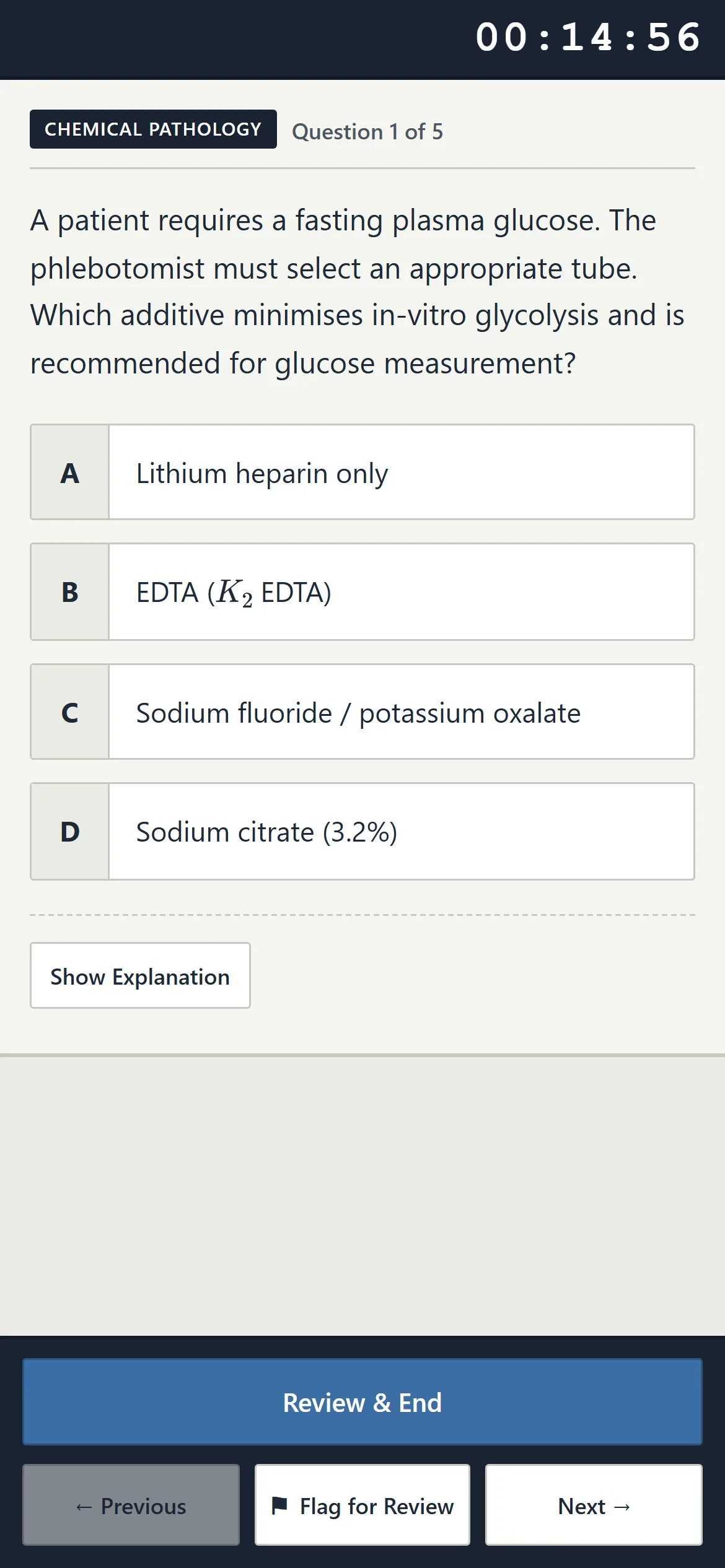
Flag and return works because the exam pack states that answers can be reviewed before submission, so you can leave a hard item and come back with the time you saved. On the first pass, answer every item, even if only with a guess, and flag the ones you want to revisit.
Answering everything first matters. A flagged item with a chosen option still scores if you run out of time. A flagged item left blank scores nothing. We found nothing in the pack about penalties for wrong answers, so check the current pack and, unless it says otherwise, answer all 150.
Keep your flags to a manageable number. If you flag more than about 20 items, you are flagging too easily, and the review pass will not be long enough. Flag items for one of two reasons: you are torn between two options, or the item is long and you want to read it again with a clear head. Do not flag items just because you feel uncertain about the whole paper.
How should you spend the last 15 minutes?
Spend the last 15 minutes on flagged items first, then a sweep for unanswered ones. Start the review at the 165-minute mark if you used the 66-second pace. Go through the flagged items in order, and give each about a minute. On a second reading, you will often see the point the first reading missed.
Do a sweep before you submit. Confirm every item has an answer; the question palette helps, and the exam room in our simulator mirrors this idea so you can practise it. Change an answer only if you can name the reason. An answer changed for a stated reason is a better bet than one changed out of nerves.
Leave the final minute free. Submitting is final, and a candidate who clicks in a rush can mistake the button. If you finish early, use the time; there is no prize for submitting at 150 minutes.
How do you build stamina for a paper with no breaks?
Build stamina by practising full three-hour sittings at the time of day you will sit, on the computer you will use. The exam pack describes no bathroom or rest breaks unless approved, so the paper is one continuous block of reading and deciding. Concentration usually fades in the last third, and the last 50 items count as much as the first 50.
Prepare the practical side before the day. Eat beforehand, use the bathroom just before you start, and make the room quiet. The pack lists what you may not have, including books, notes and headphones, so rehearse without them. Our online exam rules post covers those rules.
Notice where your own pace drops. Many people slow down in the second hour. If your log shows it, set a checkpoint just before that point and push gently there. Take a slow breath and relax your shoulders for a few seconds between items if you feel tension building; that costs almost no time, and it helps you stay level through to the last item.
How do you train your pace?
Train your pace in three steps: timed short sets, timed section sets, then full-length mocks. Short sets of 30 items in 36 minutes teach the pace in small doses. Section sets teach you how long each discipline takes at 72 seconds per item, shown below. Full-length mocks teach stamina, which matters because the pack describes no bathroom or rest breaks unless approved.
| Section | Items | Time at 72 seconds per item |
|---|---|---|
| Chemical Pathology | 30 | 36 minutes |
| Haematology | 30 | 36 minutes |
| Medical Microbiology | 26 | 31 minutes 12 seconds |
| Transfusion Science | 20 | 24 minutes |
| Molecular Pathology | 16 | 19 minutes 12 seconds |
| Anatomical Pathology | 14 | 16 minutes 48 seconds |
| Immunopathology | 14 | 16 minutes 48 seconds |
These times add up to 180 minutes. Our simulator's Full Mock has 150 items in three hours drawn from all seven disciplines and shuffled together, so you practise switching. Do not assume AIMS orders its items the same way; the point is to be ready for mixed topics.
Try a timed set in our free demo to feel the clock, and see the study plan for when to start full mocks.
Frequently asked questions
How many seconds per item does the AIMS exam allow?
An average of 72 seconds. The exam has 150 single-response items in three hours, and 180 minutes is 10,800 seconds, which divided by 150 is 72. If you reserve 15 minutes for review, your working pace on the first pass is about 66 seconds per item.
Can I go back to flagged questions?
Yes. The AIMS exam pack states that answers can be reviewed before submission. That is why flag and return is a sound approach: answer everything on the first pass, flag doubtful items, then use your reserved time to revisit them. Check the current pack for any change to the rules.
Are there breaks during the AIMS exam?
Not unless approved. The exam pack states that there are no bathroom or rest breaks unless approved. Plan for three hours of continuous work, and build the stamina in your practice. Our online exam rules post covers the other proctoring rules.
Sources
- AIMS Professional Examination Pack, Medical Laboratory Scientist ANZSCO 234611, v8.2 — Australian Institute of Medical and Clinical Scientists
- AIMS Professional Examination Pack, v8.1 (proctoring rules) — Australian Institute of Medical and Clinical Scientists
- Professional Examinations for Migration — Australian Institute of Medical and Clinical Scientists
From the publisher
Sit it here first.
TerumoEdge AIMS Ex-Sim is a simulator for the AIMS Professional Examination: a full-screen, timed exam room, a 150-item Full Mock across all seven disciplines, and a written explanation for every item.
- 5,981 items across the seven AIMS disciplines
- 39 fixed sets in each discipline, 273 in all, plus random draws
- A 150-item, three-hour Full Mock with a per-discipline score report
- An English explanation with references for every item, not a bare answer key
Try the free AIMS simulator demo Five real items in each of the seven disciplines. No account needed.
About this article
Written by the TerumoEdge AIMS editorial team, who build the TerumoEdge AIMS Ex-Sim. Exam facts are checked against the AIMS Professional Examination Pack and the AIMS Guidelines for Skills and Qualifications Assessment, and every article lists its sources. How we write and check our articles.
First published .