Guides7-minute readFor AIMS candidates reviewing Transfusion Science
AIMS Transfusion Science: 20 compulsory items, and why the pack points you to the ANZSBT guidelines
How to review AIMS Transfusion Science: 20 compulsory items, ABO and antibody logic, reactions, HDFN, blood bank QA, and the ANZSBT guidelines in the pack.
AIMS Transfusion Science is one of the five compulsory sections, with 20 items out of 150. It is still compulsory, so at least 10 correct answers are needed, whatever you score in Chemical Pathology or Haematology. That makes it a section where steady, logical preparation pays off faster than anywhere else.
Remember that only Option 2 applicants sit this paper; our guide to who sits the AIMS Professional Examination explains the three options. For those who do, this post covers how to review the blood bank in a way the items reward: a map of what the pack points to, then grouping, antibody work, component logic, reactions and quality assurance, and a two-week block.
Why does AIMS Transfusion Science deserve its own block?
Transfusion Science deserves a separate block because it is compulsory, because it is logic-heavy, and because its floor is only 10 correct answers. The AIMS Professional Examination Pack sets Transfusion Science at 20 items and lists it with the disciplines that must be passed at 50% (AIMS exam pack v8.2). Ten correct is not many, but a candidate who treats the section as an afterthought can still end with 9.
It also rewards a different skill. Chemistry and haematology reward pattern recall. Blood bank items often present a worked-out puzzle: a panel grid, a discrepancy between forward and reverse grouping, a patient history. You win those by following the same steps each time. The section is 13.3% of the paper, and our bank holds 810 items in this discipline for practice (our bank, not AIMS's own count).
The way to prepare is to learn the steps, then rehearse them under a clock. See how the section fits the whole paper in our guide to the exam format and sections.
What does the AIMS pack point you to?
The AIMS pack points to two things for Transfusion Science: quality assurance in the blood bank in the study guide, and the ANZSBT Guidelines for Transfusion and Immunohaematology Laboratory Practice in the recommended reading (AIMS exam pack v8.1). Those are the two named topics worth extra attention early in your review.
We suggest a simple check. Open the study guide in the pack, find the Transfusion Science list, and rate yourself against each line before you pick up a textbook. Then read the ANZSBT guidelines themselves. We do not restate their rules here, because the guideline is the authority and an article is a poor substitute; items written from it will use its terms.
A general blood bank textbook remains useful for mechanisms and for practice with panels. Use it for the "why", and the guideline for the local expectations. If an item names a standard or a term you have not met in your textbooks, check yourself against the guideline before assuming it is a trick.
How do you approach grouping and antibody identification?
Approach grouping and antibody identification as a fixed sequence, and you will rarely lose the plot. For grouping, always compare the forward and reverse groups. A mismatch is a discrepancy to resolve, not to guess at.
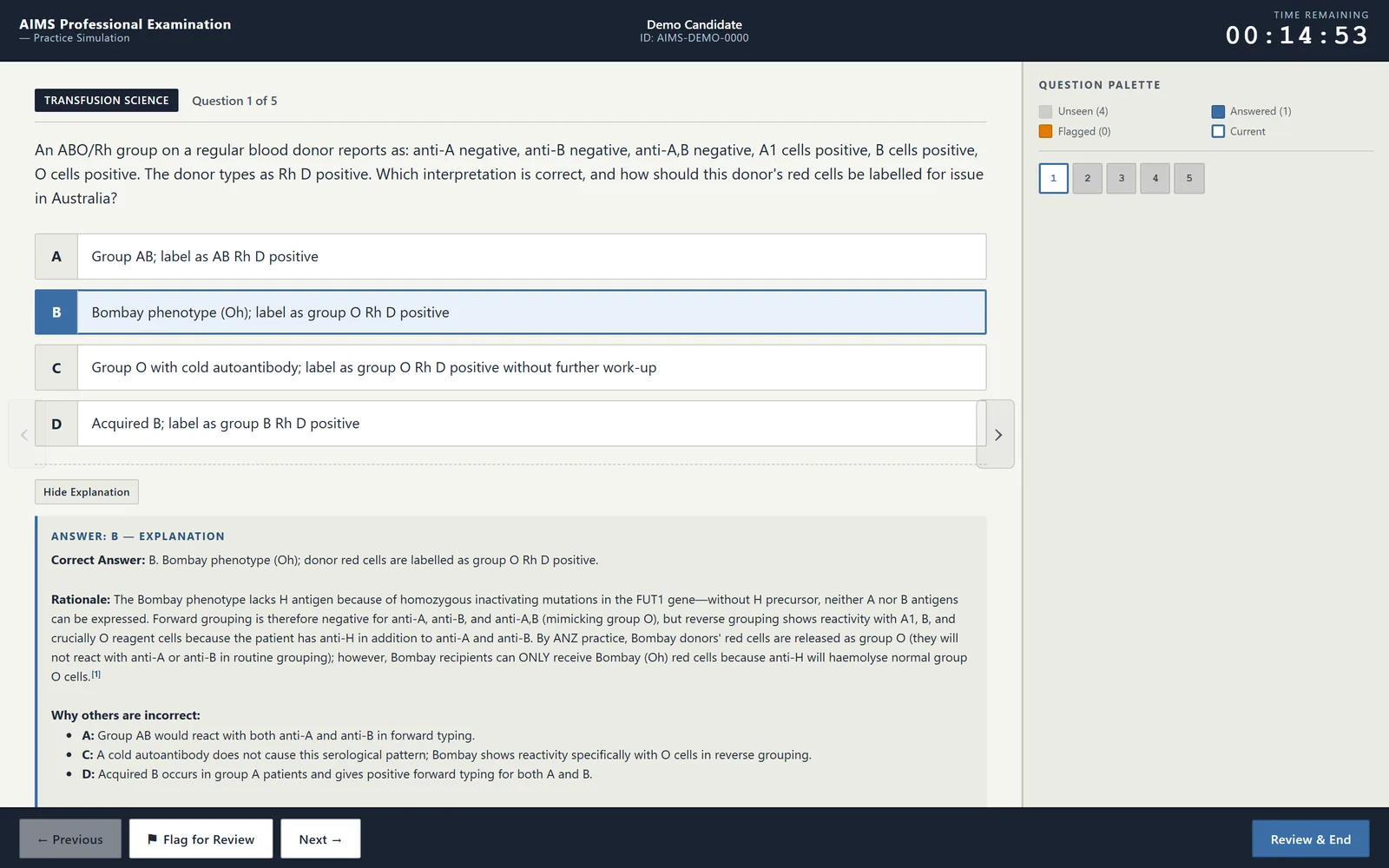
The common causes are well known. Weak or missing reverse reactions occur in neonates, in older patients and in hypogammaglobulinaemia. Rouleaux can mimic agglutination and is resolved by saline replacement. Cold autoantibodies cause unexpected reactions that warm incubation can clear. Subgroups such as A2 with anti-A1 appear as an extra reverse reaction. The Bombay phenotype lacks the H antigen: the cells type as group O, yet the serum contains anti-A, anti-B and anti-H, so the patient can receive only H-negative blood.
For antibody identification, follow the steps. Check the autocontrol and the direct antiglobulin test. Exclude specificities using cells that carry the antigen in a homozygous form, because heterozygous cells may give weak reactions, which is called dosage and applies to Rh (c, e), Kidd, Duffy and MNS antigens. Confirm the remaining candidate with the rule of three: three antigen-positive cells reacting and three antigen-negative cells not reacting. Then select antigen-negative blood and crossmatch.
What are the compatibility and component rules?
Compatibility and component questions apply a small number of principles to the clinical story. For red cells, the donor's red cells must be compatible with the recipient's plasma, so group O red cells are the universal red cell choice when the recipient's group is unknown. Plasma works the other way: the donor's plasma must not contain antibodies against the recipient's red cells, so group AB plasma is the universal plasma.
For RhD, remember the clinical rule of thumb that a RhD-negative woman of childbearing potential should receive RhD-negative red cells, because alloimmunisation can cause haemolytic disease of the fetus and newborn later.
Know each component's role. Platelets treat or prevent bleeding from low counts or dysfunction and are stored with agitation at room temperature. Fresh frozen plasma replaces clotting factors. Cryoprecipitate is the source of fibrinogen, factor VIII, von Willebrand factor and factor XIII. Irradiation prevents transfusion-associated graft-versus-host disease in at-risk recipients, and leucodepletion reduces febrile reactions and alloimmunisation.
Where an item involves local policy, such as which crossmatch method applies, answer from the guideline, not from habit.
How are reactions, HDFN and blood bank QA tested?
Reactions, haemolytic disease of the fetus and newborn, and quality assurance are tested as scenarios: symptom, cause, next step. Learn reactions by trigger and timing. An acute haemolytic reaction, usually from an ABO incompatibility caused by a clerical or sampling error, brings fever, back pain and haemoglobinuria; the first action is to stop the transfusion, keep the line open, recheck the identification and send samples for investigation. A febrile non-haemolytic reaction is a diagnosis of exclusion. Allergic reactions are mild, while anaphylaxis suggests IgA deficiency. TRALI brings acute breathlessness with non-cardiogenic pulmonary oedema, TACO is circulatory overload, and a delayed haemolytic reaction follows an anamnestic response to a previously sensitising antigen.
For HDFN, anti-D is the classic cause, and ABO incompatibility with a group O mother is usually milder and often shows a weak or negative DAT. Know why a fetomaternal haemorrhage test is done and what anti-D immunoglobulin is for.
For quality assurance, think in categories: identification and traceability, reagent and equipment control, validation, competency, incident reporting and records. Our approach is to learn the categories first, then read the guideline for the detail.
What does a two-week block look like?
A two-week block gives the first week to grouping, antibodies and components, and the second to reactions, HDFN, quality assurance and timed practice. The table below shows the topics, the core idea of each and a drill.
| Topic | Core idea | Drill |
|---|---|---|
| ABO and RhD grouping | Forward and reverse must agree | Resolve five written discrepancies |
| Antibody identification | Exclude, confirm, choose antigen-negative blood | Work three panels on paper, timing yourself |
| Compatibility and components | Red cells vs plasma rules | Pick the right product for ten case sketches |
| Transfusion reactions | Trigger, timing, first action | Flashcards: symptom to reaction to action |
| HDFN | Antibody class, titre, prevention | Trace a mother and baby through the steps |
| Blood bank QA | Traceability, reagent QC, validation | List the checks for one batch of reagents |
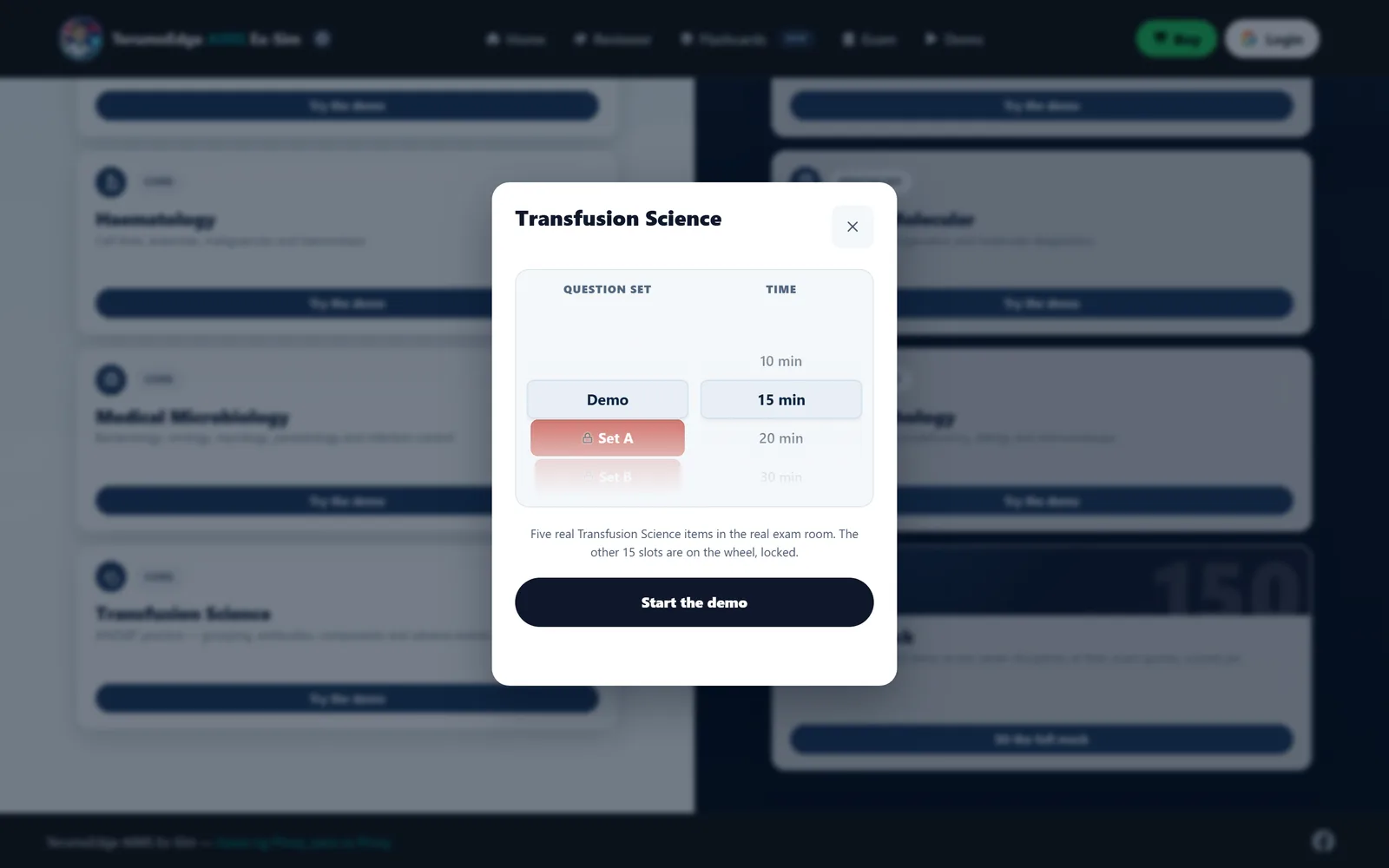
In week one, finish three panels each day and read the matching guideline sections. In week two, do two timed 20-item sets, which at 72 seconds each take 24 minutes. Review every miss, then use the free demo to see how explanations lay out the reasoning.
Frequently asked questions
How many Transfusion Science items are in the AIMS exam?
The AIMS Professional Examination has 20 Transfusion Science items out of 150. The section is compulsory, so you need at least 50% of it correct, which is 10 items, in addition to the overall requirement of 75 of 150 correct answers.
Which transfusion guidelines does AIMS recommend?
The AIMS exam pack's recommended reading includes the ANZSBT Guidelines for Transfusion and Immunohaematology Laboratory Practice. The study guide also lists quality assurance in the blood bank. Read the current pack for the full list, because AIMS reissues it from time to time.
Is Transfusion Science compulsory?
Yes. Transfusion Science is one of five compulsory disciplines, along with Anatomical Pathology, Chemical Pathology, Haematology and Medical Microbiology. You need at least 50% in each, plus 75 of 150 overall. Our passing score guide sets out the full rule.
Sources
- AIMS Professional Examination Pack, Medical Laboratory Scientist ANZSCO 234611, v8.2 — Australian Institute of Medical and Clinical Scientists
- AIMS Professional Examination Pack, v8.1 (study guide and recommended reading) — Australian Institute of Medical and Clinical Scientists
- Guidelines for Skills and Qualifications Assessment, MLS ANZSCO 234611 and MLT ANZSCO 311213, v18.2 — Australian Institute of Medical and Clinical Scientists
From the publisher
Sit it here first.
TerumoEdge AIMS Ex-Sim is a simulator for the AIMS Professional Examination: a full-screen, timed exam room, a 150-item Full Mock across all seven disciplines, and a written explanation for every item.
- 5,981 items across the seven AIMS disciplines
- 39 fixed sets in each discipline, 273 in all, plus random draws
- A 150-item, three-hour Full Mock with a per-discipline score report
- An English explanation with references for every item, not a bare answer key
Try the free AIMS simulator demo Five real items in each of the seven disciplines. No account needed.
About this article
Written by the TerumoEdge AIMS editorial team, who build the TerumoEdge AIMS Ex-Sim. Exam facts are checked against the AIMS Professional Examination Pack and the AIMS Guidelines for Skills and Qualifications Assessment, and every article lists its sources. How we write and check our articles.
First published .