
Guides8-minute readFor AIMS candidates reviewing the two largest sections
AIMS Chemical Pathology and Haematology: how to review the two 30-item sections that make up 60 of 150
How to review AIMS Chemical Pathology and Haematology: 60 of 150 items, QC and Westgard rules, acid-base, morphology, coagulation, and a three-week block.
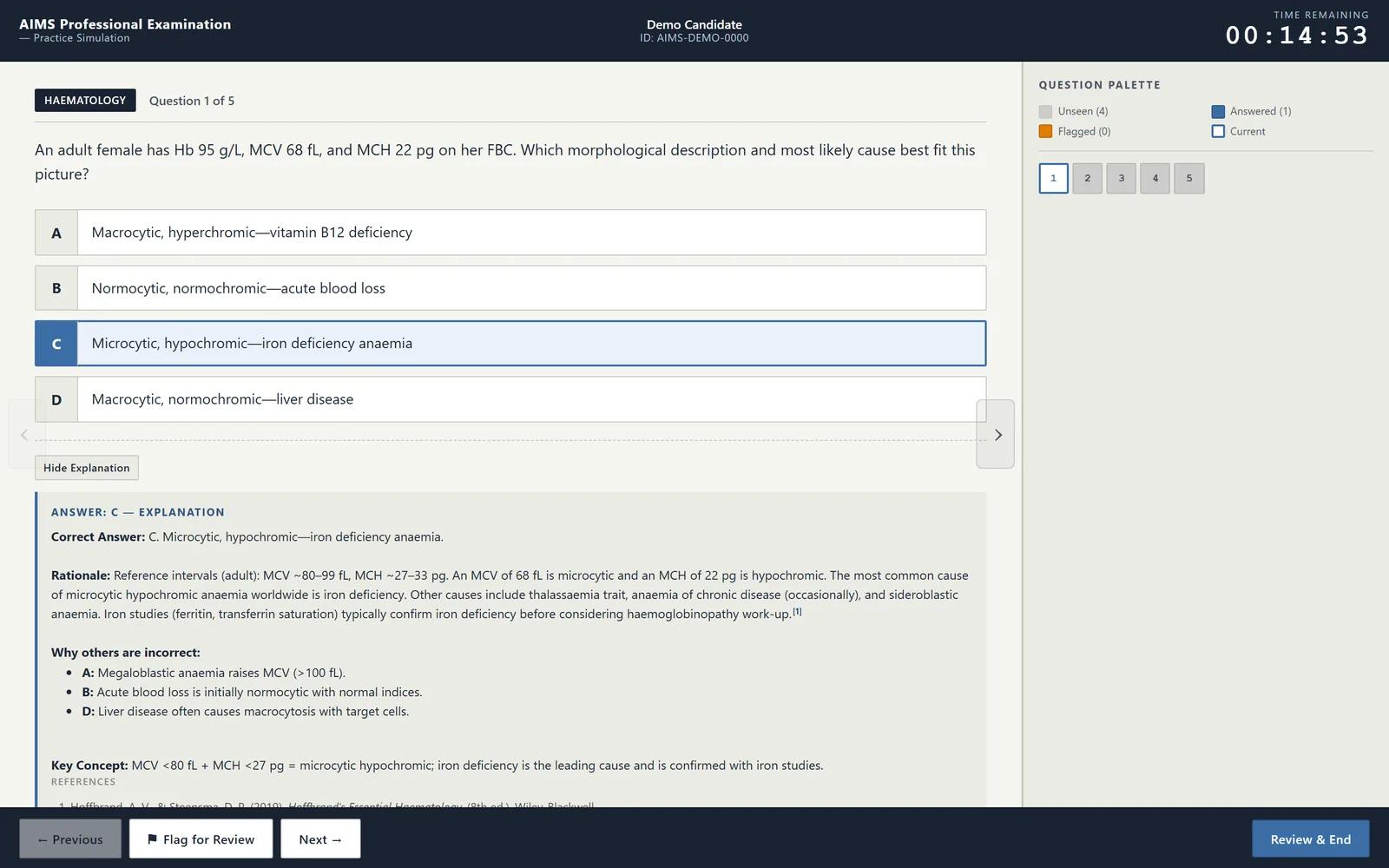
AIMS Chemical Pathology and Haematology are the two biggest sections of the Professional Examination. Each has 30 items, so together they are 60 of the 150 questions, or 40% of the paper. Both are compulsory sections: you need at least 50% in each, which is 15 correct answers apiece, and a strong score in one cannot cover a weak score in the other.
Not every applicant sits this exam, so first check that it applies to you. Only Option 2 applicants do, as we explain in who sits the AIMS Professional Examination. If you are one of them, this guide shows how to review these two sections: what to master, how items tend to test it, and how to drill. It is about method. Your own textbooks and the study guide in the AIMS exam pack supply the detail.
Why do AIMS Chemical Pathology and Haematology carry the paper?
Together the two sections hold 60 of the 150 items, and each one has its own pass floor, so they decide the result more than any other pair. The AIMS Professional Examination Pack sets Chemical Pathology and Haematology at 30 items each and lists both among the disciplines that must be passed at 50% (AIMS exam pack v8.2). The overall rule also asks for 75 of 150 correct, which we set out in the passing score post.
The practical lesson is that a lopsided review fails. A candidate who scores 25 of 30 in Chemical Pathology and 13 of 30 in Haematology has 38 of 60 across the pair and still fails Haematology. Split your hours so both sections stay comfortably above 15 correct, then aim higher in whichever you enjoy less.
Our bank holds 1,193 Chemical Pathology items and 1,193 Haematology items for practice. Those are the size of our bank, not AIMS's own counts.
How should you review quality control and method verification?
Review quality control as a set of decision rules you can apply to a control chart, because items usually give you values and ask what to do. The Westgard multirule scheme is the usual frame: a 1-2s result is a warning only, a 1-3s result or an R-4s result signals random error and rejects the run, and 2-2s, 4-1s and 10-x signal systematic error.
Work one example until it is automatic. A control has a mean of 5.0 mmol/L and an SD of 0.2. A value of 5.4 sits at +2 SD: a 1-2s warning, so inspect the other rules before deciding. A value of 5.7 sits at +3.5 SD and breaks 1-3s, so the run is rejected. Two successive controls at +2.2 SD and +2.4 SD both exceed the same 2 SD limit, which is a 2-2s rule violation and points to systematic error such as calibration drift.
Pair this with method verification. Know what each experiment tests: precision from repeated measurement, trueness against a reference or comparison method, linearity or the reportable range, and verification of the reference interval. Know also what carryover and interference mean.
How do Chemical Pathology items test panels and interpretation?
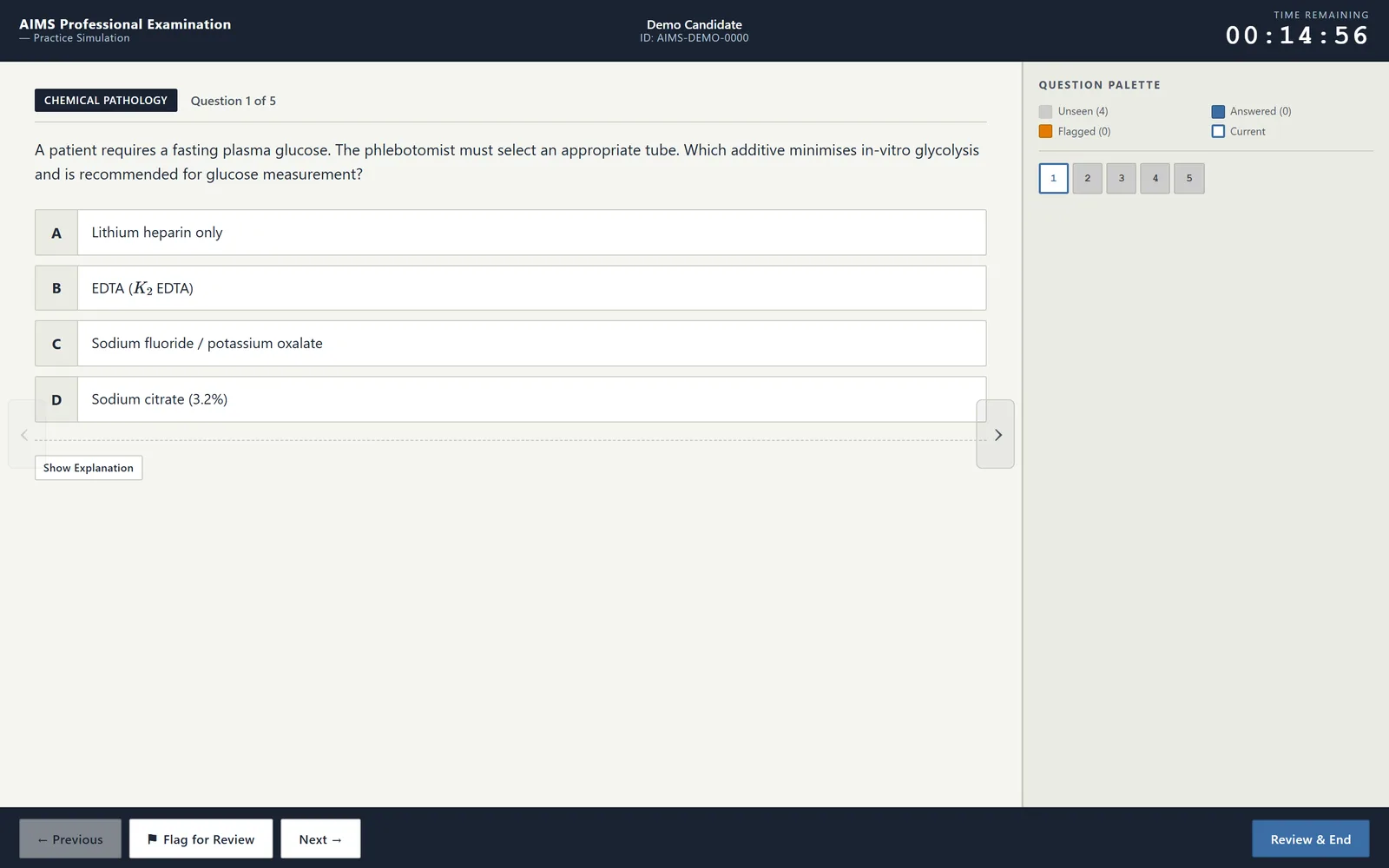
Chemical Pathology items usually give a small set of results and ask for the most likely disorder, the next test or the source of an error. The reliable way to prepare is to learn each panel as a decision tree, then check yourself on a timed set.
Acid-base is the clearest case. Read the pH first, then the primary disturbance, then the compensation. For the anion gap, subtract chloride and bicarbonate from sodium: with sodium 140, chloride 104 and bicarbonate 12 mmol/L, the gap is 24, which is high and fits a high anion gap metabolic acidosis such as ketoacidosis or lactic acidosis. A normal gap with the same low bicarbonate points toward bicarbonate loss, as in diarrhoea.
Endocrine items follow feedback loops. A high TSH with a low free T4 means primary hypothyroidism, while a low free T4 with a low or inappropriately normal TSH points to a pituitary cause. Do the same for cortisol, calcium with PTH, and the liver, cardiac and renal markers.
Be fluent in conventional and SI units. Glucose of 126 mg/dL is 7.0 mmol/L (divide by 18), and creatinine of 1.0 mg/dL is about 88 µmol/L (multiply by 88.4). The AIMS pack says a calculator will not be required (AIMS exam pack v8.1), so rehearse these without one.
How should you review Haematology morphology and malignancy?
Review Haematology morphology by pattern: start from the red cell indices, then the smear, then the confirmatory test. That order is how most items are built, and it keeps you from guessing from one clue.
For a microcytic hypochromic picture, separate three causes. Iron deficiency shows low ferritin, high total iron binding capacity and a raised red cell distribution width. Thalassaemia trait shows a normal or raised red cell count with a low MCV, and the Mentzer index (MCV divided by red cell count) is below 13. Anaemia of chronic disease shows low iron with normal or raised ferritin. In beta-thalassaemia trait, haemoglobin A2 is raised on electrophoresis or HPLC.
For macrocytic anaemia, hypersegmented neutrophils and oval macrocytes suggest vitamin B12 or folate deficiency.
For leukaemia, match the feature to the lineage. Auer rods and myeloperoxidase positivity mark myeloid blasts, TdT positivity marks lymphoblasts, and smear cells fit chronic lymphocytic leukaemia. Know the classic translocations, such as t(9;22) in chronic myeloid leukaemia and t(15;17) in acute promyelocytic leukaemia with its link to disseminated intravascular coagulation.
How should you review haemostasis and coagulation?
Review coagulation as two pathways meeting at a common pathway, and learn which test reads which. The prothrombin time reflects the extrinsic pathway (factor VII) and the common pathway, while the APTT reflects the intrinsic pathway and the common pathway. A prolonged PT with a normal APTT points to factor VII, early warfarin effect or early liver disease. A prolonged APTT with a normal PT points to factor VIII, IX, XI or XII deficiency, heparin or a lupus anticoagulant.
Use the mixing study as the next step. A prolonged APTT that corrects when mixed with normal plasma suggests a factor deficiency, and one that does not correct suggests an inhibitor, such as a lupus anticoagulant or a factor VIII inhibitor.
Know the vitamin K dependent factors (II, VII, IX and X) and why warfarin raises the INR. Know that von Willebrand disease can prolong the APTT through low factor VIII and that platelet disorders give a normal PT and APTT with abnormal platelet function tests. Connect D-dimer, fibrinogen and thrombin time to the picture of disseminated intravascular coagulation.
Which topic families should you drill, and how?
Drill by topic family, then mix them. The table below groups the two sections into families, says what to master in each and gives a drill you can run in a short session.
| Topic family | What to master | How to drill |
|---|---|---|
| QC and Westgard rules | Which rule fires, random vs systematic error, the action | Plot invented control points and name the rule |
| Method verification | Precision, trueness, linearity, reference interval | Match each experiment to the question it answers |
| Acid-base and electrolytes | pH first, compensation, anion gap | Work five gases a day on paper |
| Endocrine function | Feedback loops and suppression or stimulation tests | Draw the axis, then predict each result |
| Red cell disorders | Indices, smear, iron studies, haemoglobinopathies | Sort ten blood pictures into causes |
| Leukaemia and lymphoma | Lineage markers, translocations, smear features | One flashcard per translocation and marker |
| Haemostasis | PT, APTT, mixing studies, factor pathways | Predict PT and APTT for each factor deficiency |
Keep each drill short, then check yourself with a timed set. You can try our free demo to see how an item is explained, or use flashcards for quick recall of markers and translocations between shifts.
What does a three-week block look like?
A three-week block gives each section a full week and then tests them together. In week one, work Chemical Pathology: quality control and method verification on the first days, then acid-base, electrolytes and the endocrine axes. In week two, work Haematology: red cell patterns first, then leukaemia, then coagulation.
In week three, do timed mixed sets of both sections. The AIMS paper moves between disciplines, so you need practice switching from a Westgard question to a blood picture. Aim for 36 minutes per 30 items, which is the 72 seconds per item pace we explain in our time management post. Keep a log of every missed item with the reason it was missed: a fact you did not know, a pattern you misread or a rushed answer. After week three, rank the two sections by their error counts and let that ranking set your hours in the wider AIMS exam study plan.
Then move on to Transfusion Science, the next block in the order we suggest.
Frequently asked questions
How many Chemical Pathology items are in the AIMS exam?
The AIMS Professional Examination has 30 Chemical Pathology items out of 150. Haematology also has 30. Chemical Pathology is a compulsory section, so you need at least 50% of it correct, which is 15 items, in addition to the overall requirement of 75 of 150.
Can a strong Chemical Pathology score cover a weak section?
No. The AIMS rule requires at least 50% in each compulsory section, including Chemical Pathology and Haematology, as well as 75 of 150 overall. A high Chemical Pathology score adds to your total but cannot offset a failed Haematology, Anatomical Pathology, Microbiology or Transfusion Science section.
Do I need a calculator for the chemistry items?
The AIMS exam pack states that a calculator will not be required. Practise conversions, anion gap sums and simple ratios by hand, and expect values that work out with mental arithmetic. Check the current pack before your sitting, since the proctoring rules we cite come from the June 2025 version.
Sources
- AIMS Professional Examination Pack, Medical Laboratory Scientist ANZSCO 234611, v8.2 — Australian Institute of Medical and Clinical Scientists
- AIMS Professional Examination Pack, v8.1 (study guide and proctoring rules) — Australian Institute of Medical and Clinical Scientists
- Guidelines for Skills and Qualifications Assessment, MLS ANZSCO 234611 and MLT ANZSCO 311213, v18.2 — Australian Institute of Medical and Clinical Scientists
From the publisher
Sit it here first.
TerumoEdge AIMS Ex-Sim is a simulator for the AIMS Professional Examination: a full-screen, timed exam room, a 150-item Full Mock across all seven disciplines, and a written explanation for every item.
- 5,981 items across the seven AIMS disciplines
- 39 fixed sets in each discipline, 273 in all, plus random draws
- A 150-item, three-hour Full Mock with a per-discipline score report
- An English explanation with references for every item, not a bare answer key
Try the free AIMS simulator demo Five real items in each of the seven disciplines. No account needed.
About this article
Written by the TerumoEdge AIMS editorial team, who build the TerumoEdge AIMS Ex-Sim. Exam facts are checked against the AIMS Professional Examination Pack and the AIMS Guidelines for Skills and Qualifications Assessment, and every article lists its sources. How we write and check our articles.
First published .