
Comparisons6-minute readFor medtechs studying for the AIMS with ChatGPT
ChatGPT for AIMS exam prep: where a chatbot helps and where it quietly misleads
ChatGPT for AIMS exam prep: where a chatbot explains well, four ways it misleads, and a safe workflow for Filipino medtechs sitting the AIMS.
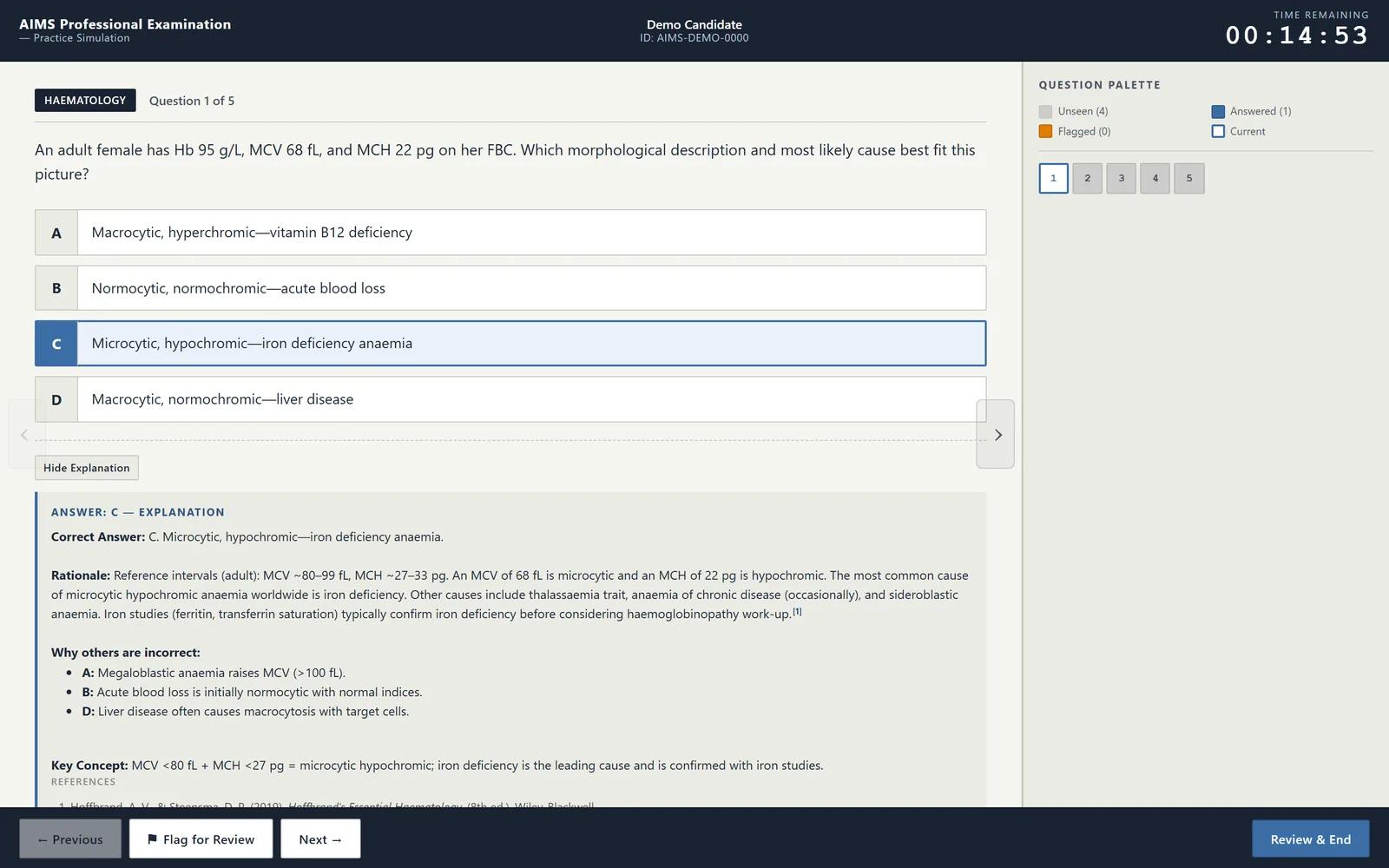
Plenty of candidates for the AIMS Professional Examination now ask a chatbot to explain a topic at midnight after a shift. That is a reasonable use. The risk is trusting it for the wrong job. This post sets out how ChatGPT for AIMS exam study helps, where it quietly misleads, and a workflow that keeps the benefit without the damage.
TerumoEdge, which publishes this blog, makes a simulator with curated explanations, so we have an interest. We say nothing here about artificial intelligence inside our product. The comparison is between a general chatbot and any fixed, reviewed source.
Is ChatGPT for AIMS exam prep a good idea?
A chatbot is a good tutor and a poor examiner. It can explain why a result looks the way it does, but it cannot tell you what AIMS will test, how AIMS scores, or whether its own answer is correct.
The exam is 150 single-response items in three hours across seven sections, and passing needs 75 correct plus the section minimums. A chatbot has no stake in those rules and no access to the real papers. AIMS states that completed examinations are not released under any circumstances, and that further sample questions will not be provided beyond the 25 in the pack. Whatever a chatbot generates is its own writing. A chatbot can even invent a convincing citation, a section number or a guideline title that does not exist, so a reference it gives you is a lead to check, never a proof.
That is fine for learning. It is not fine for measuring readiness, because you cannot tell how its items compare in difficulty, scope or accuracy with the real ones.
Where do chatbots genuinely help?
Chatbots help most with understanding mechanisms, rehearsing recall in conversation and reshaping material you already have. Used that way, they are a patient study partner.
Good uses include these:
- Mechanisms. Ask why a PCR cycle needs a denaturation step, or how a Westgard multirule catches a systematic shift, and ask for a simpler version if the first does not land.
- Socratic quizzing. Tell it to ask one question at a time, wait for your answer, then correct you.
- Converting the study guide. Paste a topic from the AIMS study guide and ask for ten short-answer prompts.
- Comparing near neighbours. Ask for the differences between two conditions or two methods in a table.
All four put you in control, and in all four you can check the output against a textbook or the pack. A habit that helps is to ask the chatbot to flag what it is least sure of, then check exactly those points first. It will not always be right about its own uncertainty, but the exercise keeps you reading critically. The help is real, provided you treat every answer as a draft to verify, not a fact. Keep a short list of what the chatbot taught you each week, and test yourself on that list with a fixed set of items a few days later. If you cannot recall it, the explanation felt clear but did not stick.
In what four ways do chatbots mislead?
Chatbots mislead through confident errors, unflagged foreign standards, nomenclature slips and stale exam facts. Each is quiet, which is why each is dangerous.
- Confident wrong answers. A chatbot writes a wrong explanation in the same assured tone as a right one. Nothing on the screen warns you.
- Standards from another country. Ask about blood bank practice and you may get one country's rules presented as universal. The AIMS pack recommends the ANZSBT Guidelines for Transfusion and Immunohaematology Laboratory Practice, so read that guideline for Australian specifics.
- Nomenclature slips. The study guide lists HGVS and ISCN nomenclature. These are exact notations, and a single character in a variant description or karyotype is the difference between correct and wrong.
- Stale or invented exam facts. Chatbots repeat the old body name, the old Genomic Pathology section name, and made-up pass rates. AIMS publishes no pass rates or examinee counts.
Can a chatbot write real AIMS questions?
No. A chatbot can write exam-style items, but it cannot write AIMS items, because no source for them is public. AIMS releases none of its completed papers and provides 25 sample questions in the pack.
Exam-style items can still be useful for recall. The risk is quality and calibration. Generated items often contain a second defensible answer, give away the key through the wording, or test trivia the exam never would. A curated bank is reviewed, fixed and answered the same way every time. That consistency lets you compare today's score with last month's.
A chatbot also has no concept of the passing rule, and no memory of your last session unless you paste it in. It will not warn you that you have answered nine Transfusion Science items and missed five, which is the thing the section minimum punishes. Section scoring, a clock and a fixed bank are what separate practice from conversation.
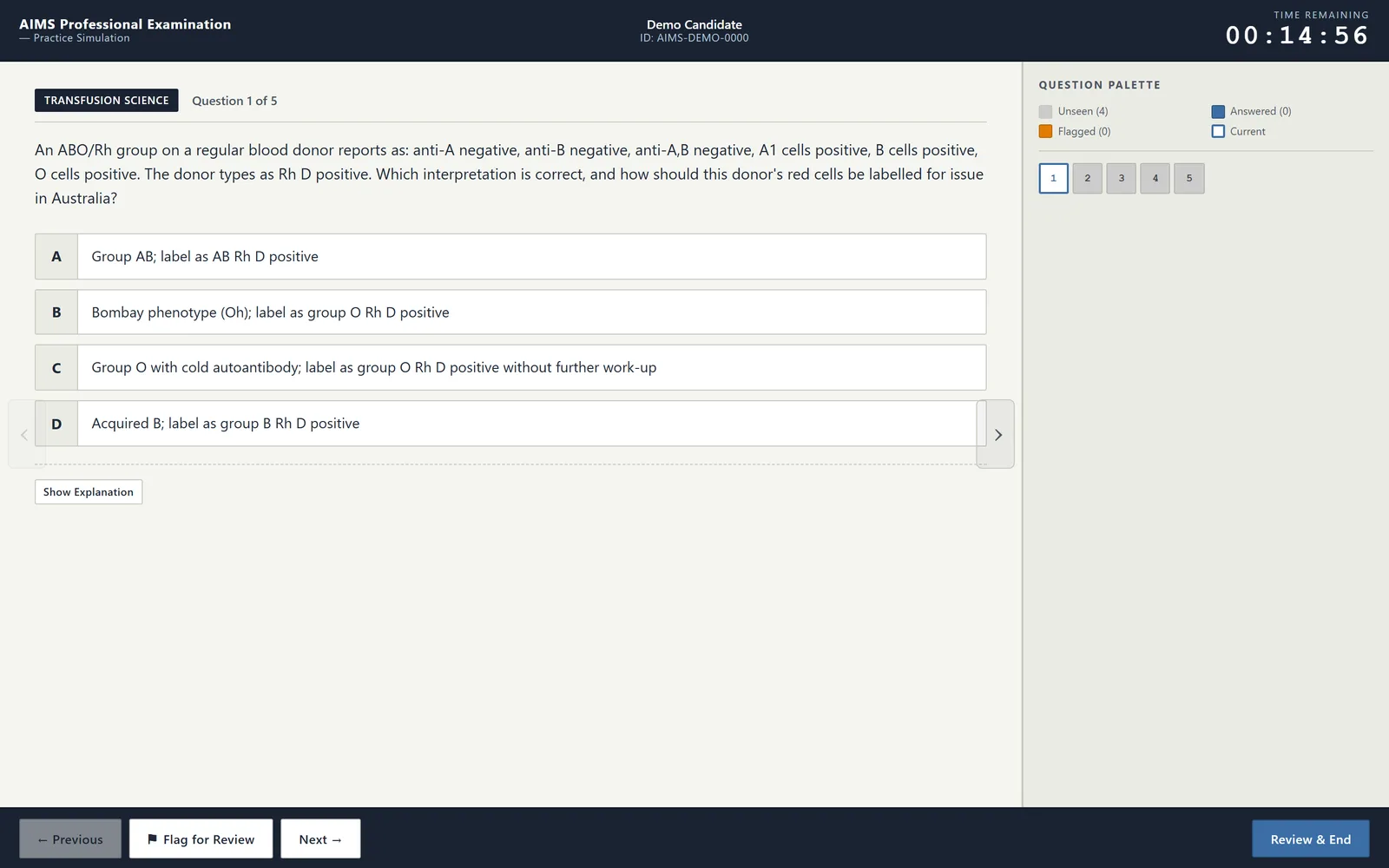
How do chatbot help and curated practice compare, task by task?
Each does some jobs well and some badly. Match the tool to the task.
| Task | A general chatbot | Curated timed practice |
|---|---|---|
| Explaining a mechanism | Strong, adjustable | Fixed explanation per item |
| Quizzing in conversation | Strong, flexible | Limited to the bank |
| A full 150-item, three-hour rehearsal | Poor; no clock or palette | Built for it |
| Section scores against the minimums | None unless you track it | A per-section report |
| Reliability of each answer | Varies; can be confidently wrong | Reviewed before release |
| Exam rules and facts | Often stale | Check the pack either way |
| Real AIMS items | Impossible | Impossible |
The last row matters. Neither a chatbot nor any simulator has real AIMS items, because none are released. TerumoEdge AIMS Ex-Sim has 5,981 four-option items with written English explanations. They are our own practice items, they are text-only, and we make no claim about artificial intelligence in the product.
What is a safe workflow?
A safe workflow uses the chatbot for understanding, the pack for facts and a fixed bank for measurement. The order matters.
- Start from the pack. Take the topic from the AIMS study guide, not from the chatbot's idea of what is important.
- Ask for explanation, not authority. Request the mechanism, then check it against a textbook or the named guideline.
- Verify standards and notation. For Transfusion Science, read the ANZSBT Guidelines. For molecular topics, check HGVS and ISCN notation against the guidance itself.
- Never take exam facts from it, and do not let it summarise the pack for you. Dates, minimums and format come from the pack and the AIMS website.
- Measure with a fixed bank. Run timed sets and full mocks, and read the explanation for each item. The free demo gives five items in each of the seven disciplines.
For a wider view of choosing tools, see how to choose an AIMS reviewer app, and for two sections where precision matters most, Transfusion Science and Molecular Pathology.
Frequently asked questions
Can ChatGPT write real AIMS questions?
No. AIMS does not release completed papers and states that further sample questions will not be provided beyond the 25 in the pack. A chatbot can write items in a similar style, but they are its own text, not AIMS's, and may contain errors or a second defensible answer.
Can I use a chatbot during the exam?
No. The sitting is online and remote proctored, with live supervision by webcam and mobile phone. The pack states no books, notes or headphones, and a secured browser called WebLock runs on the same computer. Read the current pack for every rule rather than relying on a summary.
Is a chatbot reliable on AIMS pass rates?
No. AIMS publishes no pass rates or examinee counts, so any figure a chatbot gives is invented or taken from an unreliable source. The rule it can state correctly is the published one: 75 of 150 plus the section minimums, with a scaled cut score of 500.
Sources
- AIMS Professional Examination Pack, Medical Laboratory Scientist ANZSCO 234611, v8.2 — Australian Institute of Medical and Clinical Scientists
- AIMS Professional Examination Pack, v8.1 (June 2025) — Australian Institute of Medical and Clinical Scientists
- Guidelines for Skills and Qualifications Assessment, MLS ANZSCO 234611 and MLT ANZSCO 311213, v18.2 — Australian Institute of Medical and Clinical Scientists
From the publisher
Sit it here first.
TerumoEdge AIMS Ex-Sim is a simulator for the AIMS Professional Examination: a full-screen, timed exam room, a 150-item Full Mock across all seven disciplines, and a written explanation for every item.
- 5,981 items across the seven AIMS disciplines
- 39 fixed sets in each discipline, 273 in all, plus random draws
- A 150-item, three-hour Full Mock with a per-discipline score report
- An English explanation with references for every item, not a bare answer key
Try the free AIMS simulator demo Five real items in each of the seven disciplines. No account needed.
About this article
Written by the TerumoEdge AIMS editorial team, who build the TerumoEdge AIMS Ex-Sim. Exam facts are checked against the AIMS Professional Examination Pack and the AIMS Guidelines for Skills and Qualifications Assessment, and every article lists its sources. How we write and check our articles.
First published .