The AIMS explained7-minute readFor AIMS exam candidates
The AIMS exam format: how many items, the seven sections, and why Genomic Pathology became Molecular Pathology
The AIMS exam format in full: 150 single-response items in three hours, the seven sections with item counts, and the Genomic to Molecular name change.
If you are planning to work in Australia as a Medical Laboratory Scientist, the AIMS exam format is the first thing to pin down, because every review decision follows from it. How many items are there, how long do you get, and how are the sections weighted? Many candidates have only seen the paper described in forum posts, and those descriptions drift.
This post gives you the format as the Australian Institute of Medical and Clinical Scientists (AIMS) publishes it in its current exam pack. We cover the item count, the clock, the seven sections with their exact sizes, which sections are compulsory, and the section that changed its name. For how the paper is scored, we link to a separate post.
One caution before we start. Not every applicant sits this paper at all, and we explain who does in who sits the AIMS Professional Examination.
What is the AIMS exam format at a glance?
The AIMS Professional Examination is a multiple-choice paper of 150 single-response questions, to be completed in three hours. "Single response" means each question has one best answer to choose. AIMS describes the paper in its Professional Examination Pack for Medical Laboratory Scientists (S1).
The exam is held twice a year, in March and September, and it is conducted online using remote proctored software. A proctor supervises you live through a webcam and a mobile phone (S1). AIMS also lists these sittings on its Professional Examinations for Migration page (S5).
That is the whole structure: one paper, one sitting, one three-hour clock. There are no essay questions in this paper and no separate practical component. Our post on online exam rules covers what happens on the day, and the schedule post covers the calendar.
How many items are in each AIMS section?
The 150 items are divided across seven sections, and the split is fixed: Anatomical Pathology 14, Chemical Pathology 30, Molecular Pathology 16, Haematology 30, Immunopathology 14, Medical Microbiology 26 and Transfusion Science 20. These counts come from the exam pack (S1), and the earlier June 2025 pack gives the same distribution (S2).
The table below adds each section's share of the 150 items. We calculated the percentages ourselves from AIMS's counts.
| Section | Items | Share of 150 | Status under the passing rule (S1) |
|---|---|---|---|
| Chemical Pathology | 30 | 20.0% | Compulsory |
| Haematology | 30 | 20.0% | Compulsory |
| Medical Microbiology | 26 | 17.3% | Compulsory |
| Transfusion Science | 20 | 13.3% | Compulsory |
| Molecular Pathology | 16 | 10.7% | Either-or with Immunopathology |
| Anatomical Pathology | 14 | 9.3% | Compulsory |
| Immunopathology | 14 | 9.3% | Either-or with Molecular Pathology |
The counts add up to 150. The two 30-item sections alone account for 60 questions, which is why they deserve the most review hours but never all of them.
Which AIMS sections are compulsory?
Five sections are compulsory: Anatomical Pathology, Chemical Pathology, Haematology, Medical Microbiology and Transfusion Science. The exam pack says these asterisked disciplines "MUST be passed", meaning at least 50% in each, and that a pass mark of 50% in either Molecular Pathology or Immunopathology must also be achieved (S1).
So the structure is five fixed floors plus one choice. You can fail Molecular Pathology and still pass if you clear 50% in Immunopathology, or the other way round. Failing both is not allowed.
Compulsory does not mean heavy. Anatomical Pathology has only 14 items, yet a weak score there fails the whole paper regardless of your total. The floors are about breadth, which is the reason a candidate cannot lean on one strong section.
The complete rule, including the overall mark of 75 correct, sits in our post on the AIMS passing score and results. We keep it there so the rule is stated once, in one place.
Is it Genomic Pathology or Molecular Pathology?
The current name is Molecular Pathology. The June 2025 and March 2026 exam packs use "Molecular Pathology" (S2, S1), while the June 2024 assessment guideline and older pack versions still say "Genomic Pathology" (S3).
This matters mostly when you choose study material. A reviewer or a set of notes written against the older documents may label the section "Genomic Pathology", and a search for the current name could miss it. The section is the same 16 items in both cases.
AIMS's study guide for the section lists topics such as PCR, Sanger sequencing, NGS, Bcr-Abl, BRAF V600E, JAK2 V617F, and HGVS and ISCN nomenclature (S2). Those are worth checking yourself against early, since molecular methods and variant nomenclature are areas where some candidates find the pack's list longer than their bench experience. Our Molecular Pathology review post turns the list into a two-week block.
Our simulator labels this discipline "Genomic / Molecular Pathology" so that both old and new names lead you to the right place.
What level is the AIMS exam set at?
The exam is set at the level expected of a professional Medical Laboratory Scientist with at least two years of full-time (or part-time equivalent) postgraduate professional experience (S1). It is not written for a fresh graduate, and it is not written for a specialist in one discipline.
That framing explains the style of the paper. You are expected to interpret results, choose a next step and recognise a quality problem, which is closer to what a working scientist does than to recalling a definition.
It also lines up with who is eligible. The Option 2 pathway asks for at least two years of postgraduate professional experience in a medical pathology laboratory, one year of it within the five years before applying (S3). We explain the pathway in our post on Stage 1 for Filipino medtechs.
A practical reading: if your bench rotation has kept you in one or two departments, expect the other sections to feel less familiar than the exam's level assumes. That is a reason to measure each section separately early rather than to review everything evenly.
What does the format mean for your review hours?
The format asks for three things: coverage of seven sections, stamina for three uninterrupted hours, and a clear floor in each compulsory section. Review time should follow all three.
Start by splitting hours roughly by item share, then add time to any section where you score below 50% in practice. A section with 14 items can sink the paper just as surely as one with 30. Next, practise the whole paper in one sitting, because 150 questions in three hours leaves about 72 seconds per item if you spend the time evenly, and the paper has no scheduled breaks.
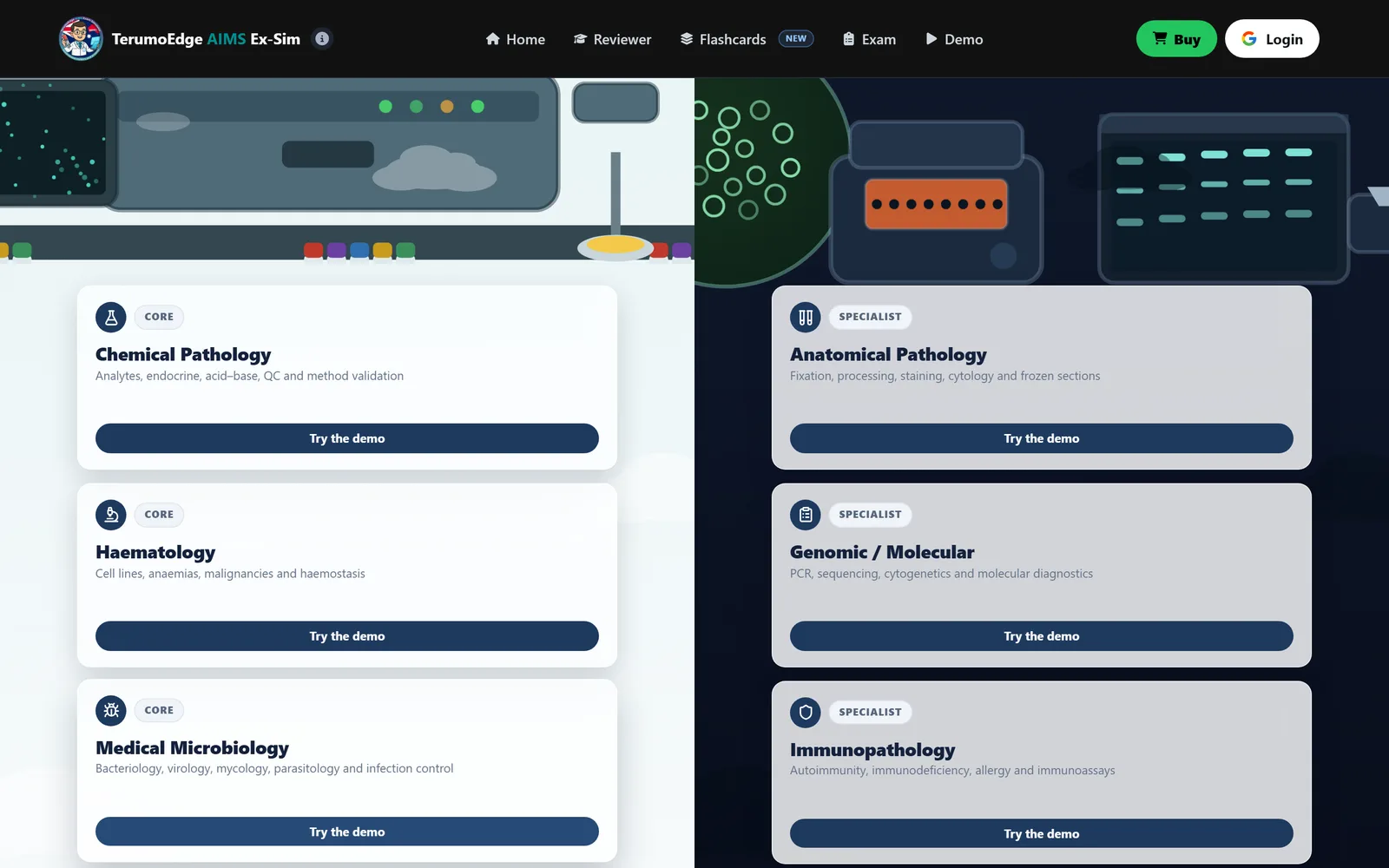
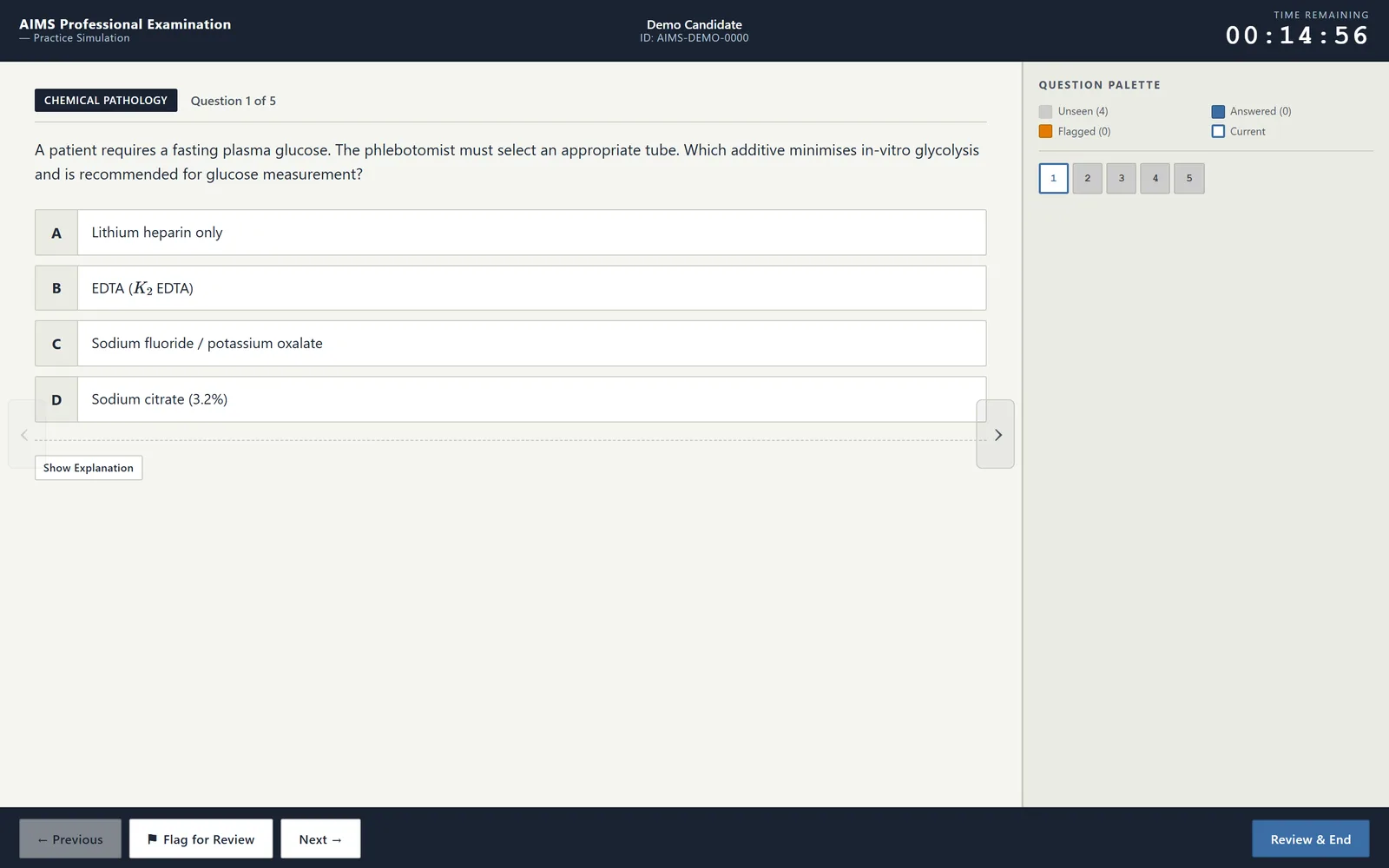
You can try discipline practice in our free demo, which gives five real items in each of the seven disciplines. The Full Mock is 150 items in three hours across all seven disciplines. It does not copy AIMS's section counts, and it reports raw marks rather than AIMS's scaled score, so treat it as stamina and breadth practice.
For a week-by-week plan, see our 16-week study plan.
Frequently asked questions
How many questions are in the AIMS exam?
The AIMS Professional Examination has 150 single-response multiple-choice questions. They are split across seven sections: Anatomical Pathology 14, Chemical Pathology 30, Molecular Pathology 16, Haematology 30, Immunopathology 14, Medical Microbiology 26 and Transfusion Science 20 (S1).
How long is the AIMS exam?
You have three hours to complete the 150 questions (S1). If you spread the time evenly, that is 72 seconds per question. The exam is conducted online with remote proctoring, and breaks are not available unless approved (S2).
Is Genomic Pathology still a section in the AIMS exam?
The section is now called Molecular Pathology in the current exam pack, with 16 items (S1). "Genomic Pathology" is the older name that still appears in the June 2024 assessment guideline (S3) and in older materials. Treat the two names as the same section, but use the current one when searching.
Is the AIMS exam multiple choice?
Yes. Every question is a single-response multiple-choice item, so you select one answer per question (S1). The separate Special Professional Examination, which applies to a different pathway, is a written paper with essay and short-answer questions (S4).
Sources
- Medical Laboratory Scientist Professional Examination Pack v8.2 (03/2026) — Australian Institute of Medical and Clinical Scientists
- Medical Laboratory Scientist Professional Examination Pack v8.1 (06/2025) — Australian Institute of Medical and Clinical Scientists
- Guidelines for Skills and Qualifications Assessment, MLS and MLT, v18.2 (06/2024) — Australian Institute of Medical and Clinical Scientists
- Special Professional Examination Pack v1.0 (07/2023) — Australian Institute of Medical and Clinical Scientists
- Professional Examinations for Migration — Australian Institute of Medical and Clinical Scientists
From the publisher
Sit it here first.
TerumoEdge AIMS Ex-Sim is a simulator for the AIMS Professional Examination: a full-screen, timed exam room, a 150-item Full Mock across all seven disciplines, and a written explanation for every item.
- 5,981 items across the seven AIMS disciplines
- 39 fixed sets in each discipline, 273 in all, plus random draws
- A 150-item, three-hour Full Mock with a per-discipline score report
- An English explanation with references for every item, not a bare answer key
Try the free AIMS simulator demo Five real items in each of the seven disciplines. No account needed.
About this article
Written by the TerumoEdge AIMS editorial team, who build the TerumoEdge AIMS Ex-Sim. Exam facts are checked against the AIMS Professional Examination Pack and the AIMS Guidelines for Skills and Qualifications Assessment, and every article lists its sources. How we write and check our articles.
First published .