
Guides7-minute readFor AIMS candidates worried about Molecular Pathology
AIMS Molecular Pathology and Immunopathology: the study-guide topics, and why the either-or rule is no excuse to skip one
Review AIMS Molecular Pathology: PCR, Sanger, NGS, Bcr-Abl, BRAF V600E, JAK2 V617F, HGVS and ISCN, plus Immunopathology and the either-or rule explained.
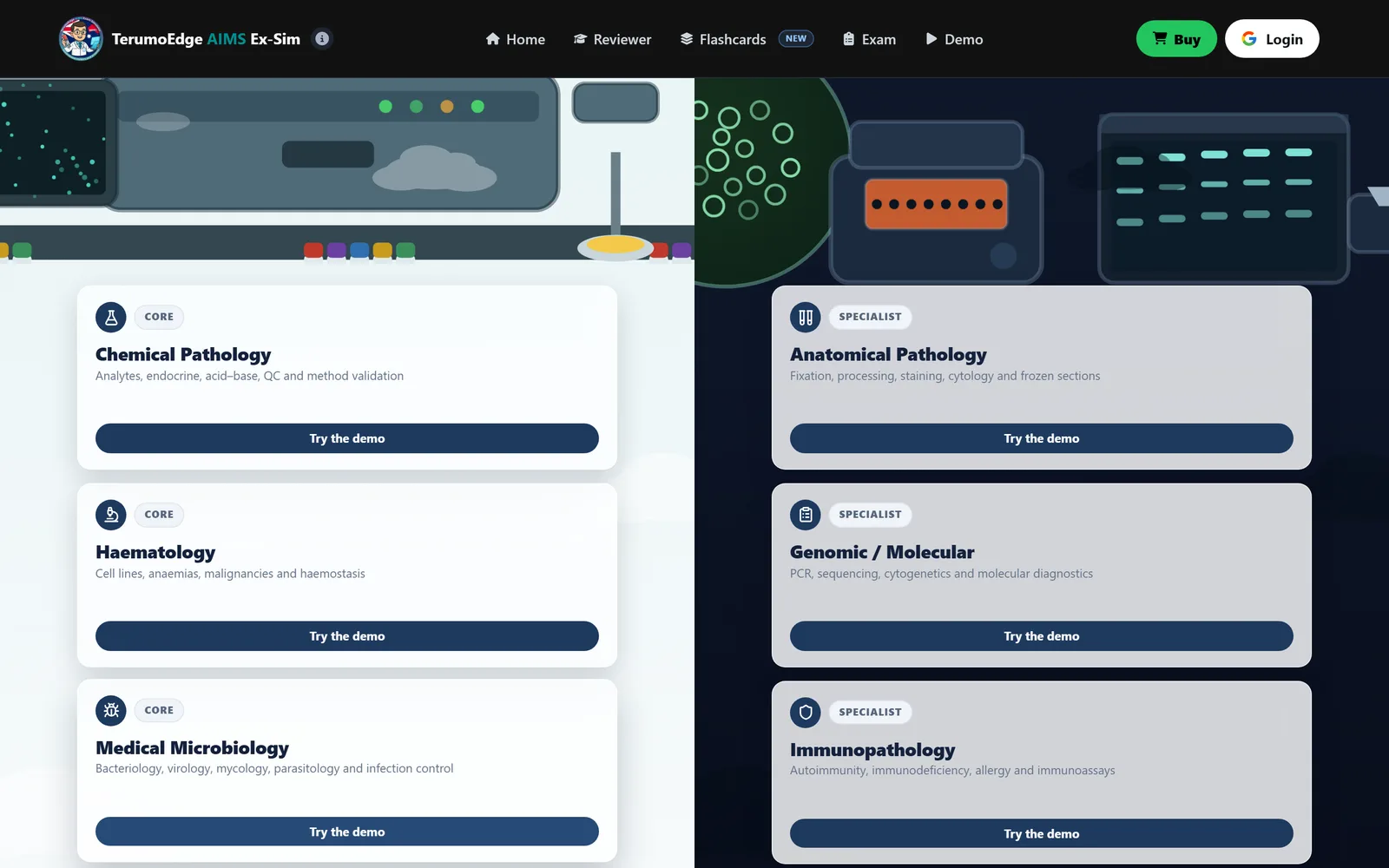
AIMS Molecular Pathology has 16 items and Immunopathology has 14, and the pass rule treats them as a pair: you need 50% in at least one of the two. Many candidates read that as permission to drop one section entirely. That reading is risky, and this guide explains why, then shows how to review the study-guide topics for the section many candidates feel least sure of.
Only Option 2 applicants sit this paper, as our guide to who sits the exam explains. If that is you, the sections below cover the rule, the topics the AIMS study guide lists, a technique-by-technique method, and a two-week block.
What is the either-or rule, and what is its trap?
The either-or rule says you must reach 50% in Molecular Pathology or in Immunopathology, not necessarily both. The AIMS Professional Examination Pack states that a pass mark of 50% in either Molecular Pathology or Immunopathology must be achieved, alongside at least 50% in each of the five asterisked disciplines and 75 correct answers overall (AIMS exam pack v8.2).
The trap is the overall total. The two sections hold 30 items between them, 20% of the paper. Skip one entirely and you can only reach the 75 you need by scoring very high elsewhere. Even a half-prepared second section lifts your total by a handful of marks, and those marks are often what separate 72 from 75.
The floors are simple arithmetic: 8 of 16 in Molecular Pathology, or 7 of 14 in Immunopathology. Prepare both, then decide on the night which is your safer pass. Our passing score guide walks through the full rule with hypothetical candidates.
What does the AIMS Molecular Pathology study guide list?
The AIMS study guide lists PCR, Sanger sequencing, NGS, Bcr-Abl, BRAF V600E, JAK2 V617F, and HGVS and ISCN nomenclature for Molecular Pathology (AIMS exam pack v8.1). Those eight names are the topics worth extra attention early, so check yourself against them before you read anything else.
The section was named Genomic Pathology in older documents, so you may meet that name in an older reviewer; the current packs say Molecular Pathology, as we explain in the format post.
The table below sets each listed topic against what you should be able to do and one way to drill it.
| Study-guide topic | What you should be able to do | How to drill it |
|---|---|---|
| PCR | Explain the cycle, the controls and contamination | Write the steps and name one failure per step |
| Sanger sequencing | Explain chain termination and read a trace | Interpret a described trace with a mixed peak |
| NGS | Outline library preparation, depth and variant fraction | Match each quality metric to a problem |
| Bcr-Abl | Link the fusion to CML and to monitoring | State the test used and what a rising level means |
| BRAF V600E | Name the change and where it is tested | Write it in HGVS form from memory |
| JAK2 V617F | Link it to the myeloproliferative neoplasms | List which diseases carry it and which do not |
| HGVS and ISCN | Read and write the nomenclature | Convert five descriptions each way |
How do you review amplification and sequencing?
Review amplification and sequencing by listing the steps, the controls and what goes wrong at each stage. Items rarely ask for a definition; they describe a result and ask for the cause.
For PCR, the cycle is denaturation at about 94 to 95 °C, annealing at a primer-dependent temperature and extension at about 72 °C with a thermostable polymerase. Know the controls: a no-template control detects contamination, a positive control shows the reaction works, and an internal control shows the sample did not inhibit it. Amplicon carryover is the classic contamination source. In real-time PCR, a lower Ct means more starting template. RNA targets need reverse transcription first.
For Sanger sequencing, fluorescent dideoxynucleotides stop chain extension, and capillary electrophoresis reads the fragment lengths. A mixed trace beneath the main peaks can mean a heterozygous variant, and Sanger finds a low-level variant poorly, roughly below 15 to 20% of the sample.
For NGS, learn library preparation, amplification, sequencing, depth of coverage, variant allele fraction and basic quality scores. Know why depth matters for low-level variants.
How should you learn the named mutations and nomenclature?
Learn the named mutations as a short list of fact sets, each with a gene, a change, a disease link and a test. The BCR-ABL1 fusion comes from t(9;22), the Philadelphia chromosome, and is central to chronic myeloid leukaemia, where quantitative RT-PCR is used to monitor response. BRAF V600E is a valine-to-glutamate change at codon 600, found in melanoma, papillary thyroid carcinoma, some colorectal cancers and hairy cell leukaemia. JAK2 V617F is a valine-to-phenylalanine change at codon 617, found in most polycythaemia vera and in around half of essential thrombocythaemia and primary myelofibrosis.
Nomenclature is where small slips cost marks. In HGVS, "c." marks a coding DNA change and "p." a protein change, so BRAF V600E is c.1799T>A, p.(Val600Glu). JAK2 V617F is c.1849G>T, p.(Val617Phe). Check the reference sequence, the numbering and the arrow.
In ISCN, a karyotype lists the chromosome count, the sex chromosomes, then the abnormalities: 46,XY,t(9;22)(q34;q11.2) describes a male with the Philadelphia translocation, and 47,XX,+21 describes a female with trisomy 21.
How should you review Immunopathology in the same block?
Review Immunopathology by method and by disease group, because both appear in items. For methods, know ELISA formats and their controls, immunofluorescence patterns for antinuclear antibodies (homogeneous, speckled, centromere, nucleolar), serum protein electrophoresis with immunofixation, flow cytometry panels and complement testing. Know assay problems, such as the high-dose hook effect in sandwich assays, where an extremely high analyte level reads falsely low, and how dilution reveals it.
For disease groups, learn hypersensitivity types I to IV with an example of each, primary and secondary immunodeficiency testing, autoimmune disease serology (for instance anti-dsDNA with lupus, and anti-CCP with rheumatoid arthritis) and the principles of HLA typing in transplantation.
Immunopathology has 14 items, so the section is small, but the content overlaps with Haematology and Transfusion Science, particularly antibodies, complement and cell markers. That overlap makes revision time here do double duty. Our bank holds 597 items in Genomic / Molecular Pathology and 597 in Immunopathology, which is the size of our practice bank, not AIMS's count.
What does a two-week block look like?
A two-week block spends week one on the Molecular Pathology list and week two on Immunopathology plus a timed check of each. In week one, take PCR and Sanger on days one and two, NGS on day three, the named mutations on day four and nomenclature on day five. Spend the weekend writing HGVS and ISCN strings from memory, then correcting them.
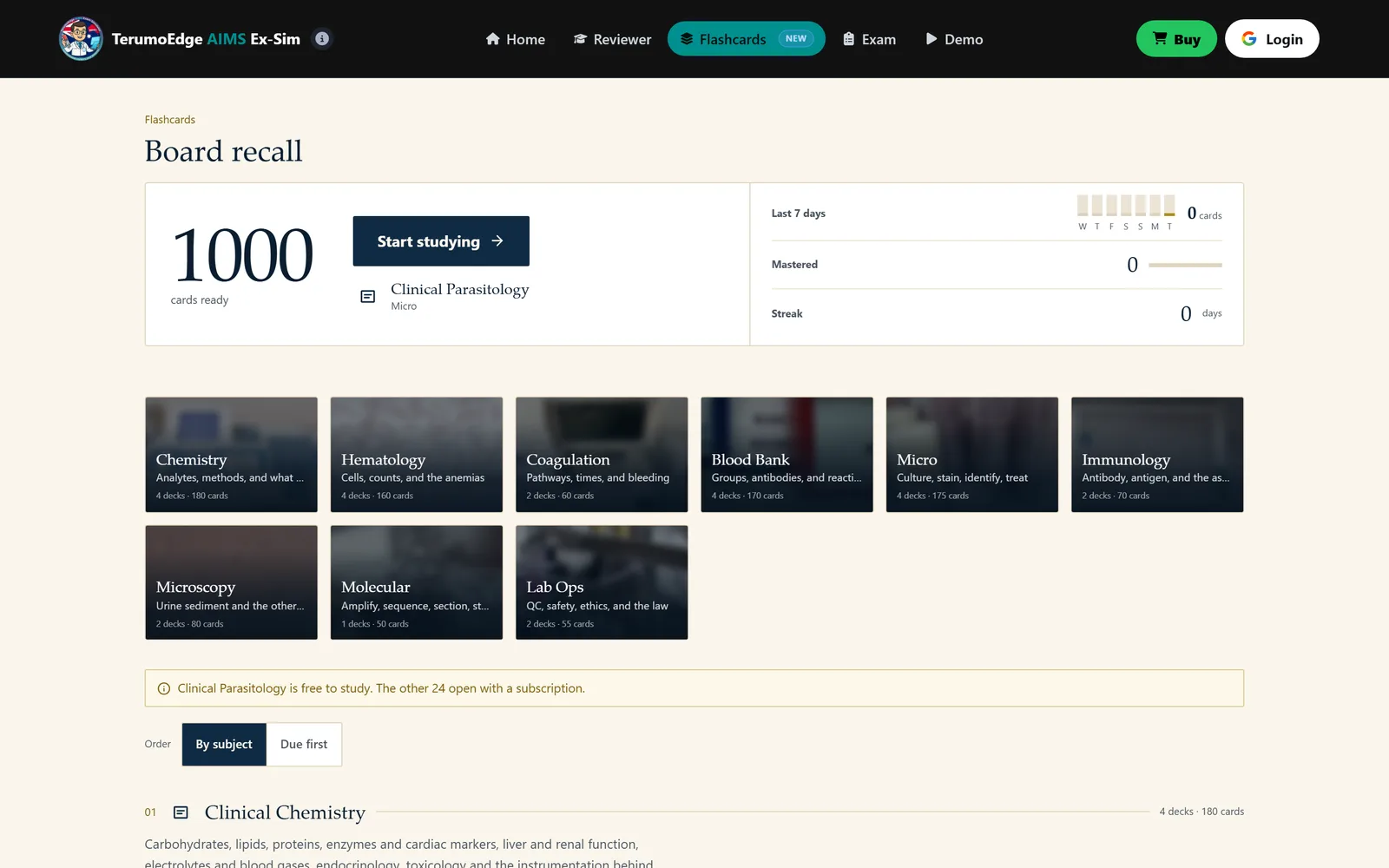
In week two, take immunoassay methods, autoantibody serology and hypersensitivity, then finish with two timed sets: 16 items in about 19 minutes for Molecular Pathology, and 14 items in about 17 minutes for Immunopathology, at the 72 seconds per item pace from our time management guide. Use flashcards for the mutation fact sets and the free demo to see how a Genomic / Molecular item is explained.
Decide at the end which section is your safer pass, but keep reviewing both. The one you do not rely on should still add marks toward the 75.
Frequently asked questions
Do I have to pass both Molecular Pathology and Immunopathology?
No. The AIMS rule requires at least 50% in either Molecular Pathology or Immunopathology, not both. Both sections still count toward the 75 of 150 correct needed overall, so preparing only one limits your total as well as your options.
What molecular topics does the AIMS test?
The AIMS study guide lists PCR, Sanger sequencing, NGS, Bcr-Abl, BRAF V600E, JAK2 V617F, and HGVS and ISCN nomenclature for Molecular Pathology. The guide in your current pack is the authority, so check it for any changes before you build your review around this list.
Is Genomic Pathology the same as Molecular Pathology?
Genomic Pathology is the older name. The AIMS guidelines of June 2024 and pack v8.0 used it, while the current packs say Molecular Pathology. When you use an older reviewer, expect the old name on its section headings and check the topic list against your current pack.
Sources
- AIMS Professional Examination Pack, Medical Laboratory Scientist ANZSCO 234611, v8.2 — Australian Institute of Medical and Clinical Scientists
- AIMS Professional Examination Pack, v8.1 (study guide) — Australian Institute of Medical and Clinical Scientists
- Guidelines for Skills and Qualifications Assessment, MLS ANZSCO 234611 and MLT ANZSCO 311213, v18.2 — Australian Institute of Medical and Clinical Scientists
From the publisher
Sit it here first.
TerumoEdge AIMS Ex-Sim is a simulator for the AIMS Professional Examination: a full-screen, timed exam room, a 150-item Full Mock across all seven disciplines, and a written explanation for every item.
- 5,981 items across the seven AIMS disciplines
- 39 fixed sets in each discipline, 273 in all, plus random draws
- A 150-item, three-hour Full Mock with a per-discipline score report
- An English explanation with references for every item, not a bare answer key
Try the free AIMS simulator demo Five real items in each of the seven disciplines. No account needed.
About this article
Written by the TerumoEdge AIMS editorial team, who build the TerumoEdge AIMS Ex-Sim. Exam facts are checked against the AIMS Professional Examination Pack and the AIMS Guidelines for Skills and Qualifications Assessment, and every article lists its sources. How we write and check our articles.
First published .