
Your situation8-minute readFor AIMS candidates who did not pass
AIMS exam retake: how to rebuild from what your result tells you
An AIMS exam retake starts with your result letter. Work out which rule you missed, check the next closing date and Stage 1 validity, and rebuild in 12 weeks.
If your AIMS result was a Fail, you are probably tired, disappointed and unsure whether to try again. That is a normal reaction after a long review, and it does not say anything about your skill at the bench. This post is about what you can do with the little information the result gives you.
An AIMS exam retake begins with a short, honest debrief. We cover what the letter shows, which rule you may have missed, how to time the next attempt, and a 12-week rebuild. We have found no published resit rules, so we say what to confirm with AIMS and avoid guessing.
What does your AIMS result letter actually tell you?
The letter tells you whether you passed or failed and, if you failed, which compulsory disciplines you did not pass. That is all AIMS says it reports. The pack states the result as Pass or Fail plus any failed compulsory disciplines, and it adds that completed examinations are not released under any circumstances (AIMS Professional Examination Pack v8.2).
So you will not see which items you missed, and you will not see your answers. The pack also describes a Rasch-based scaled score from 0 to 1000 with a cut score of 500, but it does not say you receive a per-section scaled score or give a conversion to raw marks. We make no claim about a conversion.
What you can use is your memory of how the sitting felt, your pre-exam mock results by section, and the letter's list of failed disciplines. Write these down this week while the sitting is fresh: which sections felt thin, where time ran short, what the room and proctoring were like. Do not reconstruct questions. Record impressions, not items.
Which rule did you miss?
There are three ways to fail, and the letter usually points to one. Check them in order. The rule, as stated by AIMS, is at least 50% in each of Anatomical Pathology, Chemical Pathology, Haematology, Medical Microbiology and Transfusion Science, 50% in either Molecular Pathology or Immunopathology, and 75 of 150 answered correctly overall.
| What the letter shows | Likely cause | Fix |
|---|---|---|
| Fail, with one or more compulsory disciplines listed | A section fell under its 50% floor, whatever the total | Rebuild the named section first, using timed sets and explanation review |
| Fail, no compulsory discipline listed | Possibly the overall 75 of 150 was not reached, or the Molecular-or-Immunopathology rule was not met; the letter does not say which | Raise overall accuracy through full-length mocks; check both specialist sections |
| Fail, with disciplines listed and a weak total | More than one rule may apply | Fix the named sections, then build breadth across all seven |
The floors in questions are 7 of 14 for Anatomical Pathology, 15 of 30 for Chemical Pathology, 15 of 30 for Haematology, 13 of 26 for Medical Microbiology and 10 of 20 for Transfusion Science. For the either-or pair, Molecular Pathology needs 8 of 16 and Immunopathology 7 of 14.
The full arithmetic is in our passing score post. One caution: the letter may not tell you whether the Molecular-or-Immunopathology rule was the issue, so do not rule it out.
How do you read each failure shape?
Each shape asks for a different kind of repair, so match the plan to the shape instead of reviewing everything again. A failed compulsory floor is a local problem. A shortfall on the total is usually a pace or breadth problem. A missed either-or rule means both specialist sections were too weak.
If a floor failed, the section is small enough to rebuild. Anatomical Pathology has only 14 items, so seven misses were enough to fail it regardless of your total. Our post on Medical Microbiology and Anatomical Pathology covers those two sections.
If the total fell short, the cause is often the format. Three hours for 150 items is 72 seconds per item, and the pack says there are no bathroom or rest breaks unless approved. Candidates who read for months but seldom sat a full paper may find their accuracy falls late in the sitting. That is a hypothesis for you to test with a timed mock, not a statistic.
If neither Molecular Pathology nor Immunopathology reached 50%, choose one and bring it to its floor. You need only one of them, but it must be a real pass. Both still count toward the 75 overall.
When can you sit again?
Check the closing date for the next sitting and read AIMS's resit rules before you commit. Sittings are held in March and September. Applications close at 4pm by email on 1 December for the March sitting and 10 July for the September sitting. Payment is due 31 January and 8 August. These dates come from the March 2026 pack.
The sources we relied on contain no retake limit, no waiting period and no resit rule, and we will not guess at them. Ask AIMS directly what applies to you, including whether any waiting period, extra fee or paperwork follows a Fail.
Two timing facts matter. First, your Stage 1 letter is valid for three years, and a new application must arrive within that validity, so look at the date on your letter. Second, a deferral must be requested before the payment deadline, which matters if you apply and then decide you need more time.
Work backwards from the closing date, as in the schedule post. A twelve-week rebuild fits between a result and a closing date only if you start soon. If the date is too tight, taking the later sitting is a legitimate choice. Rushing a second attempt on four weeks of review rarely changes the method.
How should an AIMS exam retake change the method, not only the hours?
Change the method, because the same routine usually produces the same result. Ask what your first review lacked. A common pattern is plenty of reading and untimed question practice, with few full-length mocks and little explanation review. We do not have data on candidates, so treat that as a prompt to check your own history.
Three changes make a real difference. First, sit full 150-item mocks under exam conditions, at least every second week. The TerumoEdge Full Mock has 150 items across the seven disciplines and reports raw marks by discipline, so you can compare sections against the 50% floors. It does not reproduce AIMS's scaled score.
Second, read every explanation, including for correct answers. An item you got right for the wrong reason is a future miss. Third, keep an error log by topic, not by question, and review it weekly. Patterns will show up in three or four weeks.
What does a 12-week rebuild look like?
A 12-week rebuild spends the first weeks on the sections that failed, the middle on mixed timed practice and the last on full mocks and the trial exam. The twelve weeks are our template, not an AIMS figure, and you should shorten or extend it to fit the next closing date.
| Weeks | Focus | Target |
|---|---|---|
| 1 | Debrief and baseline: write your impressions, then sit one full mock | A section-by-section score against the 50% floors |
| 2 to 5 | Rebuild the failed or weakest compulsory sections with timed sets and explanation review | Each of those sections clear of its floor with margin on two sets |
| 6 to 8 | Broaden across all seven disciplines; bring one of Molecular Pathology or Immunopathology well over 50% | Mixed timed sets with a stable pace |
| 9 to 11 | Full-length mocks every week or two; practise without notes, headphones or a calculator | Finish 150 items in three hours with a review buffer |
| 12 | Practice test, trial exam and taper | A calm set-up and no new material |
The June 2025 pack says the practice test and trial exam fall in the two weeks before the official exam, so check the current pack before you lock in week 12. Our study plan post has a longer version for a first attempt.
If you also work shifts, scale the weekly hours to your roster. Consistency beats volume.
What if you decide not to retake?
You are allowed to decide differently, and it is better to decide than to drift. The AIMS guideline says applicants who do not qualify for, or fail, the exam "may be assessed as suitable for" Medical Laboratory Technician, ANZSCO 311213 (AIMS Guidelines, GAPSQ v18.2). The word is "may", and we cannot say whether it applies to you.
Be careful with the rest. A pass does not grant a licence, because Australia has no statutory registration for Medical Laboratory Scientists, and the guideline says the AIMS letter "does not guarantee the awarding of any points". Decisions about your future should rest on conversations with AIMS and, where relevant, official migration advice, not on this blog.
Whatever you choose, give yourself two weeks of rest first. A rushed decision made on the day of the result is seldom the one you would pick a month later.
Frequently asked questions
How many times can I retake the AIMS exam?
The sources we used do not state a retake limit, a waiting period or a resit fee. We will not guess. Ask AIMS directly what applies to you, and check the current exam pack and the AIMS website before you plan the next attempt.
Can I see which questions I got wrong?
No. The pack states that completed examinations are not released under any circumstances. Your result is Pass or Fail plus any failed compulsory disciplines. Use that, your mock results by section and your own notes on how the sitting went to plan your review.
Is my Stage 1 letter still valid?
The Stage 1 letter is valid for three years, and a new exam application must arrive within that period. Look at the date on your letter and count forward. If you are near the end, ask AIMS what you would need to do.
Does a Fail mean I cannot work in Australia as a laboratory professional?
We cannot answer that, and this blog does not give migration or employment advice. The AIMS guideline says that applicants who fail "may be assessed as suitable for" Medical Laboratory Technician, ANZSCO 311213. Ask AIMS about your situation.
Sources
- AIMS Professional Examination Pack, Medical Laboratory Scientist ANZSCO 234611, PEP v8.2 (03/2026) — Australian Institute of Medical and Clinical Scientists
- AIMS Professional Examination Pack, PEP v8.1 (06/2025) — Australian Institute of Medical and Clinical Scientists
- Guidelines for Skills and Qualifications Assessment, MLS ANZSCO 234611 and MLT ANZSCO 311213, GAPSQ v18.2 (06/2024) — Australian Institute of Medical and Clinical Scientists
From the publisher
Sit it here first.
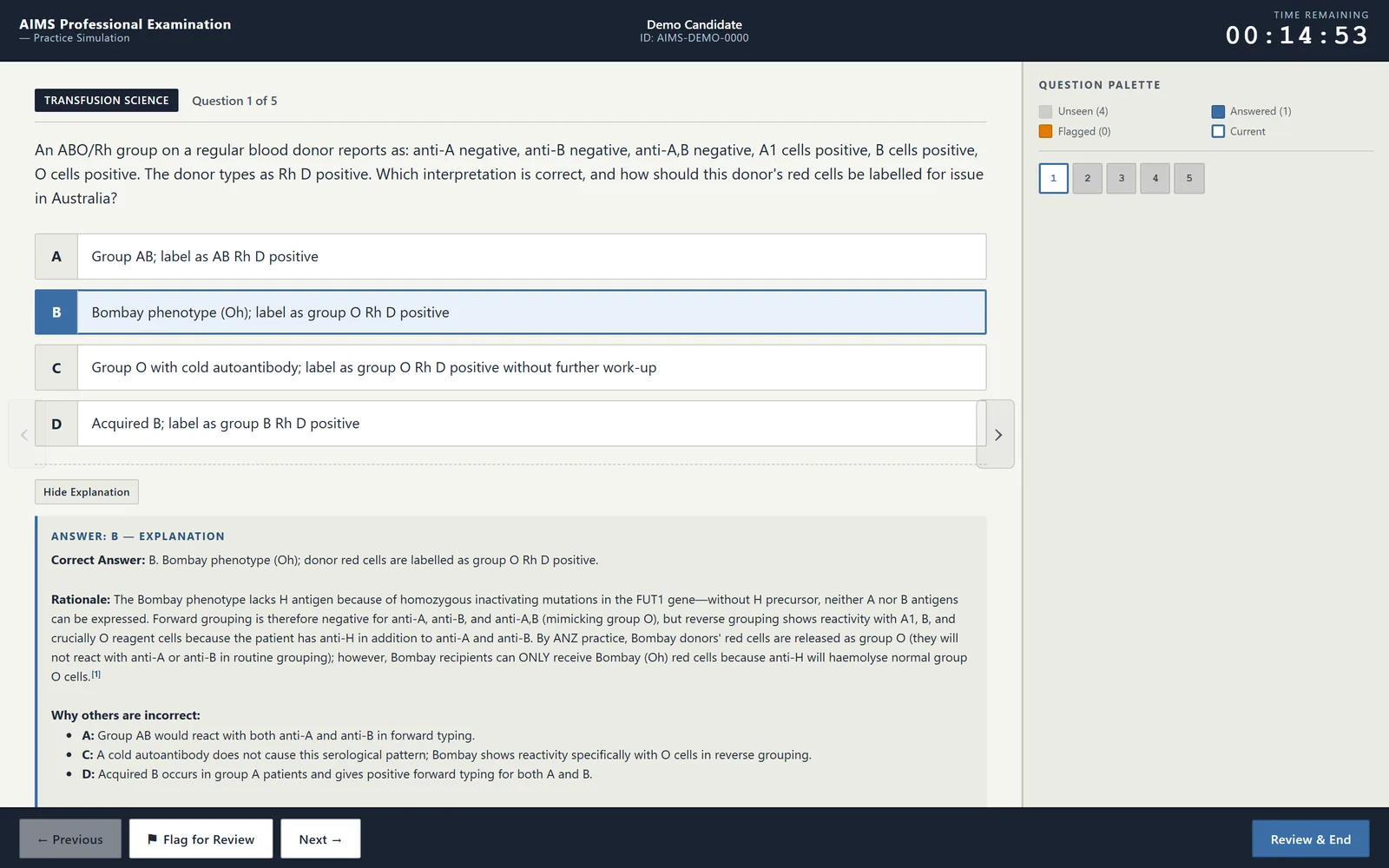
TerumoEdge AIMS Ex-Sim is a simulator for the AIMS Professional Examination: a full-screen, timed exam room, a 150-item Full Mock across all seven disciplines, and a written explanation for every item.
- 5,981 items across the seven AIMS disciplines
- 39 fixed sets in each discipline, 273 in all, plus random draws
- A 150-item, three-hour Full Mock with a per-discipline score report
- An English explanation with references for every item, not a bare answer key
Try the free AIMS simulator demo Five real items in each of the seven disciplines. No account needed.
About this article
Written by the TerumoEdge AIMS editorial team, who build the TerumoEdge AIMS Ex-Sim. Exam facts are checked against the AIMS Professional Examination Pack and the AIMS Guidelines for Skills and Qualifications Assessment, and every article lists its sources. How we write and check our articles.
First published .