
Guides7-minute readFor AIMS candidates balancing the compulsory sections
AIMS Medical Microbiology and Anatomical Pathology: two compulsory sections that are easy to underweight
Review AIMS medical microbiology (26 items) and Anatomical Pathology (14): why the 50% floors bite, identification flowcharts, fixation to stain, cytology.
AIMS medical microbiology and Anatomical Pathology are two compulsory sections, and they are easy to underweight for opposite reasons. Microbiology has 26 items, a large section that feels like familiar bench work, so it gets less time than it needs. Anatomical Pathology has only 14 items, so it feels too small to worry about, yet it has a hard floor all the same.
Only Option 2 applicants sit the exam; our guide to who sits it explains the three options. This post covers how to review both sections: the arithmetic of the floors, then a method for each, and a two-week block.
Why is a small section a hard floor?
A small compulsory section is a hard floor because the pass rule gives it no slack. The AIMS Professional Examination Pack requires at least 50% in each of five disciplines, including Medical Microbiology and Anatomical Pathology (AIMS exam pack v8.2). In Medical Microbiology that means 13 of 26. In Anatomical Pathology it means 7 of 14.
Count the margin. In Anatomical Pathology, seven misses leaves 7 correct and passes the floor, but eight misses leaves 6 and fails it, whatever you score elsewhere. With 14 items, two or three careless answers are a large fraction of the section, so a single weak topic matters more than it would in a 30-item section.
The overall total still applies too, at 75 of 150. We set the full rule out in our passing score post. Give the small section a real block, not leftover hours.
| Section | Items | Correct needed for 50% | Efficient method |
|---|---|---|---|
| Medical Microbiology | 26 | 13 | Identification flowcharts, then susceptibility logic |
| Anatomical Pathology | 14 | 7 | Follow the tissue from fixation to stain |
How do you learn AIMS medical microbiology as a flowchart?
Learn identification as a flowchart that starts at the Gram stain and ends at a confirmatory test, because items hand you a clue or two and ask for the next step or the organism. A list of facts does not help when the item starts from a colony.
For Gram-positive cocci, the first branch is catalase: positive points to Staphylococcus, negative to Streptococcus and relatives. Among staphylococci, coagulase separates Staphylococcus aureus from the coagulase-negative species. Among streptococci, the haemolysis pattern comes first, then tests such as bacitracin or PYR for group A, CAMP for group B, optochin sensitivity and bile solubility for Streptococcus pneumoniae, and bile esculin for the enterococci.
For Gram-negative rods, ask whether the organism ferments lactose on MacConkey agar, then whether it is oxidase positive (Pseudomonas is, the Enterobacterales are not). Then use indole, urease, hydrogen sulphide production and the triple sugar iron reaction. Add acid-fast staining for mycobacteria, the germ tube test for Candida albicans, and blood film recognition for malaria and other parasites.
Draw each flowchart on one page. Redraw it from memory the next day.
How do susceptibility testing and specimen logic show up?
Susceptibility testing and specimen handling show up as questions about what the result means and what a good sample looks like. Treat both as logic, not memory.
For susceptibility, understand disk diffusion zone sizes and minimum inhibitory concentrations, and what the categories susceptible, intermediate and resistant mean. Know that interpretation depends on the breakpoint standard in use, so read which one an item names. Learn the resistance mechanisms by their screens: cefoxitin screening for methicillin-resistant Staphylococcus aureus, extended-spectrum beta-lactamase confirmation, the D-test for inducible clindamycin resistance and the reason vancomycin-resistant enterococci matter for infection control.
For specimens, link the pre-analytical step to the result. Blood cultures should be drawn before antibiotics, in adequate volume, ideally as more than one set, and a coagulase-negative staphylococcus in a single bottle usually points to contamination. A midstream urine reduces contamination. A sputum Gram stain with many squamous cells and few neutrophils is a poor sample. Anaerobes and fastidious organisms need prompt transport in suitable conditions.
How does Anatomical Pathology run from fixation to stain?
Anatomical Pathology is a chain, and most items ask what happens when one link fails. Start with fixation: 10% neutral buffered formalin is the standard fixative, it works by cross-linking proteins, and the volume should be many times the tissue volume, with adequate time before processing. Delayed or poor fixation gives poor nuclear detail that no stain can repair.
Processing follows: dehydration through graded alcohols, clearing with a solvent such as xylene and infiltration with paraffin wax. Under-processed tissue is soft and crumbly to cut, and over-processed tissue is brittle. Embedding and microtomy produce sections of a few micrometres, and cutting faults, such as chatter from a blunt blade, have named appearances.
Staining is next. In haematoxylin and eosin, haematoxylin (with its mordant) stains nuclei blue-purple and eosin stains cytoplasm and collagen pink. Know the special stains by their target: PAS for glycogen and fungi, Masson trichrome for collagen, Perls for iron, Congo red for amyloid (with apple-green birefringence under polarised light), Ziehl-Neelsen for acid-fast bacilli and Grocott silver for fungi. Add immunohistochemistry: antigen retrieval, controls and what a negative control is for.
What should you know about cytology?
For cytology, know the stains, the sample types and the adequacy criteria, because items link a technique fault to a result. The Papanicolaou stain shows nuclear detail and cytoplasmic differentiation, which is why it is the standard for cervical and many non-gynaecological smears. Romanowsky stains on air-dried smears suit fine-needle aspirates and body fluids. Prompt wet fixation or spray fixation prevents air-drying artefact on smears intended for the Papanicolaou stain, and liquid-based preparations reduce obscuring blood and debris.
Learn how to recognise a sample that cannot be reported: too few cells, poor preservation or obscuring material. Learn the basic cell features that separate reactive change from malignancy, including nuclear enlargement, irregular chromatin and a raised nuclear-to-cytoplasmic ratio, and the common causes of a false result, such as drying, thick smears and contamination.
The AIMS study guide topic list we can confirm for this blog covers Molecular Pathology and Transfusion Science, so for these two sections follow the section names and textbook-standard content. Check the full current pack for any list it gives, using our approach in the exam format post.
What does a two-week block look like?
A two-week block gives the first week to Medical Microbiology and the second to Anatomical Pathology, with timed sets at the end of each. In week one, spend two days on Gram-positive and Gram-negative flowcharts, one day on susceptibility and resistance mechanisms, one day on specimens and one day on mycobacteria, fungi and parasites. Finish with a 26-item set in about 31 minutes at the 72 seconds per item pace.
In week two, spend two days on fixation and processing, one day on staining and special stains, one day on cytology and one day on mixed practice. End with a 14-item set in about 17 minutes. Mark every miss against the step of the chain where it occurs.
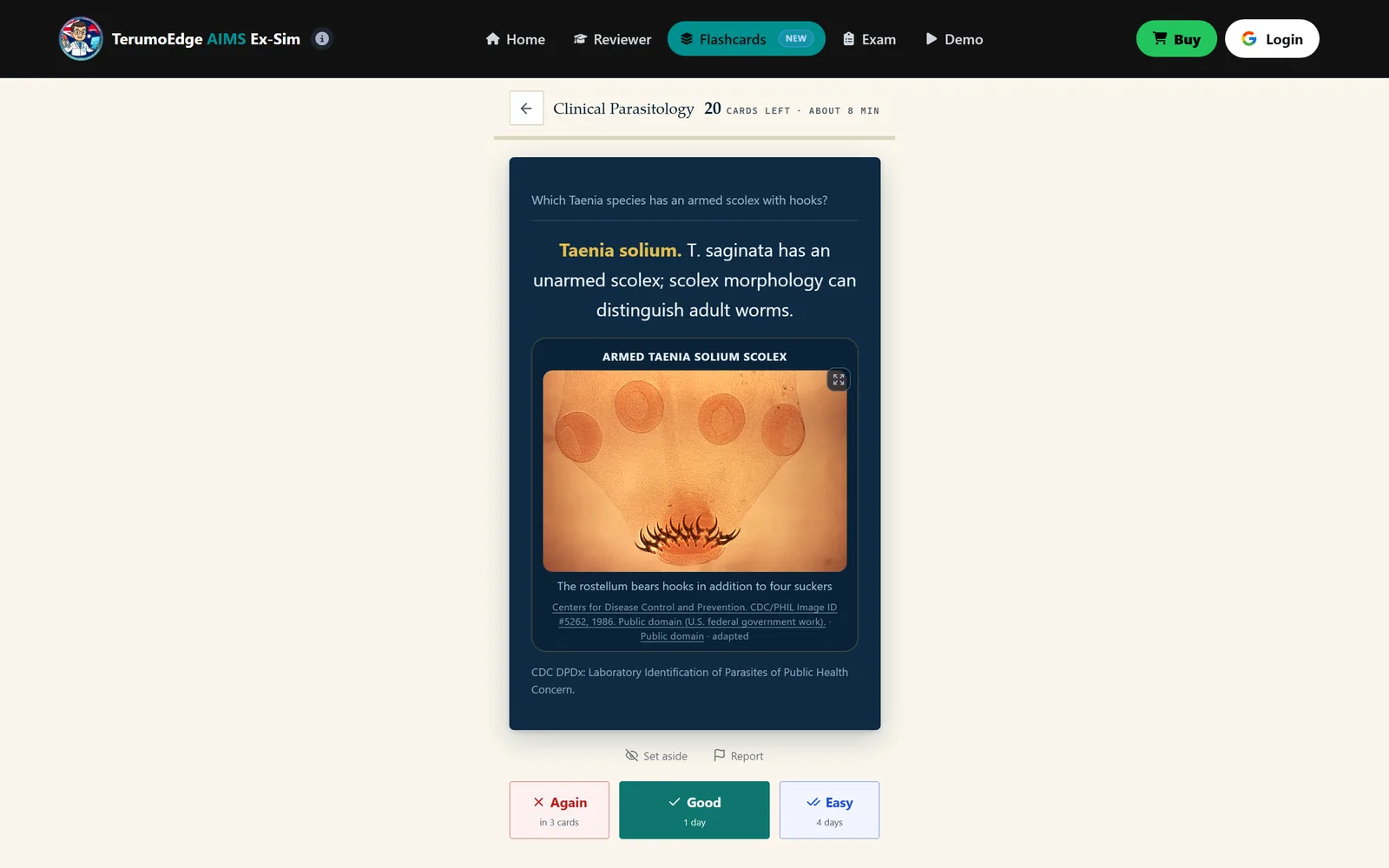
If you are weak on Anatomical Pathology, give it a third week; at 14 items, it is the quickest section to lift. Use flashcards between shifts for organism features and stain targets, and our free demo to check how items in each discipline are explained.
Frequently asked questions
How many Anatomical Pathology items are in the AIMS exam?
The AIMS Professional Examination has 14 Anatomical Pathology items out of 150. It is a compulsory section, so you need at least 50%, which is 7 correct answers. Eight misses fail the section, whatever you score in the rest of the paper.
Can I skip a small section?
No. Anatomical Pathology, with 14 items, is compulsory like Chemical Pathology, Haematology, Medical Microbiology and Transfusion Science. Each needs at least 50%. Only Molecular Pathology and Immunopathology are treated as a pair, where one of the two needs 50%.
How many Medical Microbiology items are in the AIMS exam?
Medical Microbiology has 26 items out of 150. It is compulsory, so you need at least 13 correct answers, in addition to the overall requirement of 75 of 150 correct. That makes it the third largest section after Chemical Pathology and Haematology.
Sources
- AIMS Professional Examination Pack, Medical Laboratory Scientist ANZSCO 234611, v8.2 — Australian Institute of Medical and Clinical Scientists
- AIMS Professional Examination Pack, v8.1 (study guide) — Australian Institute of Medical and Clinical Scientists
- Guidelines for Skills and Qualifications Assessment, MLS ANZSCO 234611 and MLT ANZSCO 311213, v18.2 — Australian Institute of Medical and Clinical Scientists
From the publisher
Sit it here first.
TerumoEdge AIMS Ex-Sim is a simulator for the AIMS Professional Examination: a full-screen, timed exam room, a 150-item Full Mock across all seven disciplines, and a written explanation for every item.
- 5,981 items across the seven AIMS disciplines
- 39 fixed sets in each discipline, 273 in all, plus random draws
- A 150-item, three-hour Full Mock with a per-discipline score report
- An English explanation with references for every item, not a bare answer key
Try the free AIMS simulator demo Five real items in each of the seven disciplines. No account needed.
About this article
Written by the TerumoEdge AIMS editorial team, who build the TerumoEdge AIMS Ex-Sim. Exam facts are checked against the AIMS Professional Examination Pack and the AIMS Guidelines for Skills and Qualifications Assessment, and every article lists its sources. How we write and check our articles.
First published .