Guides7-minute readFor Filipino medtechs preparing for the AIMS exam
What an AIMS exam simulator is, and why reading alone won't carry you through 150 items in three hours
What an AIMS exam simulator is, what it can and cannot reproduce from the Professional Examination, and how to use one from Stage 1 to your sitting.
You have two or more years on the bench, a plan to work in Australia as a Medical Laboratory Scientist, and an exam standing between your Stage 1 letter and the next step. The AIMS Professional Examination is 150 single-response questions in three hours, and the obvious preparation is to read. This post explains why reading alone leaves a gap, and what an AIMS exam simulator does to close it.
TerumoEdge, which publishes this blog, makes a simulator, so weigh what follows accordingly. We try to be fair to the study guide and to reviewers, because most candidates use all of them.
What is an AIMS exam simulator?
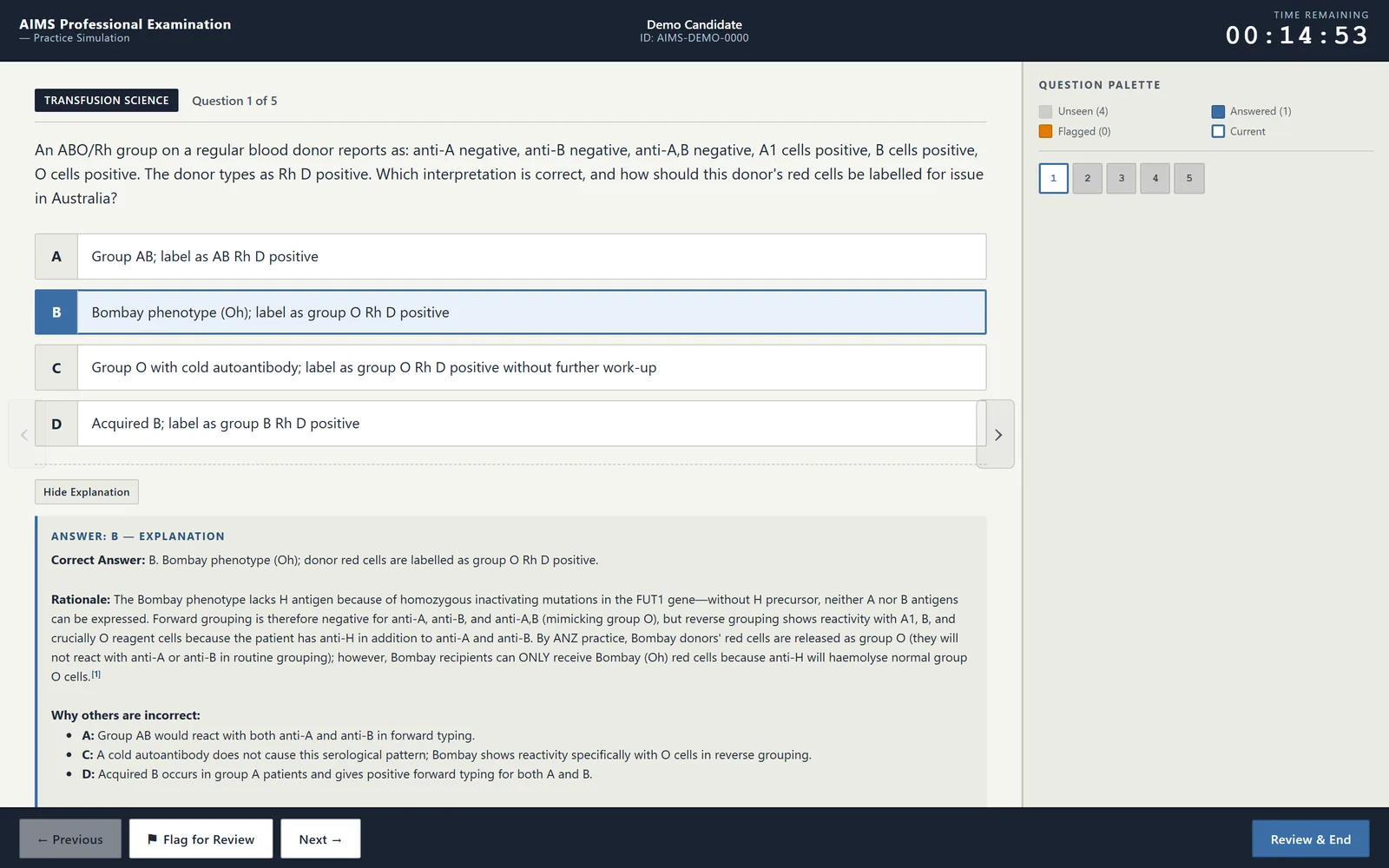
An AIMS exam simulator is a practice environment that copies the conditions of the sitting, not only its topics. You choose a discipline or a full mock, answer single-answer items under a countdown with no notes, finish, and see your score alongside the reasoning behind every item.
Three features separate a simulator from a list of questions. It is timed, so pace becomes something you can measure. It is scored by section, so you see your standing the way the passing rule sees it. It explains each item, so a wrong answer becomes a lesson instead of a red mark.
A simulator is not a lecture and not the exam. It does not teach you haematology from scratch, and it does not use AIMS's own interface. Its job is to test what you have studied and show you where the gaps are while there is still time to repair them.
Who needs an AIMS exam simulator, and who never sits the exam?
Only Option 2 applicants sit the Professional Examination. Under the AIMS Guidelines for Skills and Qualifications Assessment, Option 1 is an AIMS accredited degree with no exam. Option 2 is another acceptable science degree: a Stage 1 document assessment, then Stage 2, this examination. Option 3, for a taught Master with a pathology research project or a doctorate with laboratory experience, ends in a different paper, the Special Professional Examination.
That Option 3 paper is two hours plus ten minutes' reading, with one or two essay questions and 15 to 20 short-answer questions. Our simulator does not model it. AIMS assesses each applicant case by case, so we make no claim about where any particular degree falls.
If you are unsure of your route, read who actually sits the AIMS Professional Exam first. Candidates must complete Stage 1 and be assessed as eligible before they can sit.
Why does the AIMS exam reward rehearsal?
The AIMS exam rewards rehearsal because three of its features punish untimed reading. The paper has 150 items in 180 minutes, the sitting allows no bathroom or rest breaks unless approved, and passing requires more than a good total.
The rule is exact. A candidate needs at least 50% in each of Anatomical Pathology, Chemical Pathology, Haematology, Medical Microbiology and Transfusion Science, 50% in either Molecular Pathology or Immunopathology, and 75 of 150 correct overall. A strong section cannot rescue a collapsed one. The full rule, including the 0 to 1000 scaled score and its cut score of 500, is set out in our passing-score guide.
The exam is also set at the level of a Medical Laboratory Scientist with at least two years of postgraduate experience. That is demanding material delivered at pace, and stamina is a skill you cannot build by reading.
What can a simulator reproduce, and what can none?
A good simulator reproduces the length, the single-answer format, the clock and the section floors. It cannot reproduce the scaled score or the live proctor, and any tool that claims otherwise is overselling.
AIMS reports a Rasch-based scaled score from 0 to 1000, with a cut score of 500. A simulator reports raw marks and percentages, and nobody outside AIMS can convert one into the other. The sitting itself is also supervised live by webcam and mobile phone, and the pack describes a secured browser called WebLock. A practice room can approximate the quiet and the clock, but it is not that browser and should never be mistaken for it.
What a simulator can honestly give you is rehearsal: finishing 150 items without drifting, noticing which section falls under half, and learning to move on from an item you cannot resolve.
How does a simulator compare with the study guide and the sample questions?
Each tool trains something different, and none replaces the others. The study guide builds knowledge, the 25 sample questions show the style, and a simulator tests retrieval at length.
| Tool | What it trains | What it cannot do |
|---|---|---|
| The study guide and recommended reading in the AIMS pack | Knowledge of the topics AIMS lists, such as the Molecular Pathology topics and QA in the blood bank | Test recall, timing or stamina |
| The 25 sample questions in the pack | Familiarity with the item style | Give a section score, since 25 items cannot cover seven sections |
| A simulator | Retrieval under a clock, section-level feedback, explanations | Produce AIMS's scaled score or release real AIMS items |
AIMS states that further sample questions will not be provided, and that completed examinations are not released under any circumstances. Anything sold as "actual AIMS questions" therefore cannot be released exam content. Treat that claim with suspicion wherever you see it.
What does TerumoEdge include?
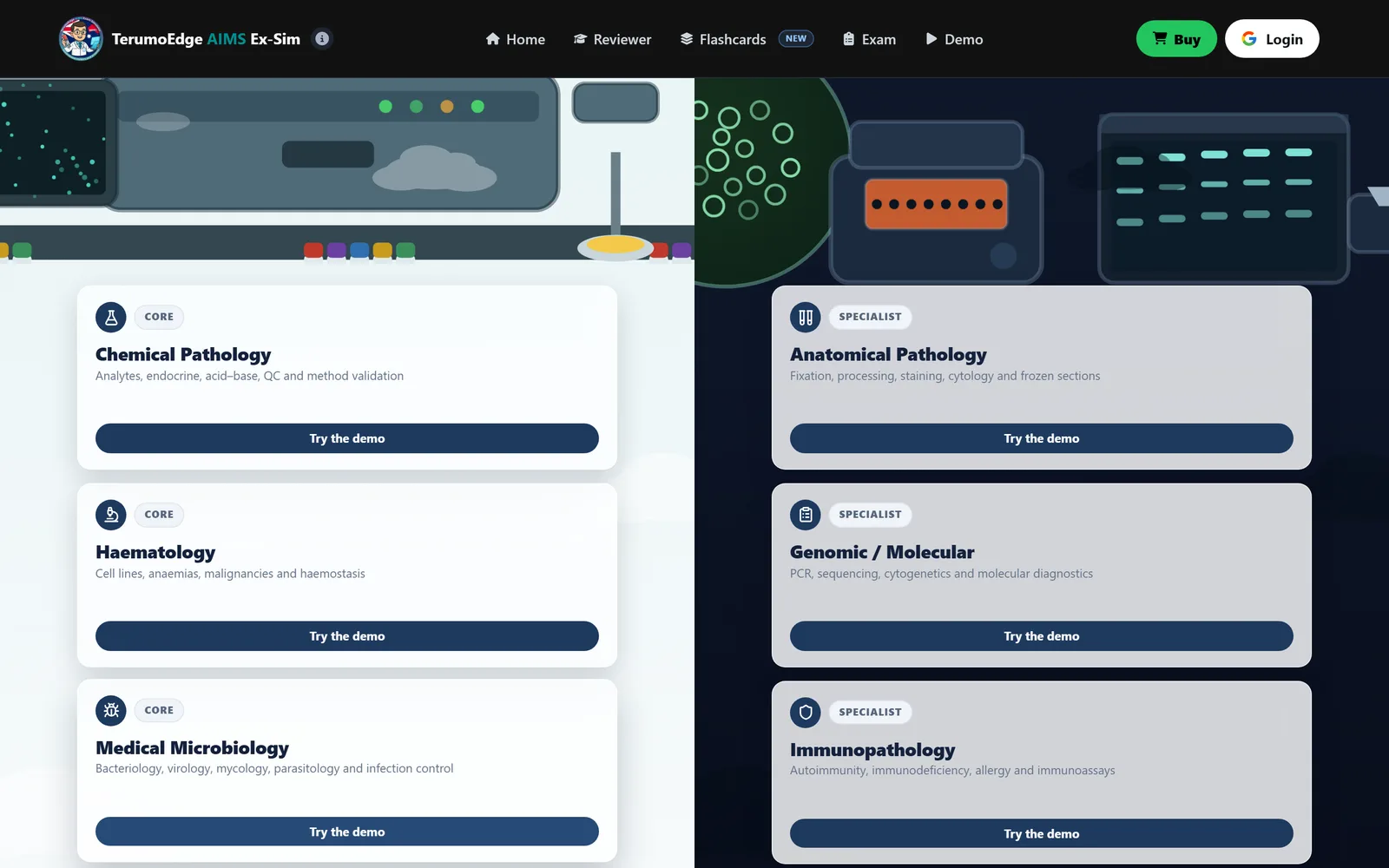
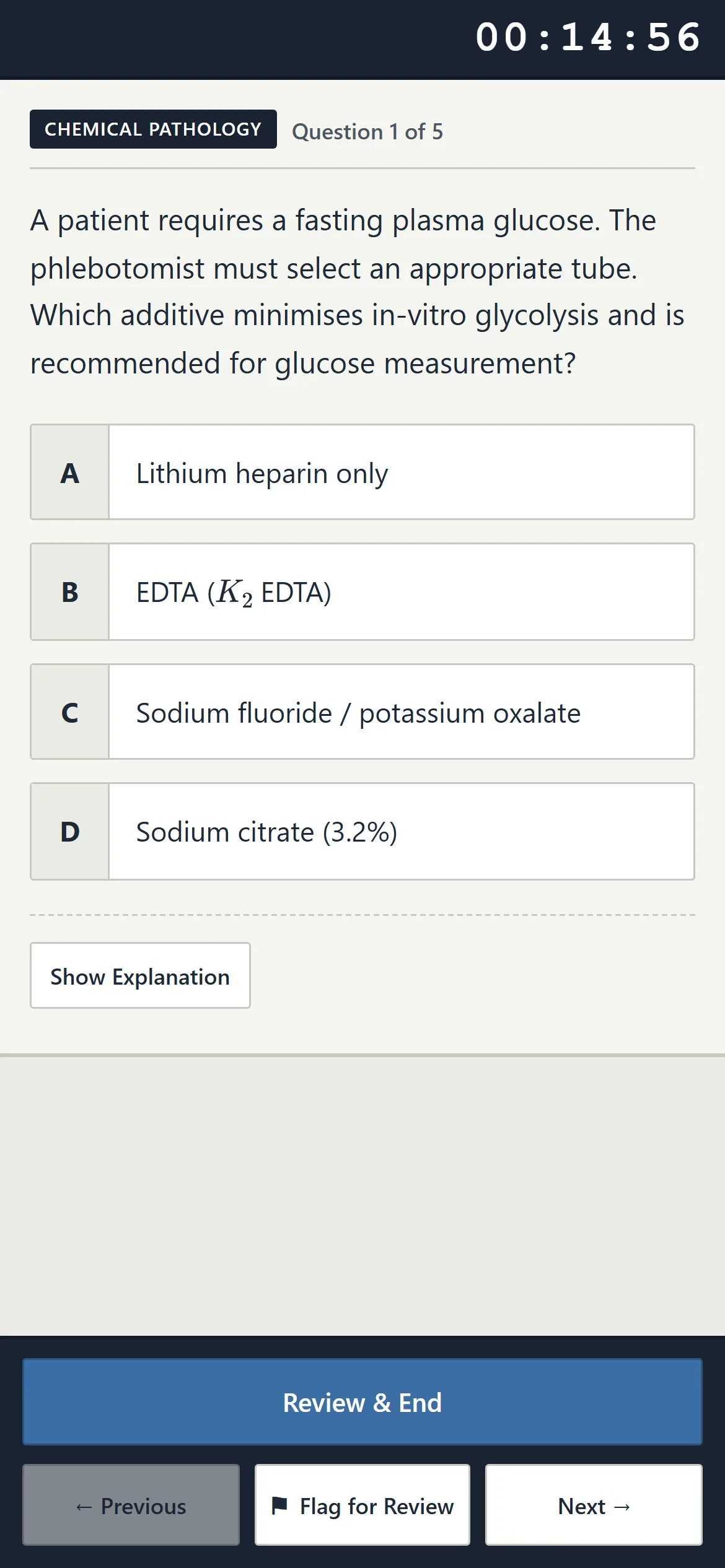
TerumoEdge AIMS Ex-Sim includes 5,981 four-option, single-answer items across the seven AIMS disciplines, a Full Mock, fixed sets, random draws and a written English explanation for every item. The items are text-only, with no image-based questions.
The Full Mock is 150 items in three hours, drawn from all seven disciplines and shuffled together. Its score report applies the published 50% minimums and the Molecular-or-Immunopathology rule to raw marks. We do not claim it uses AIMS's exact section counts.
For practice by discipline there are 39 fixed sets in each discipline, 273 in all, plus random draws. The free demo gives five items in each of the seven disciplines, so you can judge the explanations before you commit. Open it from the exam picker.
How should you use a simulator from Stage 1 to the sitting?
Start reading during Stage 1, add timed sets by discipline in the middle months, and move to full mocks and the AIMS trial exam near the end. Stage 1 can take AIMS 16 weeks to assess and document verification may take up to 6 months, so the waiting period is review time, not dead time.
| Phase | Focus | Simulator use |
|---|---|---|
| During Stage 1 | Read the pack's study guide; find your weakest sections | A free demo in each discipline as a baseline |
| Building months | Section blocks | Timed discipline sets, then read every explanation |
| Final weeks | Stamina and pacing | Full 150-item mocks, scored against the floors |
| Within 2 weeks of the sitting | AIMS's own practice test and trial exam | Light review only |
Pair it with a free laboratory science reviewer and flashcards for background reading and recall. They are general study aids, not the AIMS study guide. For pacing, see our time-management guide.
Frequently asked questions
Is there a free AIMS exam simulator?
TerumoEdge offers a free demo with five items in each of the seven disciplines, with no account needed. It is a sample of the full simulator, not the whole bank. Use it to judge item style and explanations before deciding whether to buy.
Does AIMS provide practice questions?
Yes, but only 25. They are in the Professional Examination Pack, and AIMS states that further sample questions will not be provided. Completed papers are never released, so any other source of questions is written by someone other than AIMS, whatever it is called.
Can a simulator predict my AIMS result?
No. AIMS reports a Rasch-based scaled score from 0 to 1000 with a cut score of 500, and a simulator reports raw marks. A mock tells you whether you can sustain 150 items and clear the section floors, which is useful, but it cannot forecast your official result.
Do I need a simulator if my degree is AIMS accredited?
No exam is required under Option 1, which is for holders of an AIMS accredited degree. Whether your degree qualifies is for AIMS to decide, because it assesses applicants case by case. Check your route with AIMS before spending time on exam preparation.
Sources
- AIMS Professional Examination Pack, Medical Laboratory Scientist ANZSCO 234611, v8.2 — Australian Institute of Medical and Clinical Scientists
- AIMS Professional Examination Pack, v8.1 (June 2025) — Australian Institute of Medical and Clinical Scientists
- Guidelines for Skills and Qualifications Assessment, MLS ANZSCO 234611 and MLT ANZSCO 311213, v18.2 — Australian Institute of Medical and Clinical Scientists
- AIMS Special Professional Examination Pack, v1.0 — Australian Institute of Medical and Clinical Scientists
- Professional Examinations for Migration — Australian Institute of Medical and Clinical Scientists
- Skills Assessment for Overseas Qualified Professionals — Australian Institute of Medical and Clinical Scientists
From the publisher
Sit it here first.
TerumoEdge AIMS Ex-Sim is a simulator for the AIMS Professional Examination: a full-screen, timed exam room, a 150-item Full Mock across all seven disciplines, and a written explanation for every item.
- 5,981 items across the seven AIMS disciplines
- 39 fixed sets in each discipline, 273 in all, plus random draws
- A 150-item, three-hour Full Mock with a per-discipline score report
- An English explanation with references for every item, not a bare answer key
Try the free AIMS simulator demo Five real items in each of the seven disciplines. No account needed.
About this article
Written by the TerumoEdge AIMS editorial team, who build the TerumoEdge AIMS Ex-Sim. Exam facts are checked against the AIMS Professional Examination Pack and the AIMS Guidelines for Skills and Qualifications Assessment, and every article lists its sources. How we write and check our articles.
First published .