Comparisons7-minute readFor medtechs building their AIMS study materials
AIMS exam reviewer vs simulator: textbooks for the seven sections, timed items for the three hours
AIMS exam reviewer or simulator? See what the exam pack, a PDF reviewer and a simulator each train, and when to use each in your preparation.
Most candidates for the AIMS Professional Examination collect materials in a predictable order: a PDF reviewer, perhaps some notes, and later a question source. The useful question is not which is best. It is what each one trains. This post sorts an AIMS exam reviewer, the official pack and a simulator by the job each does, so you can spend your hours where they count.
TerumoEdge, which publishes this blog, makes a simulator and also offers a free reviewer, so we benefit from a mixed answer. We have tried to be fair to both and to say what each cannot do.
What is the short answer on an AIMS exam reviewer versus a simulator?
An AIMS exam reviewer trains knowledge. A simulator trains retrieval under pressure. You need both, in that order, with timed practice starting well before the last month.
The reason is the exam's shape. The AIMS Professional Examination is 150 single-response questions in three hours, online and remote proctored, so success depends on recalling accurately and quickly across seven sections. Reading can show you what a Westgard rule is. Only answering questions shows whether you can apply it in 72 seconds, with a distractor that looks right.
If you only have time for one habit, make it this: read a topic, then test it the same week with items and read every explanation, including those for options you got right.
What does the AIMS pack itself give you?
The AIMS pack gives you three things: a study guide, a recommended reading list and 25 sample questions. It is the official description of what the examination expects, and everything else should be checked against it.
The study guide lists topics by section. For Molecular Pathology it names PCR, Sanger sequencing, NGS, Bcr-Abl, BRAF V600E, JAK2 V617F, and HGVS and ISCN nomenclature. For Transfusion Science it includes quality assurance in the blood bank. The recommended reading includes the ANZSBT Guidelines for Transfusion and Immunohaematology Laboratory Practice.
The 25 sample questions show the style, but AIMS states that further sample questions will not be provided, and completed examinations are not released. Twenty-five items cannot cover seven sections or test stamina, so they are a starting point, not a practice programme. Download the current pack from the AIMS website, because it is reissued from time to time.
What do PDF reviewers do well?
PDF reviewers condense a large body of content into something you can carry, annotate and re-read. For a working medtech, a good reviewer saves hours of hunting through textbooks.
They are strongest at review of familiar ground, the quick pass before a shift or a sitting. A reviewer can lay out a coagulation cascade, a bacterial identification flow or a staining sequence in a page, and you can read it on a break. They are also cheap to share, easy to print and usable offline.
Good ones are organised by discipline, which matches the way the exam is scored. If a reviewer follows the seven sections under their current names, you can map your reading directly onto the passing rule.
Treat the source with care. Many reviewers are written for other exams, and some predate the move from Genomic Pathology to Molecular Pathology. A reviewer built for another exam may cover topics AIMS does not test and skip ones it does. Check any reviewer against the pack's study guide before you rely on it.
Where do reviewers stop?
Reviewers stop at the point where recall under time begins. They cannot time you, cannot score you by section, and cannot tell you why a plausible wrong option is wrong.
Reading creates a feeling of familiarity, and familiarity is not recall. Highlighting and re-reading are the most comfortable ways to study and among the least revealing, because nothing in them can fail. A page you have read three times can still leave you stuck when the same fact appears as a four-option item with a close distractor. The gap between recognising and retrieving is the one a reviewer cannot measure.
A reviewer also gives no feedback on balance. The passing rule needs at least 50% in each of five compulsory sections, 50% in either Molecular Pathology or Immunopathology, and 75 of 150 overall. A reviewer cannot tell you that you are sitting at 45% in Transfusion Science while a strong Chemical Pathology result hides it in your total.
Finally, a reviewer cannot rehearse the sitting: 150 items, three hours, no breaks unless approved. Sitting for three hours without a pause is a physical skill. Candidates who have only ever read in forty-minute blocks often find the fourth section of a long mock is where concentration thins, and the first time you meet that should not be the real paper.
What does a simulator add?
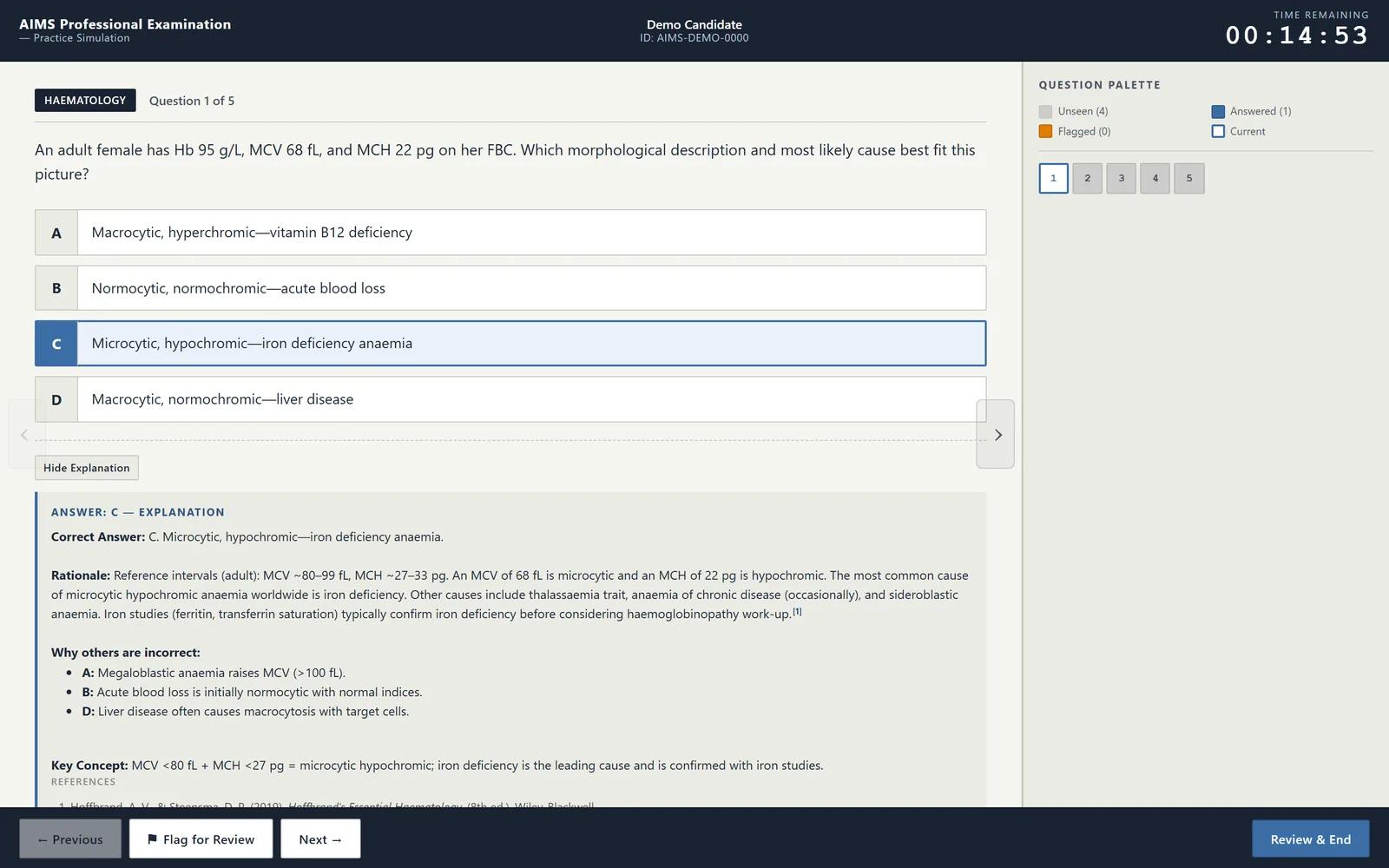
A simulator adds timed items, section-level scoring and an explanation for each option. It turns reading into measurable retrieval.
TerumoEdge AIMS Ex-Sim has 5,981 four-option, single-answer items across the seven AIMS disciplines, each with a written English explanation and references. Its Full Mock is 150 items in three hours, with a per-discipline score report that applies the published 50% minimums and the Molecular-or-Immunopathology rule to raw marks.
It cannot give you AIMS's Rasch-based scaled score of 0 to 1000, and its items are text-only. It is also not the official exam interface. What it can do is show you, before the sitting, which section falls under half.
How do the three compare?
Each tool covers a different criterion. The grid below shows where each is strong and where it needs help.
| Criterion | AIMS pack | PDF reviewer | Simulator |
|---|---|---|---|
| Coverage of the seven sections | Study guide and reading list | Depends on the author | Item bank across all seven |
| Retrieval under time | 25 samples only | None | Timed sets and full mocks |
| Explanations | Check the pack; not a feature we rely on | Often brief | Written per item |
| Section-level feedback | None | None | Per-discipline report |
| Official status | Official | Unofficial | Unofficial, not AIMS |
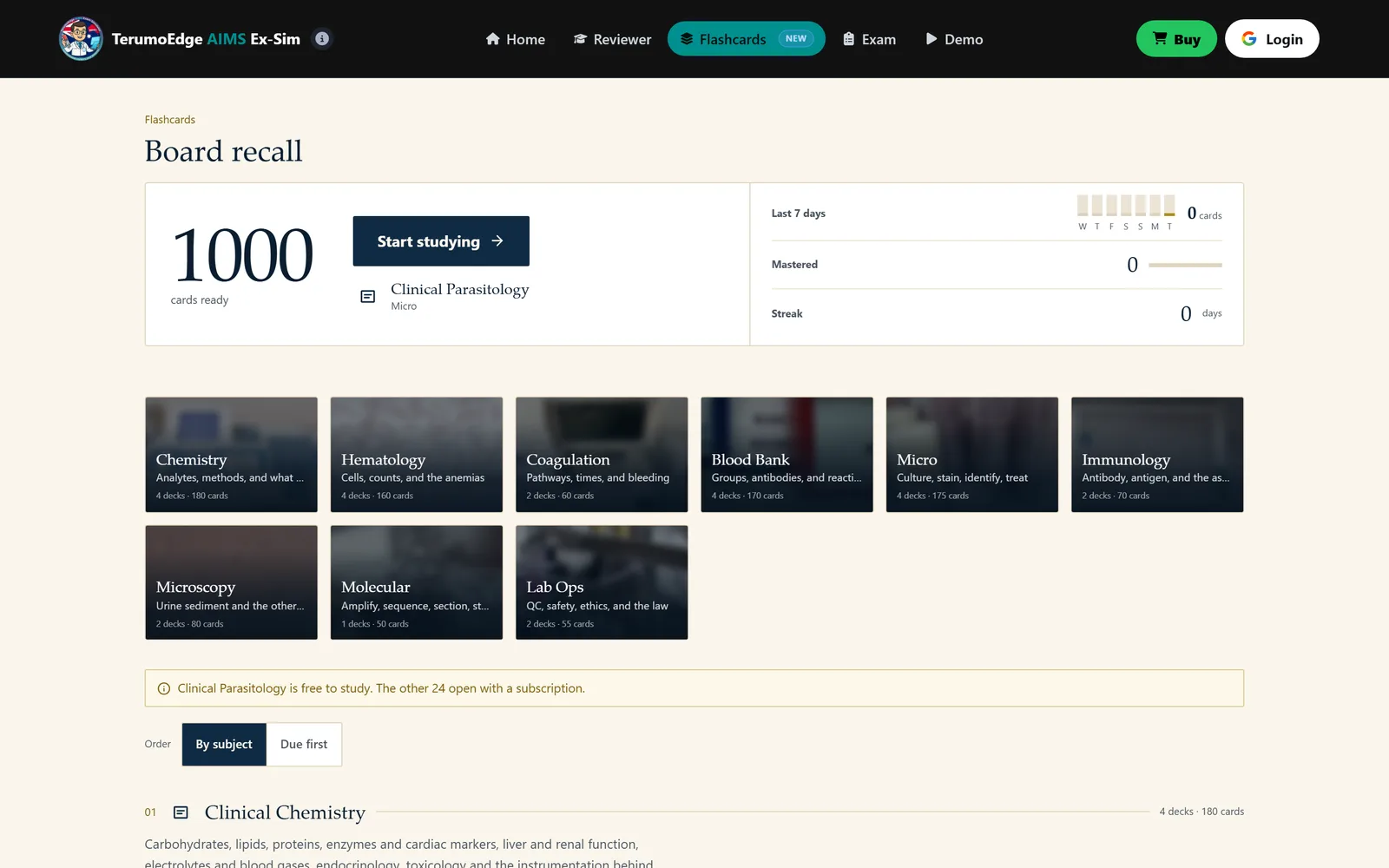
Use the pack as the reference, the reviewer as the compact text and the simulator as the test. If you are still deciding between a course and studying alone, our comparison of a review center and self review sets out the trade-offs. Our free laboratory science reviewer and flashcards can serve as general background and recall aids, but they are not AIMS-specific.
When should you use which?
Read first for new topics, test within days, and switch to mostly timed work as the sitting approaches. The balance shifts across your preparation.
In the first weeks, spend most time on the pack's study guide and a reviewer, and use short discipline sets to find weak spots. In the middle months, alternate: study a section, then drill it with timed items. In the last weeks, run full mocks and repair the weakest compulsory section. Our study-plan guide sets out one way to do this, and the molecular pathology review applies it to a section candidates often find hard.
Try the free demo at the exam picker to see how a simulator explanation reads, with five items in each discipline. Then judge for yourself whether it fills a gap in your current materials.
Frequently asked questions
Where is the official AIMS study guide?
It is inside the AIMS Professional Examination Pack, which AIMS publishes on its website. The pack contains the study guide, the recommended reading and 25 sample questions. AIMS reissues the pack from time to time, so download the current version and check the date before you rely on it.
Are old AIMS reviewers still valid?
Partly. The core science does not change, but older reviewers may use outdated section names, notably Genomic Pathology, which is now Molecular Pathology in the current packs. Check the reviewer against the current study guide and see our format guide for the naming history. If a section you cannot find in the reviewer is one that the pack lists, the reviewer has a gap, however polished it looks.
Should I read first or answer questions first?
Do both, in short cycles. Attempt a few items on a section before you read, to find what you do not know, then read, then test again. Answering first often makes reading more focused, and explanations teach as well as grade.
Sources
- AIMS Professional Examination Pack, Medical Laboratory Scientist ANZSCO 234611, v8.2 — Australian Institute of Medical and Clinical Scientists
- AIMS Professional Examination Pack, v8.1 (June 2025) — Australian Institute of Medical and Clinical Scientists
- Guidelines for Skills and Qualifications Assessment, MLS ANZSCO 234611 and MLT ANZSCO 311213, v18.2 — Australian Institute of Medical and Clinical Scientists
From the publisher
Sit it here first.
TerumoEdge AIMS Ex-Sim is a simulator for the AIMS Professional Examination: a full-screen, timed exam room, a 150-item Full Mock across all seven disciplines, and a written explanation for every item.
- 5,981 items across the seven AIMS disciplines
- 39 fixed sets in each discipline, 273 in all, plus random draws
- A 150-item, three-hour Full Mock with a per-discipline score report
- An English explanation with references for every item, not a bare answer key
Try the free AIMS simulator demo Five real items in each of the seven disciplines. No account needed.
About this article
Written by the TerumoEdge AIMS editorial team, who build the TerumoEdge AIMS Ex-Sim. Exam facts are checked against the AIMS Professional Examination Pack and the AIMS Guidelines for Skills and Qualifications Assessment, and every article lists its sources. How we write and check our articles.
First published .