Your situation8-minute readFor Filipino medtechs with two years' lab experience building the Stage 1 file
Two years on the bench and ready to apply? Building your AIMS Stage 1 file as a Filipino medtech
AIMS Stage 1 explained for Filipino medtechs: the two-year experience rule, foundation subjects, English, 16 weeks to 6 months, and the 3-year letter.
You have worked at the bench for a couple of years and you want to apply to the Australian Institute of Medical and Clinical Scientists (AIMS) as a Medical Laboratory Scientist, ANZSCO 234611. AIMS Stage 1 is the first step on the route that leads to its Professional Examination, and it is mostly a test of paperwork and patience.
This post lays out what AIMS itself says Stage 1 requires: the experience rule, the foundation subjects, English, how long assessment takes and how long your letter lasts. Where AIMS says nothing, we say so instead of guessing. Not everyone sits the exam at all, so check which option applies to you first.
What is AIMS Stage 1, and is it the route for you?
Stage 1 is the document assessment for Option 2 applicants, and passing through it makes you eligible to sit the Professional Examination. AIMS is specified under the Migration Regulations 1994 as the assessing authority for ANZSCO 234611 (AIMS Guidelines for Skills and Qualifications Assessment, GAPSQ v18.2). Its guidelines describe three options. Option 1 is an AIMS accredited degree, with no exam. Option 2 is another acceptable science degree, followed by Stage 1 and then Stage 2, the Professional Examination. Option 3 is postgraduate study with laboratory experience, followed by a different paper.
AIMS says candidates must complete the document assessment in Stage 1 and be assessed as eligible to sit the exam (Professional Examinations for Migration).
Whether a Philippine degree places you in Option 1, Option 2 or elsewhere is a case-by-case decision. AIMS says it does not provide a simple assessment that compares your qualification to Australian levels, and its guideline has no statement about BS Medical Technology. We make no claim about how AIMS will treat your degree. Ask AIMS if you need certainty.
How does the experience rule work, and what is the recency trap?
Option 2 requires at least two years of postgraduate professional experience in a medical pathology laboratory, and one of those years must fall wholly within the five years before you apply. The guideline counts full-time work or its part-time equivalent (AIMS GAPSQ v18.2).
The recency requirement catches people who left bench work. Suppose you worked three years in a laboratory, then moved into a sales or administrative job six years ago. You have the length of experience, but no year of it falls in the last five. Read the wording carefully: the year must be completed wholly within the five-year period immediately before applying.
Two other points deserve a check. The experience must be in a medical pathology laboratory, so ask yourself whether each role qualifies under that phrase. And it must be postgraduate, meaning after your degree.
Start collecting evidence of dates and duties now. We cannot list the exact documents AIMS accepts, because the sources we rely on do not give a checklist. The current guideline and application form are the authority.
How do you check your transcript against the foundation subjects?
Compare your transcript against the guideline's list before you apply, so there are no surprises. AIMS names six foundation subjects: Chemistry, Statistics, Cell and tissue biology, Biochemistry, Microbiology, and Genetics and Molecular Biology. It also requires basic studies in all the professional disciplines and advanced studies in at least two, preferably three, of the asterisked ones (AIMS GAPSQ v18.2).
The asterisked disciplines are the five compulsory exam sections: Anatomical Pathology, Chemical Pathology, Haematology, Medical Microbiology and Transfusion Science.
Make a grid with the subjects down the side and your course titles beside them. Mark each as basic or advanced and note the credit or hours if your transcript shows them. Gaps in the grid are information, not a verdict, because AIMS assesses cases individually and we cannot say how it will read any transcript.
Keep in mind that the guideline's wording is your test, not a general impression that your degree was thorough. Keep course descriptions or syllabi if you can, since they may help explain what a subject covered.
What about English before you apply?
Plan your English test early, because a failed or ineligible test can delay the whole file. Since 12 March 2026, AIMS requires the Department of Home Affairs "Proficient English" level. Tests with a One Skill Retake component are not accepted, and all four components must be sat in one sitting (Skills Assessment for Overseas Qualified Professionals).
That last rule means you cannot combine scores from two sittings. A candidate who scores well in three components and misses the fourth has to take the whole test again.
The June 2024 guideline listed IELTS 7.0 in each band, PTE 65 in each, OET grade B, TOEFL and Cambridge C1 at 185, with no exemptions. Treat those as the June 2024 figures, because they predate the March 2026 rule. We do not state the current Proficient English scores, since our sources do not give them. Confirm today's accepted tests and scores with AIMS before booking.
Book the test with your timeline in mind. Results take time to arrive, and a retake may need weeks. Sitting the test first means the rest of the file is not waiting on it.
How long does Stage 1 take, and what does the timeline look like?
AIMS aims to finish assessments within 16 weeks of receiving them, but verifying documents can take up to six months. That is AIMS's own statement (Skills Assessment for Overseas Qualified Professionals). Treat 16 weeks as an aim, not a promise, and plan for the longer figure.
| Step | Who acts | How long |
|---|---|---|
| Book and sit an English test | You | Varies |
| Gather degree, transcript and experience evidence | You, plus your university and employers | Varies |
| Submit the Stage 1 application | You | Varies |
| AIMS assessment | AIMS | Aims for 16 weeks from receipt |
| Document verification | AIMS and issuing bodies | Up to 6 months |
| Stage 1 letter issued | AIMS | Valid for 3 years |
| Exam application | You | Closes 1 December (March sitting) or 10 July (September sitting) |
The closing dates come from the March 2026 pack (AIMS Professional Examination Pack v8.2). Work backwards from the sitting you want, as in our post on the exam schedule and deadlines. If verification takes six months, a September sitting needs an early start.
How long is the Stage 1 letter valid, and why does it matter?
The Stage 1 results letter is valid for three years, and your exam application must arrive within that period. The pack states that a new application must arrive within the three-year validity of the Stage 1 letter, and the guideline says the same (AIMS Professional Examination Pack v8.2).
Three years sounds generous, but it is easier to use up than you think. A deferral must be requested before the payment deadline. A sitting you postpone for work reasons moves you to the next March or September. If you need more than one attempt, the clock keeps running from the date on your letter.
Note the date on your letter the day it arrives and set two calendar reminders: one at two years and one at 30 months. Keep your experience and English evidence current as well, since details like recency are judged against the date you apply.
AIMS does not publish resit rules in the sources we used, so we say nothing about retake counts here. If a retake is a possibility, read our retaker post and ask AIMS.
Why should you start reviewing during Stage 1?
Start reviewing during Stage 1, because the waiting time is one stretch of the process when you control your hours. The exam is 150 single-response questions in three hours, set at the level of a Medical Laboratory Scientist with at least two years of experience, so your bench years already give you a base.
Use the wait to find your gaps instead of to cram. The study guide in the exam pack lists Molecular Pathology topics such as PCR, Sanger sequencing, NGS, Bcr-Abl, BRAF V600E, JAK2 V617F, and HGVS and ISCN nomenclature. Check yourself against that list early. It also lists quality assurance in the blood bank for Transfusion Science. These are areas Filipino-trained graduates often need to strengthen only if their own self-check shows gaps, and yours may not.
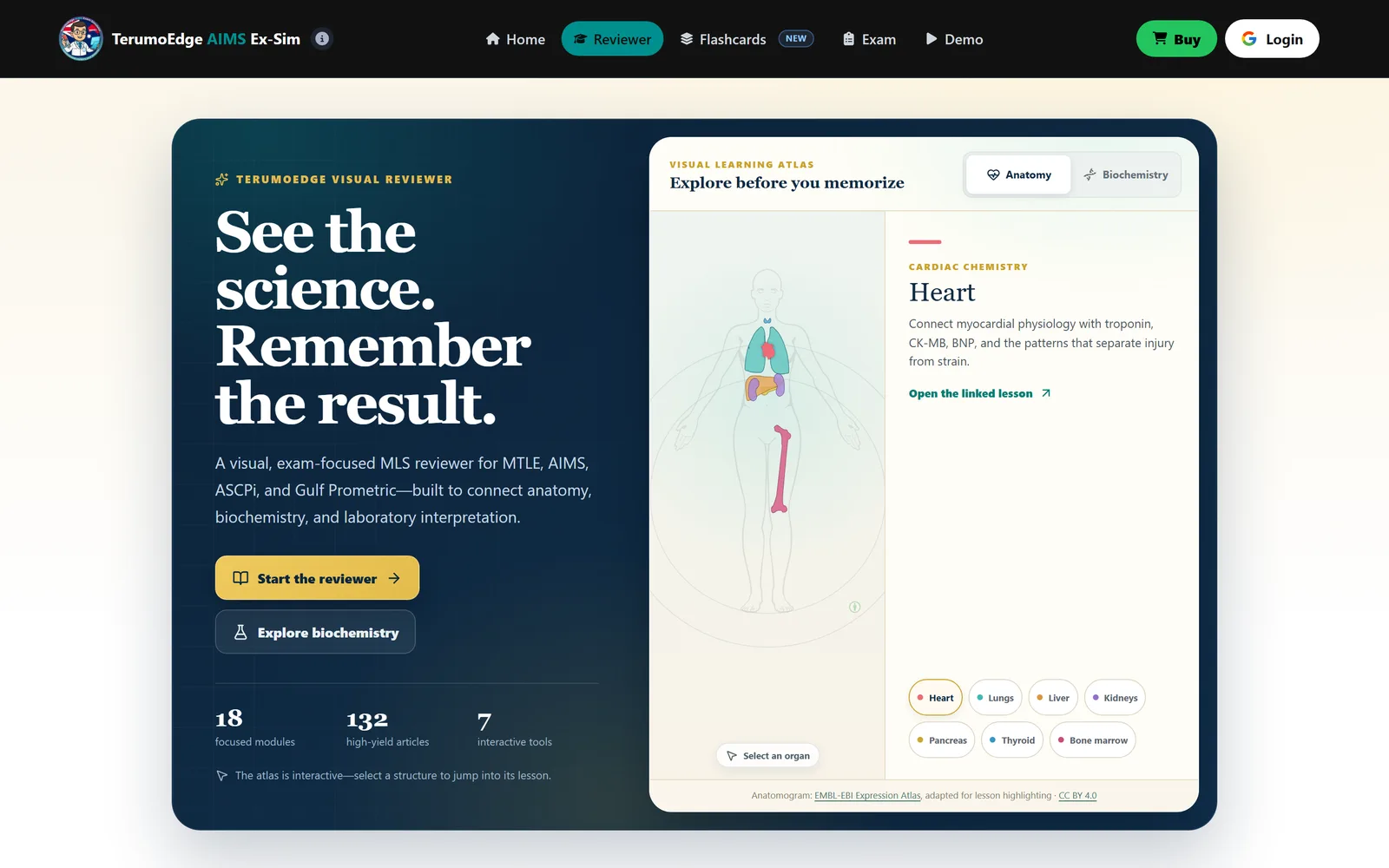
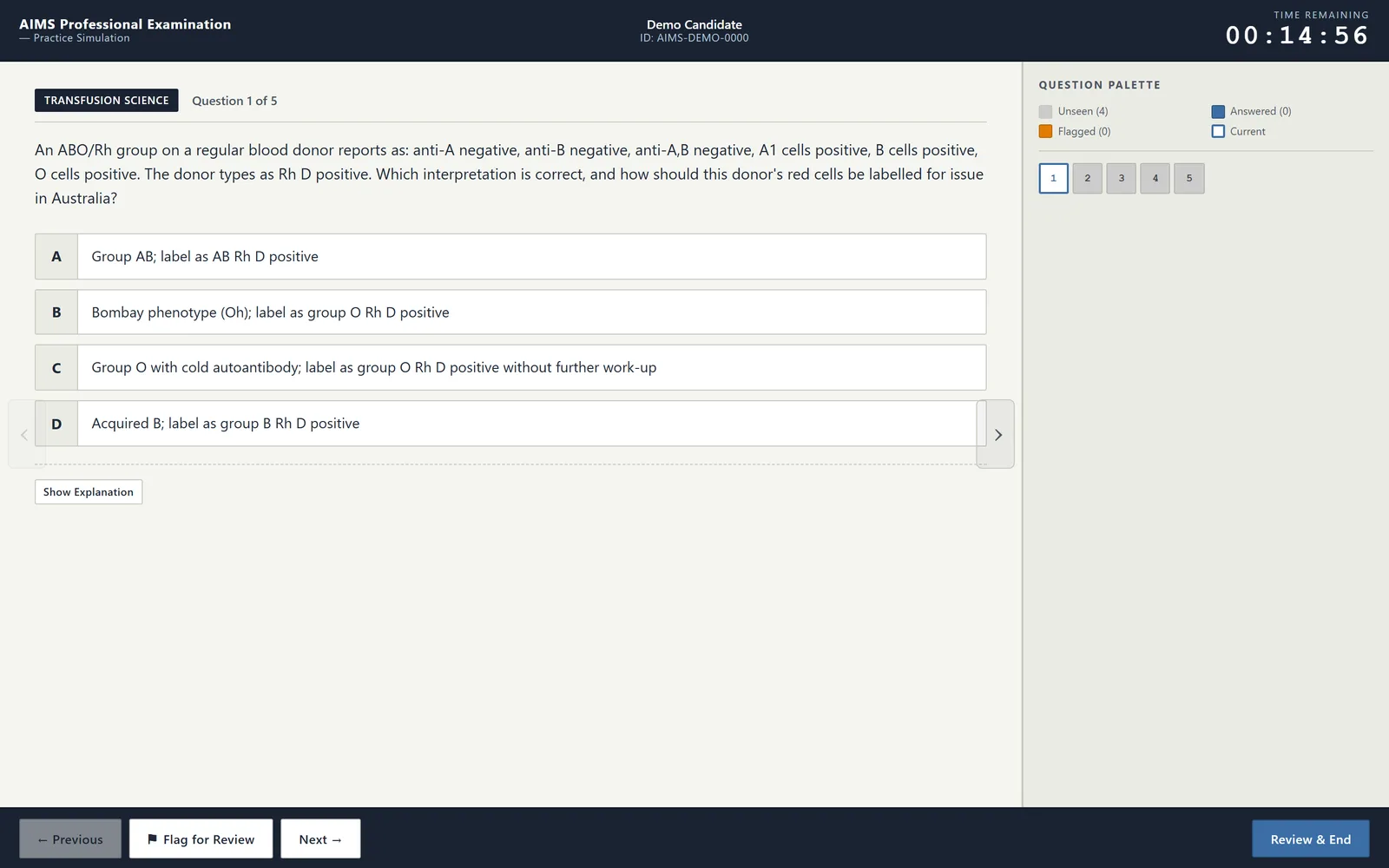
The free demo gives five items in each of the seven disciplines, which is enough to see how the practice room feels.
Frequently asked questions
How many years of experience does AIMS need for Option 2?
Option 2 needs a minimum of two years of full-time postgraduate professional experience, or the part-time equivalent, in a medical pathology laboratory. At least one of those years must be completed wholly within the five years immediately before you apply. These are the terms of AIMS's June 2024 guideline, so check the current version.
Which English tests does AIMS accept?
From 12 March 2026, AIMS requires the Department of Home Affairs Proficient English level, and tests with a One Skill Retake component are not accepted. The June 2024 guideline listed IELTS, PTE, OET, TOEFL and Cambridge scores, but those predate the change. Confirm current accepted tests and scores with AIMS.
How long does the AIMS assessment take?
AIMS aims to complete assessments within 16 weeks of receiving them. It also warns that verification of documents may take up to six months. Plan for the longer figure, and do not treat 16 weeks as a guarantee.
Can I combine English scores from two sittings?
No. AIMS states that all four test components must be sat in one sitting. Scores from separate sittings cannot be combined to meet the requirement.
Will AIMS accept my BS Medical Technology degree?
We cannot say. AIMS assesses applicants case by case, and its guideline has no statement on Philippine BS Medical Technology degrees. Do not assume a particular option or outcome, and contact AIMS if you need an answer for your own situation.
Sources
- Guidelines for Skills and Qualifications Assessment, MLS ANZSCO 234611 and MLT ANZSCO 311213, GAPSQ v18.2 (06/2024) — Australian Institute of Medical and Clinical Scientists
- Skills Assessment for Overseas Qualified Professionals — Australian Institute of Medical and Clinical Scientists
- AIMS Professional Examination Pack, Medical Laboratory Scientist ANZSCO 234611, PEP v8.2 (03/2026) — Australian Institute of Medical and Clinical Scientists
- Professional Examinations for Migration — Australian Institute of Medical and Clinical Scientists
From the publisher
Sit it here first.
TerumoEdge AIMS Ex-Sim is a simulator for the AIMS Professional Examination: a full-screen, timed exam room, a 150-item Full Mock across all seven disciplines, and a written explanation for every item.
- 5,981 items across the seven AIMS disciplines
- 39 fixed sets in each discipline, 273 in all, plus random draws
- A 150-item, three-hour Full Mock with a per-discipline score report
- An English explanation with references for every item, not a bare answer key
Try the free AIMS simulator demo Five real items in each of the seven disciplines. No account needed.
About this article
Written by the TerumoEdge AIMS editorial team, who build the TerumoEdge AIMS Ex-Sim. Exam facts are checked against the AIMS Professional Examination Pack and the AIMS Guidelines for Skills and Qualifications Assessment, and every article lists its sources. How we write and check our articles.
First published .