Comparisons7-minute readFor medtechs choosing how to review for the AIMS
AIMS review center or self review? Choosing for an exam with no past papers and only 25 official samples
AIMS review center or self review? Compare structure, schedule, materials and timed practice, and see what both routes must cover for the AIMS exam.
If you are preparing for the AIMS Professional Examination, you have probably been asked whether you are joining an AIMS review center or reviewing on your own. Both can work, and neither is a guarantee. This post compares the two by category and lists what each must add to prepare you for 150 single-response items in three hours.
TerumoEdge, which publishes this blog, makes a simulator, so weigh our views accordingly. We name no review centers and quote no prices, because both change and neither belongs in a fair comparison.
Which AIMS review center or self review route should you choose?
Choose an AIMS review center when you want a fixed schedule, a teacher and people to study with. Choose self review when your shifts are irregular, you are working abroad, or you prefer to start from the AIMS pack and build your own plan. The AIMS review center route trades flexibility for structure, and self review trades structure for flexibility.
First, confirm that you sit this exam at all. Under the AIMS assessment guidelines, only Option 2 applicants sit the Professional Examination, after a Stage 1 document assessment. Option 1 applicants hold an AIMS accredited degree and sit no exam, and Option 3 applicants sit a different paper. See who actually sits the AIMS exam before you commit months or money to either route.
Whichever you choose, the sitting is the same: 150 items in three hours, online and remote proctored, held in March and September.
What does a review course give you?
A review course gives you a ready-made sequence, regular contact and accountability. Someone else decides what week three covers, which saves the planning effort that often stalls a self-driven reviewee.
The strengths are real. Lectures can explain a difficult mechanism faster than a page can, a cohort gives you people to quiz and compare with, and a fixed timetable pushes you through the less comfortable sections. For a candidate who has been away from formal study, that scaffolding matters.
The weaknesses are also real. Fixed class times can clash with rotating shifts and night duty. A course is only as good as its alignment with the current exam pack, and the pack changes. Ask whether it uses the current section names, since the older Genomic Pathology section is now Molecular Pathology, and whether it offers timed 150-item practice or only lectures and handouts.
What does self review give you?
Self review gives you control over when, where and how you study, and you can anchor it to the AIMS pack itself. The pack contains the study guide, the recommended reading and the 25 sample questions. It is the official description of what AIMS expects, and nothing else carries that status.
You choose the pace, repeat what you find hard, and study after a shift without waiting for a class. You can combine free resources, such as a laboratory science reviewer and flashcards, with the recommended reading, for example the ANZSBT Guidelines the pack lists for Transfusion Science.
The cost is discipline and design. Nobody tells you that you have neglected a 14-item section, and no cohort notices when you stall. You must build the schedule, balance seven sections, and schedule timed practice on your own. Without a plan, self review drifts toward the topics you already like.
How do they compare side by side?
The two routes differ most on structure and schedule, and least on the gap that matters. Neither supplies timed practice unless you add it.
| Factor | Review center or course | Self review |
|---|---|---|
| Structure | Set by the provider | Set by you |
| Schedule | Fixed class times | Fits your shifts |
| Materials | Lectures, handouts, sometimes mocks | The AIMS pack, textbooks, free and paid tools |
| Timed 150-item practice | Varies; ask before enrolling | Only if you add it |
| Cohort and accountability | Built in | You must find a study group |
| Cost of time | Travel, set hours, fixed pace | Planning effort, self-discipline |
The last row of the table is the one candidates underestimate. A course that meets in the evening may not fit a week of nights, and a self-study plan with no accountability may not survive the third week.
Who should choose which?
Choose a course if you learn best with a teacher, struggle to start alone or want a cohort. Choose self review if you work rotating shifts, live far from any class, or already have strong foundations and need to target gaps.
Consider your situation honestly. If you work nights and a weekday class is impossible, an online or recorded course may fit better than an in-person one. If you are abroad, self review plus a study group over video can work. If you have not studied formally in years, a short course to rebuild habits can pay for itself.
Your weakest area also matters. The pack's study guide lists Molecular Pathology topics such as PCR, Sanger sequencing, NGS, Bcr-Abl, BRAF V600E, JAK2 V617F, and HGVS and ISCN nomenclature. Areas Filipino-trained graduates often need to strengthen should be checked against that list early, whichever route you take. For rotating-shift schedules, see reviewing for the AIMS exam while working.
Is a hybrid better?
A hybrid often fits best: a course, tutor or study group for content, and your own timed practice for rehearsal. The two halves cover different weaknesses.
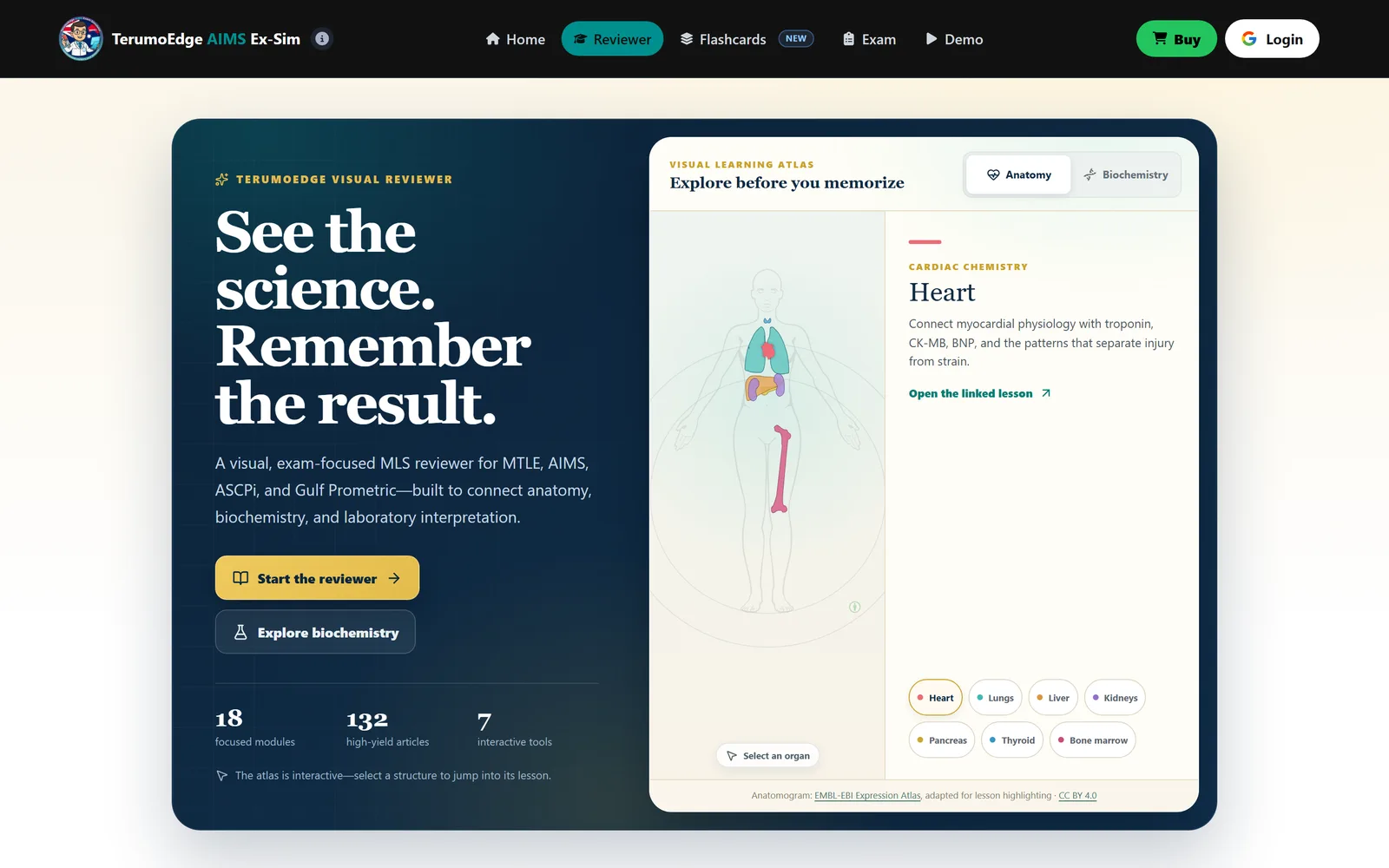
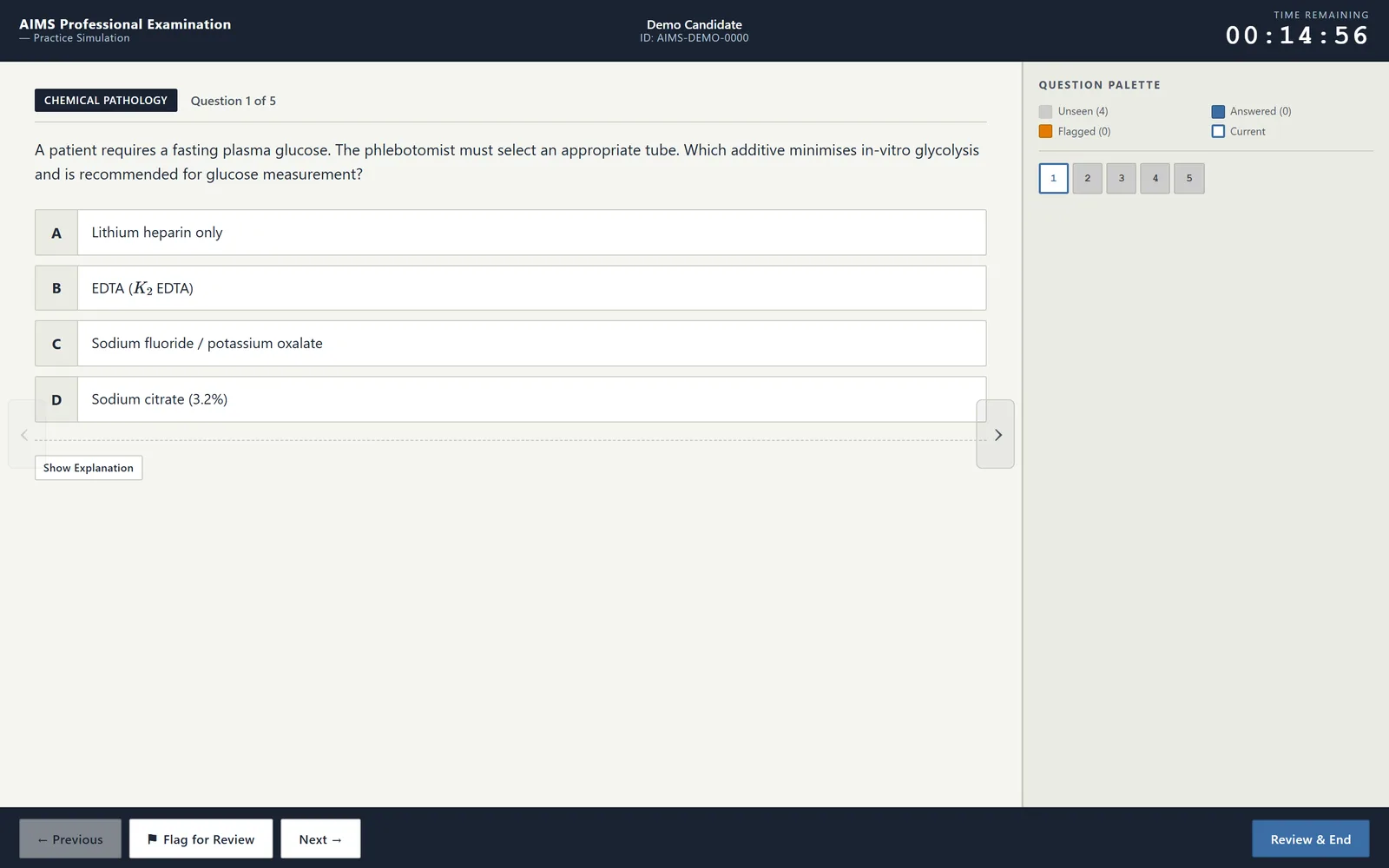
A typical hybrid uses lectures or a group to cover unfamiliar topics, the AIMS pack as the checklist, and a simulator to test retrieval under a clock. The simulator is where you find out whether the lecture stuck. TerumoEdge AIMS Ex-Sim has a Full Mock of 150 items in three hours, and a score report that applies the published 50% minimums to raw marks. It does not produce AIMS's scaled score, and no outside tool can.
You can try it free. The demo gives five items in each of the seven disciplines at the exam picker. Our study-plan guide shows how to lay out the weeks.
What red flag should you watch for either way?
The red flag is any material sold as "actual AIMS questions". AIMS states that completed examinations are not released under any circumstances, and that further sample questions will not be provided beyond the 25 in the pack.
That means a course, a group or a seller cannot legitimately hold past papers. Material may be called "recalled" or "exam-style", and some of it may be useful, but treat it as the provider's own writing. Memorising it as the real thing can leave you confident about items that will not appear and unprepared for those that do.
Other warning signs are promises of a certain pass, which no one can honestly give, and claims about pass rates. AIMS publishes no pass rates or examinee counts, so any number quoted is invented or unsourced. Also ask whether a provider follows the current pack, because the old section name and old deadlines still circulate.
Frequently asked questions
Can you pass the AIMS exam through self review?
Many candidates prepare alone, but there are no published pass statistics to quote either way. Self review works when it covers all seven sections, uses the AIMS pack as its checklist and includes timed 150-item practice scored against the section minimums. It tends to fail when it has no schedule.
Does AIMS endorse any review course?
The AIMS documents we relied on name no review course, and we make no claim beyond that. The exam pack and website are the authoritative description of the exam. Ask any provider which pack version it follows and confirm exam details directly with AIMS.
What should I study first?
Start with the AIMS pack itself. It contains the study guide, the recommended reading and the 25 sample questions. Then check your weakest compulsory sections against it, and add timed practice early rather than saving it for the last weeks.
Is a review center worth it if I work night shifts?
It can be, if the schedule fits. Look for recorded or evening options, and check that timed practice is included. If the timetable would force you to skip shifts or sleep, self review with a fixed weekly routine may serve you better.
Sources
- AIMS Professional Examination Pack, Medical Laboratory Scientist ANZSCO 234611, v8.2 — Australian Institute of Medical and Clinical Scientists
- AIMS Professional Examination Pack, v8.1 (June 2025) — Australian Institute of Medical and Clinical Scientists
- Guidelines for Skills and Qualifications Assessment, MLS ANZSCO 234611 and MLT ANZSCO 311213, v18.2 — Australian Institute of Medical and Clinical Scientists
- Professional Examinations for Migration — Australian Institute of Medical and Clinical Scientists
From the publisher
Sit it here first.
TerumoEdge AIMS Ex-Sim is a simulator for the AIMS Professional Examination: a full-screen, timed exam room, a 150-item Full Mock across all seven disciplines, and a written explanation for every item.
- 5,981 items across the seven AIMS disciplines
- 39 fixed sets in each discipline, 273 in all, plus random draws
- A 150-item, three-hour Full Mock with a per-discipline score report
- An English explanation with references for every item, not a bare answer key
Try the free AIMS simulator demo Five real items in each of the seven disciplines. No account needed.
About this article
Written by the TerumoEdge AIMS editorial team, who build the TerumoEdge AIMS Ex-Sim. Exam facts are checked against the AIMS Professional Examination Pack and the AIMS Guidelines for Skills and Qualifications Assessment, and every article lists its sources. How we write and check our articles.
First published .