Comparisons7-minute readFor medtechs comparing AIMS reviewer apps
How to choose an AIMS reviewer app: nine checks against the published exam pack
How to choose an AIMS reviewer app: nine checks against the published exam pack, a 10-minute demo test, red flags and a disclosed self-assessment.
Searching for an AIMS reviewer app turns up a mix of generic laboratory quiz apps, review-center portals, exam apps built for other countries, and a few tools aimed squarely at the AIMS Professional Examination. They look similar in a store listing and differ a great deal in practice. This post gives you nine checks, grounded in the published exam pack, to tell them apart before you commit time or money.
TerumoEdge, which publishes this blog, makes a simulator, so we score ourselves openly at the end, including where we fall short. We name no apps and quote no prices.
Why does an AIMS reviewer app need to differ from generic laboratory apps?
Generic laboratory apps miss the AIMS because the exam has a specific shape that a general question pool does not follow. The paper is 150 single-response questions in three hours, split across seven sections with different weights and a layered passing rule.
The sections are Anatomical Pathology (14 items), Chemical Pathology (30), Molecular Pathology (16), Haematology (30), Immunopathology (14), Medical Microbiology (26) and Transfusion Science (20). Five are compulsory at 50% each, either Molecular Pathology or Immunopathology must reach 50%, and 75 of 150 must be correct overall.
An app that serves a mixed pool of chemistry and microbiology questions with a running percentage will not tell you whether you are failing a floor. An app built for another country's exam may also lean on standards and units that the AIMS pack does not use. The nine checks below turn these differences into things you can test.
What are the nine checks?
The nine checks cover content, format, scoring, explanations, references, set-up and honesty. Each can be verified from a demo.
| Check | Why it matters | How to test it in a demo |
|---|---|---|
| 1. Seven sections under current names | The current pack says Molecular Pathology, not only Genomic | Look for all seven on the picker |
| 2. A full 150-item, three-hour mode | Stamina and pacing only show at full length | Find a mock with the 150 and the three-hour clock |
| 3. Section scores against the minimums | The pass rule is per section, with 75 overall | Finish a set and look for a per-section result |
| 4. Explanations for every option, with references | A wrong answer should teach | Open an explanation and check the wrong options |
| 5. Australian references where the pack names them | The pack recommends the ANZSBT Guidelines for Transfusion Science | Check what a Transfusion item cites |
| 6. Practice without a calculator | AIMS states a calculator will not be required | Look for items that need none |
| 7. Desktop practice | The real sitting runs in a secured browser on a computer | Open it on a laptop |
| 8. Transparency about the pack version | Packs are reissued | Look for a stated version or date |
| 9. No predictions, visa promises or "actual AIMS questions" | None can be true | Read the home page and listing |
The next sections group these into what an app teaches, how it scores and what it claims.
How do you judge content and format (checks 1 to 3)?
Judge content and format by whether the app mirrors the exam's structure. On the picker, count the sections and read their names. All seven should be present. The current packs say Molecular Pathology, while the June 2024 guideline and the older pack v8.0 say Genomic Pathology, so a hybrid name is acceptable but a missing section is not.
Then look for a full-length mode of 150 items in three hours. An app that offers only short quizzes cannot train pacing. If it does offer a mock, check whether it admits that its section counts may differ from AIMS's published 14, 30, 16, 30, 14, 26 and 20. A mixed mock is fine so long as the app does not claim to copy the real split.
Finally, look at scoring. A useful report shows each section against the 50% floor and flags a failed compulsory section. It should also say plainly that raw marks are not AIMS's scaled score, which runs from 0 to 1000 with a cut score of 500.
How do you judge explanations and references (checks 4 and 5)?
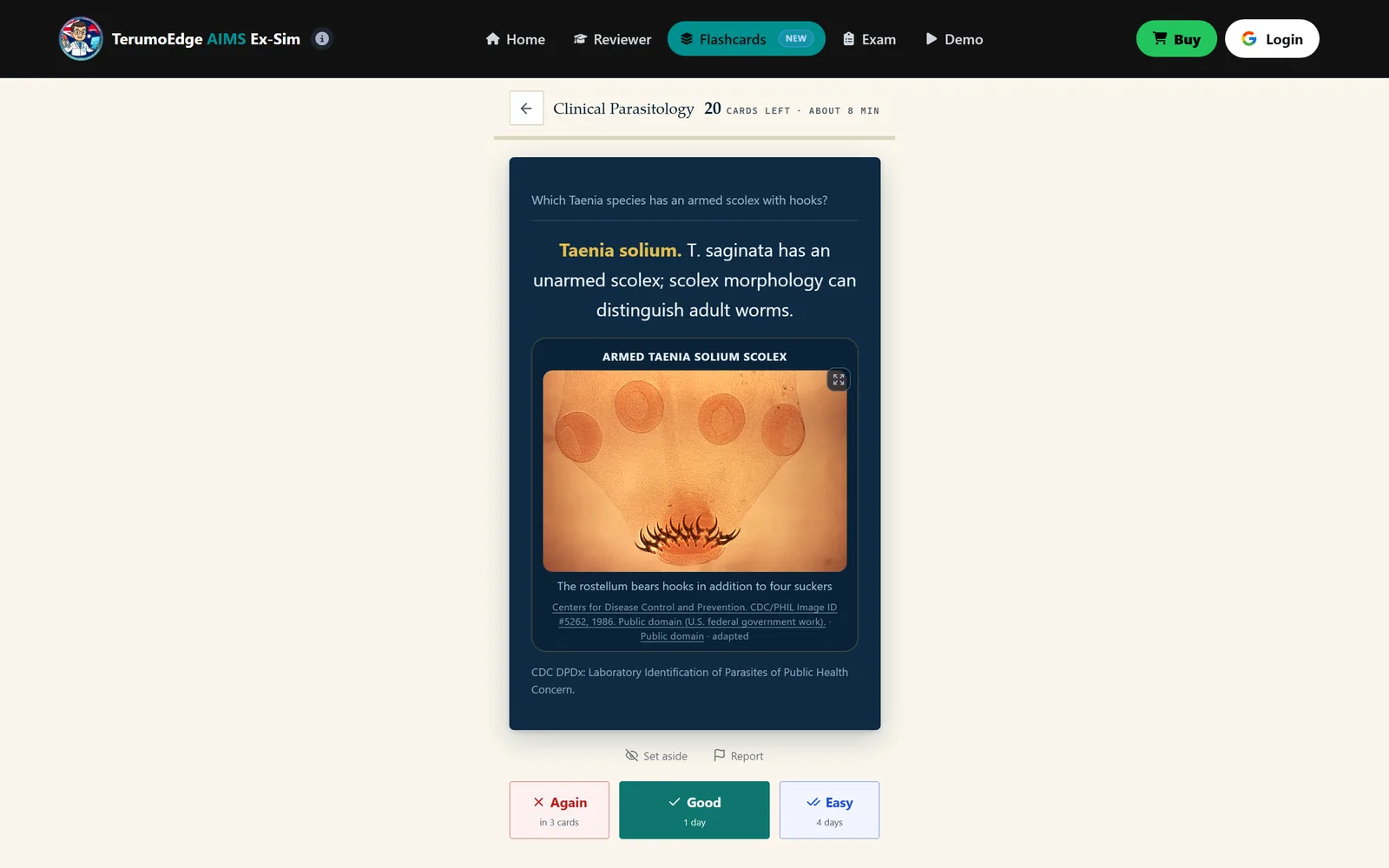
Judge explanations by whether they cover every option and cite a reference. An answer key that says only "B" teaches nothing. A good explanation states why B is right, why A, C and D are wrong, and which concept the item tests.
Open three explanations in different sections. In each, ask whether you could explain the topic to a colleague after reading it. Look for references you can follow up, not an anonymous paragraph.
For Transfusion Science, check whether the app points to the Australian guideline the pack recommends. The AIMS recommended reading includes the ANZSBT Guidelines for Transfusion and Immunohaematology Laboratory Practice. We make no claim about which standards any other country's laboratories follow. We say only that the pack names this guideline, so an app should not treat transfusion practice as a single worldwide rule.
How do you judge set-up, transparency and claims (checks 6 to 9)?
Judge these by testing the environment and reading what the app promises. The pack states that a calculator will not be required, so an app that depends on one is built for a different exam. The real sitting runs in a secured browser on a computer, so check that the app works well on a laptop, even if it also runs on a phone.
Look for a stated pack version or review date. AIMS reissues its pack, and an app that does not say which version it follows may be teaching last year's rules. For example, the pack now gives March 2026 as v8.2.
Finally, read the claims. No honest app can predict your AIMS result, because AIMS applies Rasch scaling to produce a 0 to 1000 score. No app can promise a visa. AIMS is the assessing authority for ANZSCO 234611, and its own guideline says the letter does not guarantee the awarding of any points. And no source can sell "actual AIMS questions", because completed papers are never released.
What is a 10-minute demo test?
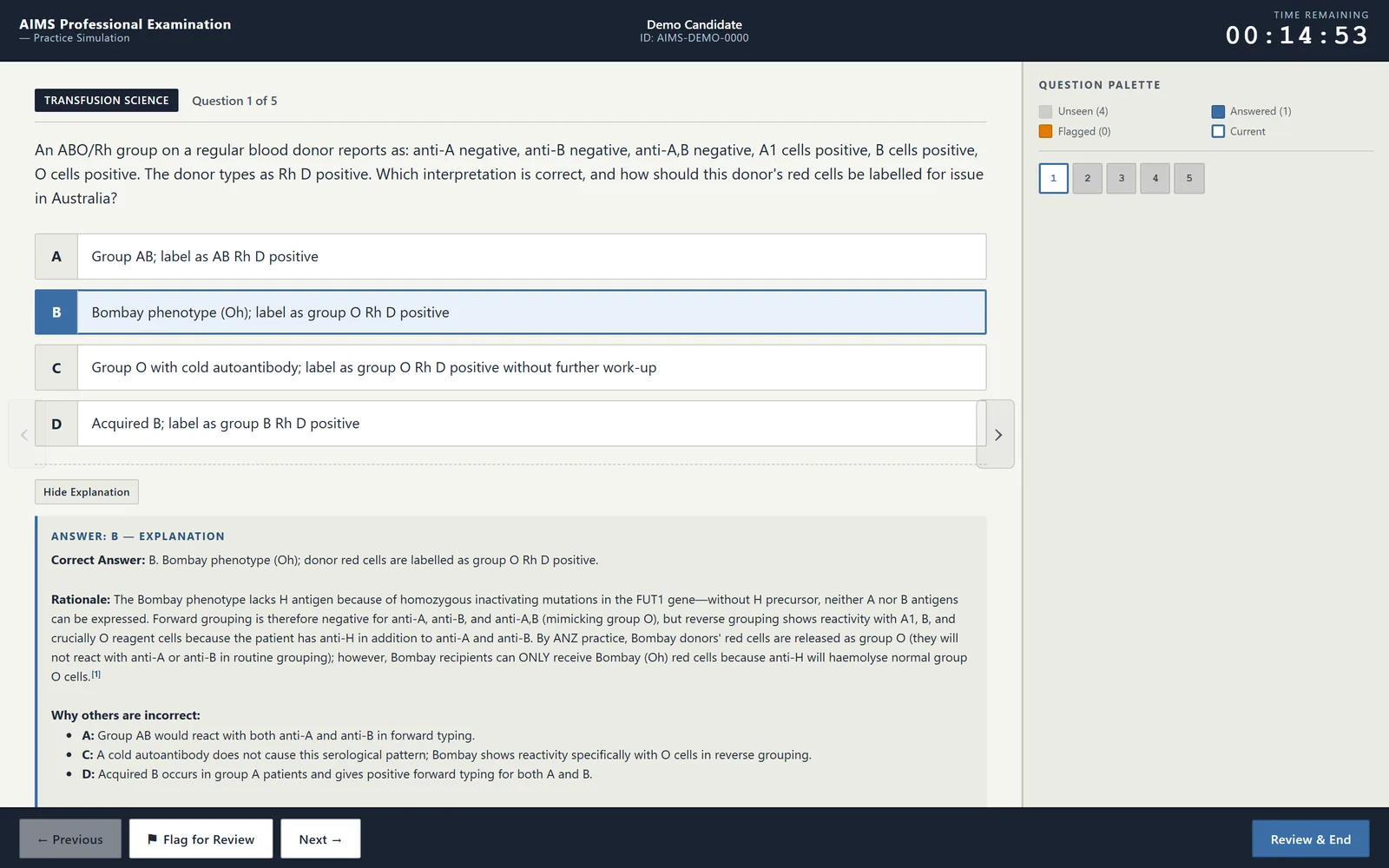
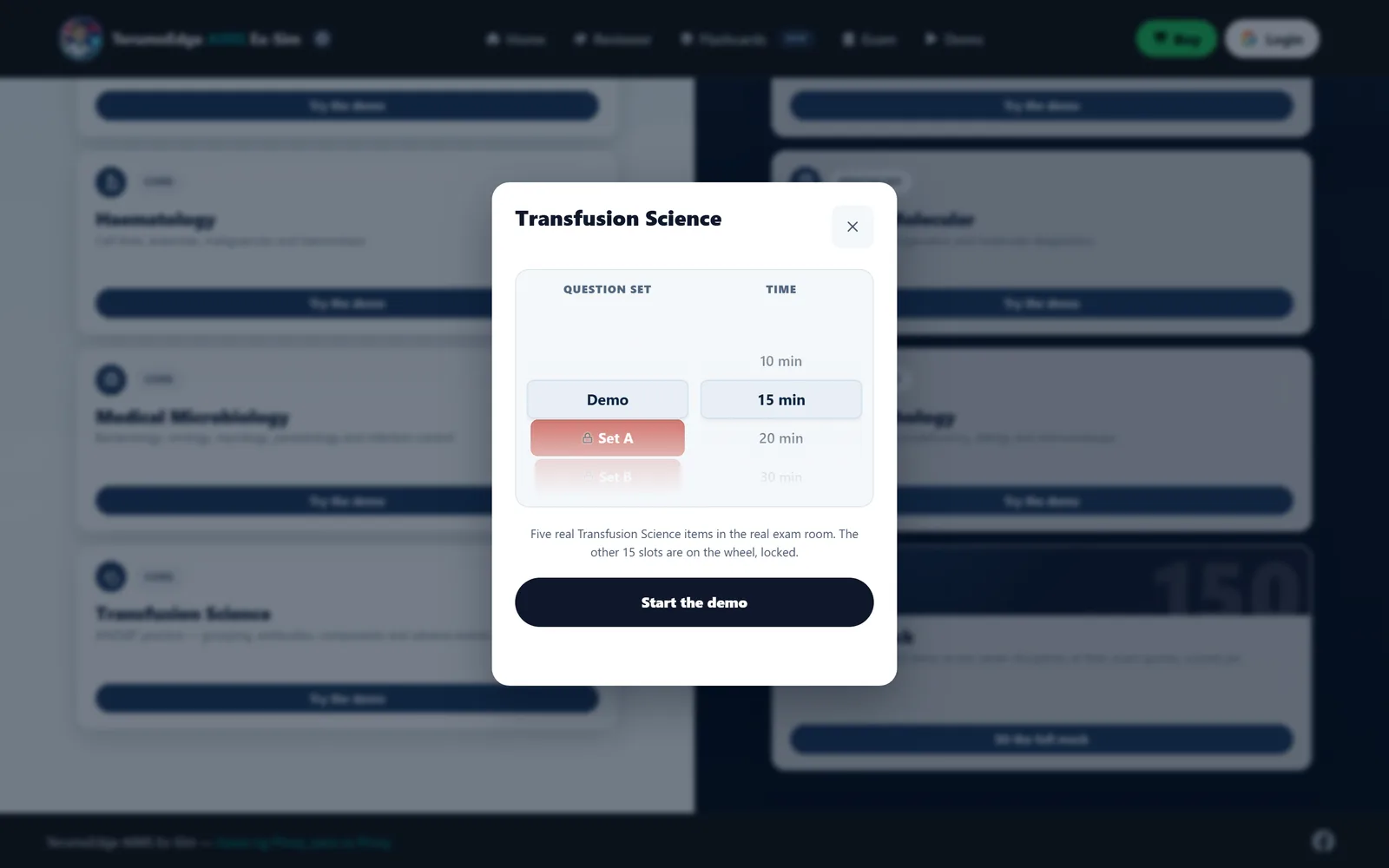
A 10-minute demo test checks five things quickly: structure, one explanation, one score report, the claims and the device. It needs no purchase.
- Minutes 0 to 2: open the picker and count the sections and their names.
- Minutes 2 to 5: answer five items in a discipline you know well.
- Minutes 5 to 7: open the explanation for one correct and one wrong answer.
- Minutes 7 to 9: read the result screen for a per-section score and any claim about AIMS.
- Minutes 9 to 10: scan the listing for pass predictions, visa promises and "actual questions".
If an app has no free demo, ask yourself why you are being asked to pay before judging it.
How does TerumoEdge measure up?
TerumoEdge AIMS Ex-Sim meets most of the nine checks and fails some, and we would rather you know which. This is our own assessment, so verify it in the free demo.
- Check 1: all seven sections are present. The product labels one "Genomic / Molecular Pathology".
- Check 2: the Full Mock is 150 items in three hours across all seven disciplines. Its per-section split differs from AIMS's, and we do not claim otherwise.
- Check 3: the report applies the 50% minimums and the Molecular-or-Immunopathology rule to raw marks. It gives no scaled score.
- Checks 4 and 5: every one of its 5,981 items has a written English explanation with references. We make no claim that it follows the AIMS study guide.
- Check 6 and 7: items need no calculator, and the exam room runs best on a desktop.
- Check 8: we update as AIMS reissues packs, but check the pack yourself.
- Check 9: we make no predictions or visa promises. Items are text-only, and we are not affiliated with AIMS.
For how a simulator fits beside a reviewer, see our reviewer comparison and the simulator explainer. If you are using a chatbot as well, read our fair look at ChatGPT for AIMS prep.
Frequently asked questions
Is a free app enough for the AIMS?
A free app can cover content and some practice, but check the nine items above. Most free tools lack a full 150-item three-hour mode and a per-section report against the minimums. If a free tool covers the seven sections and explains each option, it may be enough for a start.
Can an app give me my AIMS scaled score?
No. AIMS reports a Rasch-based scaled score from 0 to 1000 with a cut score of 500, and only AIMS can calculate it. An app can report raw marks and percentages. Treat any claim to convert raw marks into your official score as a red flag.
Are apps built for other countries' exams enough?
Not on their own. Apps built for other countries' licence or certification exams prepare for different exams run by different bodies, so check that an app covers the seven AIMS sections under their current names and follows the pack's format. Content overlap in the science is real, but the structure and passing rule are not the same.
Sources
- AIMS Professional Examination Pack, Medical Laboratory Scientist ANZSCO 234611, v8.2 — Australian Institute of Medical and Clinical Scientists
- AIMS Professional Examination Pack, v8.1 (June 2025) — Australian Institute of Medical and Clinical Scientists
- Guidelines for Skills and Qualifications Assessment, MLS ANZSCO 234611 and MLT ANZSCO 311213, v18.2 — Australian Institute of Medical and Clinical Scientists
From the publisher
Sit it here first.
TerumoEdge AIMS Ex-Sim is a simulator for the AIMS Professional Examination: a full-screen, timed exam room, a 150-item Full Mock across all seven disciplines, and a written explanation for every item.
- 5,981 items across the seven AIMS disciplines
- 39 fixed sets in each discipline, 273 in all, plus random draws
- A 150-item, three-hour Full Mock with a per-discipline score report
- An English explanation with references for every item, not a bare answer key
Try the free AIMS simulator demo Five real items in each of the seven disciplines. No account needed.
About this article
Written by the TerumoEdge AIMS editorial team, who build the TerumoEdge AIMS Ex-Sim. Exam facts are checked against the AIMS Professional Examination Pack and the AIMS Guidelines for Skills and Qualifications Assessment, and every article lists its sources. How we write and check our articles.
First published .